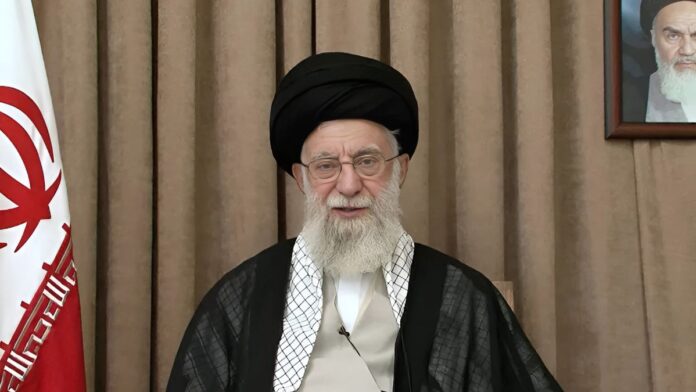

Massive crowds poured into Tehran on Saturday for the official start of the six-day state funeral of Ayatollah Ali Khamenei, the Supreme Leader of Iran for 36 years who was killed in a joint US-Israeli airstrike on February 28. The scenes at the Imam Khomeini Mosalla Grand Mosque — hundreds of thousands of black-clad mourners weeping, chanting and pressing toward five coffins draped in Iranian flags — represent what Iranian authorities have called the largest public gathering in the Islamic Republic’s history.
More than 10 million people are expected to attend ceremonies across the country before Khamenei is buried in Mashhad on July 9. The political message being transmitted through the streets of Tehran is intended not just for Iranians, but for the US negotiators who resume talks after the funeral concludes.
The Scenes in Tehran
Massive crowds showed up Saturday for the official start of the funeral of Iran’s late Supreme Leader Ayatollah Ali Khamenei in Tehran, the beginning of a multi-day ceremony meant to project the strength and resilience of the Islamic Republic after a bruising war with the United States and Israel.
From dawn, black-clad crowds streamed into main boulevards and the Imam Khomeini Mosalla Grand Mosque, clutching flags, Qurans and portraits of the 86-year-old leader. The coffins of four of his family members killed in the same strike — including his three-year-old granddaughter Zahra Mohammadi Golpayegani — were placed alongside his on the stage, draped in Iranian flags.
Men and women in the crowd wept openly. Women slapped their heads with their hands in mourning, while men beat their chests in unison — a tradition observed at Shia funerals. There were chants of “Death to America” and large red signs reading “#KillTrump.”
Authorities have opened more than 5,000 schools and tens of thousands of classrooms nationwide to accommodate pilgrims travelling to the capital. Security forces fanned out across major squares and junctions, setting up checkpoints and guiding the tightly packed crowds in an attempt to keep the vast procession orderly. Banners invoking martyrdom and resistance hang from overpasses and lampposts, tying Khamenei’s death to Shia narratives of sacrifice during the first ten days of Muharram.
Who Came — and Who Didn’t
The international attendance provides its own political map. Russia, which has supported Iran during the war and received drones from Iran for its campaign in Ukraine, sent former President Dmitry Medvedev. Pakistan’s Prime Minister Shehbaz Sharif — whose country has emerged as the primary mediator in the US-Iran peace talks — travelled to Tehran personally.
Iraq’s president attended, as did the Afghan foreign minister and a delegation from Hamas. Saudi Arabia — which has been at odds with Iran for decades and whose military base was attacked by Iran in March — sent a delegation, a signal of the cautious diplomatic recalibration underway in the Gulf.
The United States sent no representative. Nor did Israel, the United Kingdom, or the European Union’s leadership.
The Question of Mojtaba Khamenei
The most closely watched question as the multi-day ceremony unfolds is whether Iran’s new Supreme Leader, Mojtaba Khamenei, will appear publicly. He has not been seen or directly heard from since February 28 — the day his father was killed and he was reportedly wounded in the same strike. His wife was also killed.
His absence from public view for 127 days has generated significant analytical uncertainty about the durability of Iran’s post-war leadership structure. Whether he appears at the funeral — and if so, in what condition and with what degree of visible authority — will be one of the most significant political signals to emerge from the week of ceremonies.
Iranian authorities have neither confirmed nor denied reports of his injury, and Iranian state media has not published any interview, statement or public appearance by Mojtaba Khamenei since the war began.
The Divided Iranian Public
Not all Iranians are mourning.
A 32-year-old woman whose brother was killed during nationwide anti-government protests — in which the IRGC killed at least 7,000 people according to the Iranian human rights organisation HRANA — told NPR that Khamenei’s funeral gave her little comfort. She asked NPR not to use her name for fear of government retaliation.
“Even in the Ayatollah’s death he still causes us torment,” she told NPR. A 33-year-old woman named Fatmeh, also speaking anonymously, described arguing with her mother, who sees Khamenei as part of her religion. “She is definitely going to go to the funeral,” she said.
The chants of “Death to America” and “#KillTrump” signs visible in the crowds reflect a mobilised segment of Iranian society — but analysts note they coexist with a broader Iranian population that includes significant numbers of people who participated in the 2025 anti-government protests and who hold the Islamic Republic responsible for decades of economic mismanagement, political repression and international isolation.
What the Funeral’s Political Language Signals for the Peace Talks
The political language saturating the funeral — martyrdom, vengeance, resistance — sits in direct tension with the diplomatic language that Iran’s own negotiators were using in Doha just days ago, where mediators reported “positive progress” toward a peace agreement.
Iran’s chief negotiator Mohammad Bagher Ghalibaf — simultaneously the parliament speaker — called on Iranians to avenge Khamenei’s killing. “The nation’s call for vengeance must ring in the ears of the whole world,” he said. That language, delivered publicly and with full state backing, will be heard by US negotiators as they assess whether Iran’s diplomatic engagement is substantive or tactical.
The six-day funeral creates a formal pause in the diplomatic process. The next round of indirect talks through Qatari mediators is not expected before July 10 at the earliest. Within a framework that originally gave both sides 60 days — and which has already been consumed significantly by military exchanges, precondition-setting and now this funeral pause — the window for resolving the fundamental questions about Iran’s nuclear programme, the Strait of Hormuz and sanctions relief is narrowing rapidly.
The Burial on July 9
The final day of ceremonies will take Khamenei’s body to Mashhad, his hometown and Iran’s second-holiest city, for burial on July 9. The six-day journey from Tehran through Qom to the Iraqi holy cities of Najaf and Karbala before returning to Iran reflects the geographical scope of Khamenei’s religious authority across the Shia world.
Whether the enormous crowds filling Tehran’s streets on Saturday will be matched across each city the procession visits through the week remains to be seen. What is already clear is that the Islamic Republic has organised a farewell for its slain leader that — whatever the true complexity of Iranian public opinion — presents the regime as unified, present and determined to project continuity. That message, like the chants echoing through the Grand Mosalla, is aimed at more than one audience.