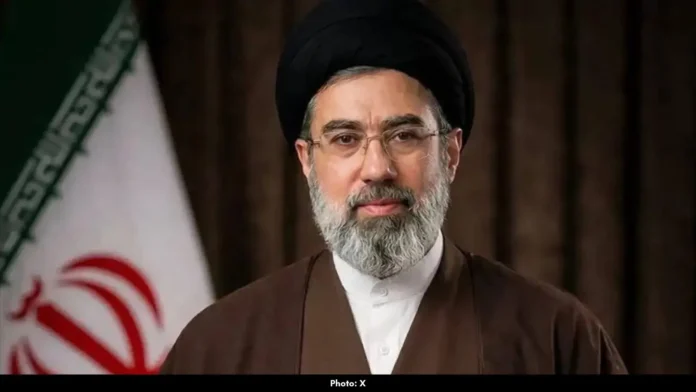

Unconfirmed reports circulating among senior Iranian officials suggest Supreme Leader Mojtaba Khamenei may be gravely ill, according to sources cited by the opposition-aligned outlet IranWire and other media, months after he succeeded his father as Iran’s top authority following the elder Khamenei’s assassination in February. Iran’s government has not officially confirmed or denied the reports.
What Happened
IranWire reported this week that two sources close to Iranian President Masoud Pezeshkian’s administration said rumors that Mojtaba Khamenei is in “extremely critical condition” and could die at any moment are circulating widely within the highest levels of Iran’s government. One source told the outlet that no cabinet member has met with Khamenei since he assumed the role of Supreme Leader, describing his physical condition as poor and saying, “We would not be surprised if we heard news of his martyrdom soon.”
Khamenei has not made any public appearances, delivered a televised address, or engaged openly with government officials since succeeding his father, according to multiple reports. Iranian state media has released only written statements attributed to him, without any accompanying live video or direct public communication. President Pezeshkian said in an interview broadcast on state television that contact with the Supreme Leader is currently “very difficult.”
Several reports, including from Israeli outlets Channel 14 and the Jerusalem Post, have suggested Khamenei was wounded during the February 28 strike that killed his father and other senior Iranian officials, and that he has since remained in a secure, undisclosed location, communicating with officials primarily through intermediaries. Iran’s Health Ministry had previously described his initial injuries as superficial, though international reporting has repeatedly challenged that official characterization.
Why It Matters
Any confirmed uncertainty regarding the Supreme Leader’s health or capacity to govern would carry major implications for Iran’s internal power structure and its approach to ongoing negotiations with the United States, including the currently advancing talks over reopening the Strait of Hormuz, which reportedly require final approval from Khamenei himself before any agreement can be finalized.
The prolonged absence of direct communication between Khamenei and even senior cabinet officials raises fundamental questions about whether decision-making authority has effectively shifted to other figures within Iran’s ruling establishment, a particularly significant concern given the concentration of ultimate authority in the Supreme Leader’s office under Iran’s political system.
For the broader region, instability or uncertainty at the top of Iran’s leadership structure, layered on top of an already fragile ceasefire process and ongoing military tensions across multiple fronts including Yemen and the Gulf, adds a further significant variable to an already volatile regional security environment.
Context and Background
Mojtaba Khamenei succeeded his father, Ayatollah Ali Khamenei, as Iran’s Supreme Leader after the elder Khamenei was killed in a US-Israeli strike on February 28, 2026, part of a broader campaign of strikes against senior Iranian officials at the outset of the current conflict. He was elected by Iran’s Assembly of Experts and has been characterized by analysts, including the Atlantic Council, as more hardline than his father, with close ties to some of the country’s most ideologically extremist clerics.
The February 28 strikes killed more than 40 senior Iranian officials in total, triggering what has been described as an unprecedented succession crisis within Iran’s government. Reports have suggested that senior regime figures, including former judiciary chief Sadegh Larijani and his brother Ali Larijani, who was himself later killed in the conflict, had attempted unsuccessfully to reach Khamenei directly during the war’s early stages regarding potential talks with Washington.
The uncertainty surrounding Khamenei’s condition comes as Iran pursues an actively advancing diplomatic track with Oman regarding the Strait of Hormuz, an agreement that regional officials have said awaits his final approval, a procedural requirement that would be directly complicated by any genuine incapacity on his part.
Analysis
Iran analysts caution that reports originating from opposition-aligned outlets like IranWire, while often well-sourced within Iran’s political establishment, should be treated with appropriate caution given the outlet’s explicit opposition orientation and Iran’s tightly controlled information environment, which makes independent verification of claims about senior leadership health extremely difficult.
At the same time, analysts note that the consistency of similar reports across multiple, editorially distinct outlets, including Israeli media, opposition Iranian media, and mainstream Western coverage, over a period of several months lends some additional credibility to the underlying claim that meaningful uncertainty exists regarding Khamenei’s health and governing capacity, even if the most severe characterizations remain unconfirmed.
Regional analysts also point to the practical significance of Khamenei’s continued absence from public view regardless of the precise medical explanation, noting that in a system built around the Supreme Leader’s direct authority, prolonged ambiguity about who is actually exercising that authority carries destabilizing implications independent of whatever the underlying medical reality turns out to be.
What Happens Next
Iran’s government has offered no official statement addressing the specific health claims reported this week, and it remains unclear whether or when any official clarification might be issued. The finalization of the Oman-mediated Strait of Hormuz agreement, which reportedly awaits Khamenei’s direct approval, may serve as one practical indicator of his current capacity to engage in state decision-making.
Given the significance of any potential leadership transition for Iran’s domestic political stability and its ongoing negotiations with the United States and regional powers, further developments regarding Khamenei’s health and governing role are likely to remain a closely watched, if difficult to independently verify, storyline in the coming weeks.