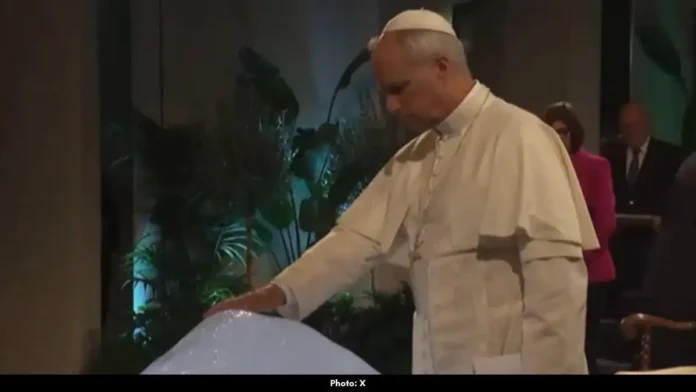

Pope Leo XIV — born in a Chicago suburb, the first American to lead the Catholic Church — spent the 250th anniversary of his country’s founding not in the United States but on Lampedusa: the tiny Italian island south of Sicily that has become the defining symbol of Europe’s migration crisis, and where more than 1,400 people have died or disappeared attempting to cross the Mediterranean Sea this year alone.
His presence there on July 4 was, Vatican officials confirmed, entirely deliberate. The visit was timed to coincide with American Independence Day. The message — about immigration, human dignity and the gap between national ideals and national policy — was aimed at both continents simultaneously.
Why Lampedusa
Lampedusa is an island of roughly 6,000 permanent residents located in the Mediterranean Sea between Tunisia and Malta. It is the southernmost point of Italy and of the European Union. For hundreds of thousands of migrants crossing from North Africa and sub-Saharan Africa toward Europe on makeshift boats, it is the first European soil they can reach — or the last place they are seen.
A total of 14,464 migrants have arrived in Italy by sea so far this year, according to UN Refugee Agency data, with more than half landing in Lampedusa. The figure exceeds the island’s entire resident population. More than 1,400 people have died or gone missing while attempting to cross the Mediterranean this year, including 28 children.
Pope Francis, Leo’s predecessor, visited Lampedusa in July 2013, just four months after his election, placing migration at the centre of his pontificate and using the island as the symbolic backdrop for a message about the globalisation of indifference. Leo has now followed the same path — and deliberately so. Vatican officials said the pope wanted to underline his message of support for migrants and deliberately timed the visit to coincide with the July 4 US Independence Day holiday.
What the Pope Did and Said
Arriving on the island shortly before 9 a.m., Leo began his visit at the “Door to Europe” — a metal arch sculpture standing on the island’s shore as a memorial to the thousands of migrants who have died or disappeared trying to reach Europe. The pope paused there, looking out over the blue waters of the Mediterranean, a gust of wind blowing away his white zucchetto, before proceeding to the island’s cemetery, where there is a section reserved for migrants. He laid flowers at the grave of Yusuf Ali Kanneh, a six-month-old who drowned in a migrant boat wreck in 2020.
Among those he met on the island was a boy named Leo — who arrived at Lampedusa ten years ago, aged four, alone, having lost his mother during the crossing. The boy presented the pope with a letter and a ball, asking that it be passed on to another migrant child. “I’m super excited to meet you! 10 years ago my story began here in Lampedusa. I was alone and had lost everything, above all my mom. They say I stopped crying only when they gave me a ball,” the letter read.
Leo celebrated an open-air Mass for the island’s residents and the migrants currently on the island. In his homily, he called on European leaders to tackle migration in a comprehensive manner, integrating immediate relief efforts into a long-term strategic plan capable of receiving, protecting, supporting and integrating migrants. He also called on them to help improve conditions in migrants’ home countries so that fewer people feel compelled to leave.
The Liberty Medal — and the Message to America
The day before his Lampedusa visit, Pope Leo delivered a virtual address to the National Constitution Center in Philadelphia, accepting the 2026 Liberty Medal — awarded to him for advancing religious liberty and freedom of conscience and expression. In his remarks, he praised America’s history of welcoming immigrants, recalling how it had opened its doors to successive waves of immigrants, enabling them and their children to play their part in shaping the future of the nation.
He also released a letter addressed to the American people to mark the 250th anniversary. It read: “Defending human life also includes welcoming, protecting and assisting immigrants, whose hopes, sacrifices and contribution have formed part of the history of this country from its very beginning. In every generation, those who have arrived seeking freedom, opportunity and a place to belong have helped to shape the nation’s character. To receive them with compassion and generosity is not only an act of charity, but also a recognition of the dignity that belongs to every human person.”
The Clash With Trump and Vance
Leo’s strong stances on immigration and war have repeatedly put him at odds with Western leaders, particularly President Donald Trump. Trump has called Leo “terrible for Foreign Policy” and “weak.” Vice President JD Vance — a converted Catholic — described the Vatican’s position on immigration as “troubling” this week. In February 2025, Vance had invoked an obscure Catholic theological principle to defend restrictive immigration policy, prompting a pointed rebuke first from Pope Francis and then from Leo himself, who described the administration’s treatment of migrants as “inhuman.”
Two high-profile leaders in the US Catholic church told CNN that Leo’s July 4 visit to Lampedusa sends a direct message to the US about immigration. “He’s not going to be afraid of opposition. He’s going to do what he’s called to do in his ministry,” Cardinal Blase Cupich, Archbishop of Chicago and a close ally of the pope, said of Leo.
Anna Leer, an official with the UN Refugee Agency, said the visit had global resonance. “Pope Leo XIV’s presence sends a clear message at a time when the global political debate on migration is often framed around borders and deterrence rather than protection and shared responsibility. Every act of witness to the humanity of those who flee violence, persecution and conflict carries moral and political weight.”
Why This Matters Beyond Religion
The pope’s choice of how to spend America’s 250th birthday is itself a political act — one that juxtaposes the language of American founding ideals with the reality of how migration is being managed in 2026. The Declaration of Independence, which Leo quoted in his Liberty Medal speech, holds that all men are created equal and endowed with inalienable rights.
The policies of the US government, whose Supreme Court recently allowed the deportation of 350,000 Haitians and Syrians, represent a different interpretation of those ideals. Leo’s visit to Lampedusa makes that gap visible — without needing to state it explicitly.
Whether the pope’s moral intervention shifts policy is unlikely in the near term. What it does is ensure that the human cost of migration policy — visible most starkly in the grave of a six-month-old child on a small island in the Mediterranean — remains part of the political conversation on both sides of the Atlantic.