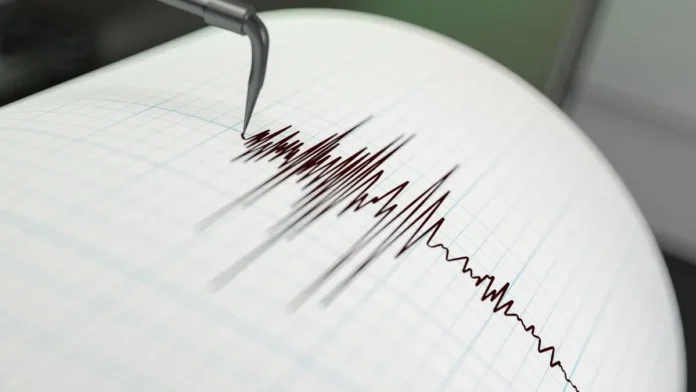

A powerful magnitude 7.8 earthquake struck offshore of Mindanao in the southern Philippines on June 8, killing at least 35 people, collapsing buildings, triggering a one-metre tsunami that hit coastal communities, and setting off alerts across Asia as far as Japan — in what is being described as one of the strongest earthquakes to strike the southern Philippines in more than a decade.
An offshore magnitude 7.8 earthquake rocked the southern Philippines on Monday, killing at least 32 people, injuring more than 200 others mostly in damaged buildings and sending a 1-meter tsunami into nearby coasts.
The magnitude 7.8 earthquake struck off Sarangani on Monday morning, killing at least 35 people, leaving 12 others missing and injuring more than 200 as buildings collapsed and landslides hit several areas in Mindanao. The Philippine Institute of Volcanology and Seismology said the tectonic earthquake occurred at 7:37 a.m.
The quake’s epicentre was located approximately 32 kilometres southwest of Maasim town in Sarangani Province, at a depth of 33 kilometres. Its initial magnitude was recorded as 7.0 before being upgraded to 7.8 by the USGS — a revision that reflects the enormous destructive energy the quake released across a wide area of southern Mindanao.
General Santos, a city of 722,000 people in southern Mindanao, sustained some of the most serious damage. The initial earthquake was followed by more than an hour of aftershocks, according to the Philippine Institute of Volcanology and Seismology. The largest aftershock measured 6.5.
What the Earthquake Did
The scenes in General Santos City — the commercial capital of the Soccsksargen region and one of the major tuna fishing ports of Asia — documented by journalists and by residents on social media conveyed the sudden, comprehensive nature of earthquake destruction.
Videos posted to social media and verified by AFP showed a shopping centre with a Jollibee fast food restaurant reduced to rubble in General Santos City, while a school building that officials said was unoccupied crumpled in another. “Lord, it has really collapsed! The building has really collapsed!” someone can be heard shouting as the school structure toppled.
PHIVOLCS said the city experienced a “very strong” event on its internal intensity scale. Parts of the city’s St Elizabeth Hospital were severely damaged, forcing patients and medical personnel to evacuate and temporarily operate outside the main hospital building.
The evacuation of a hospital — with patients moved from wards to the open air while aftershocks continued — illustrates the immediate medical crisis that a major earthquake creates even before the full injury toll is known. Medical staff treating the injured from the quake itself were simultaneously managing the displacement of existing patients, operating without full access to their equipment and facilities, in conditions of significant aftershock uncertainty.
Police Major Roland Catoburan told AFP two people had been crushed to death by a collapsing wall in Alabel, a municipality near General Santos City. “We have casualties. A wall fell on them,” he said, adding officers were not being allowed to re-enter their stations, some of which now had cracked walls.
The Landslide: 13 Dead in One Village
Among the most concentrated casualty events was a landslide in the mountainous municipality of Glan in Sarangani Province.
The quake also triggered a landslide in Sarangani province in the southern Philippines that killed 13 villagers. A disaster-mitigation official for the province said the landslide hit houses in the mountainous town of Glan.
Glan is a farming and coastal community that sits in the highlands of Sarangani, where the combination of steep terrain and earthquake-loosened soil creates exactly the conditions under which landslides occur rapidly and with little warning. The 13 deaths in Glan alone represent nearly a third of the confirmed toll — the concentrated casualty pattern of a landslide that struck houses before residents could evacuate.
The Tsunami: Asia-Wide Alerts
The offshore location of the earthquake — beneath the Celebes Sea — created immediate concern about tsunami generation. Tsunami warnings were issued in the Philippines, Indonesia, Palau, Taiwan and Papua New Guinea after the offshore quake struck about 32 kilometres southwest of Maasim, Sarangani, at a depth of 33 kilometres. Authorities urged residents in coastal communities to move to higher ground immediately.
The actual tsunami that reached Philippine shores was measured at approximately one metre in height — sufficient to cause damage and displacement in low-lying coastal communities but not the catastrophic multi-metre wave that the highest-intensity warnings anticipate. Smaller waves were recorded in Indonesia, Palau, and as far as southern Japan — demonstrating the geographic reach of the seismic energy released but also confirming that the tsunami did not develop the destructive power that had been initially feared.
The Pacific Tsunami Warning Center said the threat of a tsunami largely passed about five hours after the quake. Philippine officials also lifted a tsunami warning by mid-afternoon.
Tsunami damage was documented in at least one southern coastal village, with six structures on stilts in Indonesian waters also damaged by the wave energy.
Aviation and Infrastructure
The international airport in General Santos was temporarily shut due to the earthquake and 17 domestic flights were cancelled, the Civil Aviation Authority of the Philippines said.
The airport closure affected not only civilian travel but the logistical capacity for humanitarian response — aircraft being among the fastest ways to deliver medical supplies, search and rescue teams, and emergency personnel to a disaster zone. It was reopened after structural assessments were completed.
Road damage was also reported across southern provinces, with large cracks documented in roads in South Cotabato Province and Sarangani. The integrity of road infrastructure is critical for ground-based rescue operations — teams that cannot reach collapsed buildings or landslide sites cannot save survivors.
The Philippines and Earthquake Risk
The Philippines sits at one of the most seismically active points on Earth — the meeting of multiple tectonic plates in the Pacific Ring of Fire. The archipelago of 7,641 islands experiences hundreds of earthquakes annually, with major seismic events historically causing significant casualties. A magnitude 6.9 earthquake struck just days before this event, killing 76 people and damaging or destroying 72,000 structures.
The concentration of this seismic activity around Mindanao reflects the proximity of the Philippine Trench — one of the world’s deepest ocean trenches — to the island’s southern coast. The same geology that produces the Philippines’ rich marine environments and agricultural fertility also concentrates tectonic stress along fault lines that periodically release in events precisely like Monday’s earthquake.
President Ferdinand Marcos Jr. activated the national disaster response system immediately, ordering the cancellation of classes in affected areas and directing all disaster-response agencies to deploy. Marcos said “the national government is moving and we will not leave Mindanao behind.”
What Happens Next
Search and rescue operations are underway across multiple municipalities. The priority is finding survivors in collapsed structures before the survival window closes — typically 72 to 96 hours after a major earthquake.
The aftershock sequence — which has already produced at least one 6.5 magnitude event — will continue for days or weeks. Aftershocks complicate rescue operations by creating new dangers for both rescue teams and survivors in partially collapsed structures. They also cause further damage to buildings already weakened by the main earthquake.
As of Tuesday morning, the confirmed death toll stood at 35 with 12 people still missing and more than 200 injured. The Office of Civil Defense was continuing to compile casualty reports from municipalities across the affected region. The final toll will almost certainly be higher once reports from the more remote areas of Sarangani, South Cotabato, and Davao Occidental are compiled.
LoudFact.com is an independent global news and explainer platform. This report is based on reporting from Al Jazeera, NPR/OPB, Philippine Inquirer, RNZ, and AFP as of June 8-9, 2026.