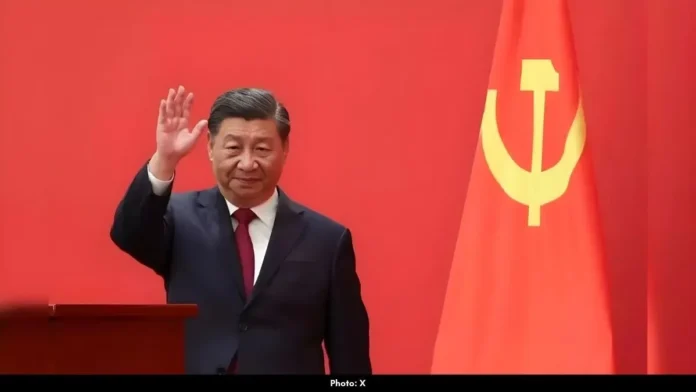

Xi Jinping’s choice to make North Korea his first overseas destination of 2026 — after hosting both Donald Trump and Vladimir Putin in Beijing — is not a diplomatic coincidence. It is a deliberate statement about China’s role at the centre of a world order in which the lines between adversaries and partners have become more complicated than the Cold War map anticipated.
The trip comes weeks after Xi hosted both Vladimir Putin and Donald Trump in Beijing. Xi’s visit aims to reassert China’s role as North Korea’s most critical economic and diplomatic partner amid growing Russia-North Korea ties.
The sequence deserves attention. Xi hosted Trump — China’s most significant strategic rival, the president whose tariffs and Iran war policies have reshaped global markets. Xi hosted Putin — China’s most significant security partner, whose Ukraine war has cost China diplomatic capital with Europe while providing economic benefits through energy supply disruption. And then Xi flew to Pyongyang — to a country that barely appears in most Western strategic assessments of the global order, but that sits at the intersection of three major power competitions simultaneously.
That Xi chose Kim’s invitation over every other potential first overseas destination of 2026 is itself a strategic signal. It says: the Korean Peninsula matters more than the Middle East to China’s immediate diplomatic priorities; the Russia-North Korea alignment requires China’s active management; and China is willing to invest in relationships that the US has largely abandoned or failed to develop.
The Russia-North Korea Factor
For North Korea, Xi’s visit marks another chapter in its longstanding balancing act between Russia and China, as it seeks military and economic benefits from both while avoiding excessive reliance on either.
The Russia-North Korea relationship has deepened dramatically since 2022. North Korea has supplied Russia with an estimated 4-5 million artillery shells, multiple types of ballistic missiles, and reportedly personnel for operations in Ukraine. Russia has provided North Korea with oil, food, and technical assistance — including, US intelligence suggests, satellite and re-entry vehicle technology that has accelerated North Korea’s ICBM programme.
The relationship is mutually beneficial but asymmetric: North Korea has become militarily valuable to Russia in ways that give Pyongyang unprecedented leverage over Moscow. Kim can set terms. Russia needs what North Korea has to offer.
For Beijing, this dynamic is genuinely concerning. China remains North Korea’s most important economic partner. Trade between the two increased to US$2.79 billion last year, the highest since the coronavirus pandemic and approaching pre-pandemic levels in 2019. But the Russia-North Korea military partnership creates a channel through which Kim can receive technology, economic support, and diplomatic backing that reduces his dependence on Chinese goodwill. A North Korea that can credibly turn to Russia as an alternative patron is a North Korea that is harder for China to moderate.
What Kim Showed — and What Xi Heard
Five days before Xi arrived, Kim Jong Un toured a new nuclear bomb fuel production facility and announced plans to expand his arsenal “at an exponential rate.”
The timing of that disclosure — days before Xi’s arrival was publicly announced — is almost certainly not coincidental. Kim was sending Xi a message before he arrived: the nuclear programme is not a subject for negotiation; it will continue; Chinese pressure to constrain it will not succeed.
Xi’s visit has sparked speculation about whether he aims to act as a mediator between Trump and Kim Jong-un. Whether Xi raised the nuclear issue directly in his meetings with Kim is not publicly known. The joint statement, when it is released, will be watched closely for any language that references denuclearisation or nuclear restraint — and its absence will be equally informative.
China was ready to expand cooperation in areas like economics and trade, agriculture, health, construction, science and technology, Xi said. The list of cooperation areas noticeably excludes the one area the rest of the world most wants to see addressed: nuclear restraint. Xi came to offer, not to demand.
The Triangle: China, Russia, North Korea
The emerging strategic triangle between China, Russia, and North Korea is one of the least-discussed features of the current global order, despite being one of the most consequential.
Russia and North Korea are in an active military supply relationship. China and Russia have deepened their economic and diplomatic alignment since 2022. China and North Korea have a formal mutual defence treaty. But the three relationships are not equivalent, and the triangle is not a coordinated alliance in the NATO sense.
China and Russia disagree about North Korea’s nuclear programme — China officially supports denuclearisation; Russia has become more accommodating of North Korean nuclear reality. China and North Korea disagree about the pace of nuclear expansion. North Korea and Russia have been expanding their relationship without Chinese coordination or approval.
What the triangle represents is not a coordinated anti-Western bloc but a network of bilateral relationships that are each individually beneficial — and that collectively create a counter-weight to Western-led international institutions that neither Beijing nor Moscow nor Pyongyang wishes to explicitly name.
What It Means for the United States
The US position in the Korea-China-Russia triangle is the weakest it has been in decades. The Trump-Kim summit diplomacy of 2018-2019 produced no lasting agreement and no denuclearisation. Kim’s programme has advanced dramatically since. The US is currently consuming significant diplomatic and military bandwidth in the Iran war. North Korea has fallen off the US diplomatic priority list.
The primary objective of the Xi trip is to repair and strengthen the diplomatic bond between Beijing and Pyongyang. Every repair to that bond reduces the likelihood that China will ever be willing to apply the economic pressure on North Korea that would actually constrain its nuclear programme. And without that Chinese pressure, the tools available to the US to address North Korean nuclear expansion are sharply limited.
Xi’s Pyongyang visit is not a crisis. It is a data point in a longer trajectory: a world in which China manages the relationships between the major powers while the US is otherwise occupied; in which North Korea extracts benefits from multiple great power relationships simultaneously; and in which the architecture of the post-Cold War international order — built on the assumption of US primacy and the irrelevance of adversary axis formation — is being quietly but systematically replaced by something more multipolar, more transactional, and more dangerous.
LoudFact.com is an independent global news and explainer platform. This report is based on reporting from CNN, Al Jazeera, Tempo.co, CryptoBriefing, InformedClearly, and NPR as of June 8-9, 2026.