
A wave of drone and missile attacks on Saudi Arabia’s largest oil processing facility and on American forces in the region has triggered the deadliest exchange in weeks, as the United States and Saudi Arabia carried out joint strikes in Iraq that killed at least 20 fighters and raised fresh fears of a broader war.
What Happened
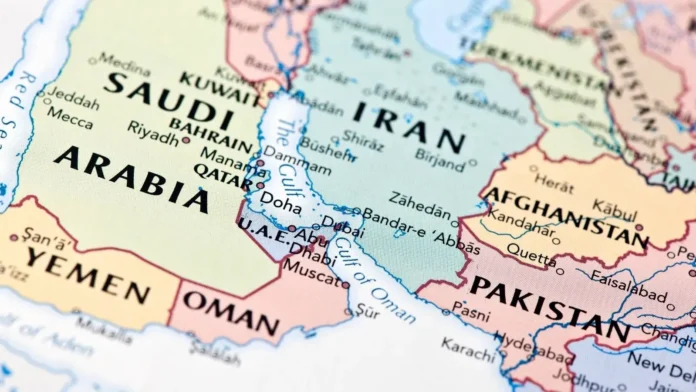
Iran launched a barrage of ballistic missiles at American forces in the Middle East early Wednesday, days after a brief pause in direct US-Iran fighting had raised hopes of de-escalation. The strike followed a separate incident on Monday, when Saudi Arabia’s defense ministry said it intercepted drones aimed at oil facilities in its eastern province and in Riyadh, attributing the attacks to Iran-backed groups launching from Iraq.
Satellite imagery from the European Union’s Sentinel-2 satellite and NASA’s fire-tracking system showed smoke and flaring at Saudi Aramco’s Abqaiq facility, the world’s largest crude oil stabilization plant, following the Monday attacks. The site processes up to 7 million barrels of oil per day, roughly 5 to 7% of global supply.
Saudi authorities said they initiated emergency flaring at multiple production sites, though neither Aramco nor the Saudi government has published a formal damage assessment or confirmed how much processing capacity, if any, remains offline. The Islamic Resistance in Iraq, the coalition Saudi Arabia blamed, has denied responsibility and instead pointed to Yemen’s Houthi movement, which separately claimed a strike on Aramco’s Jazan refinery complex on the Red Sea coast on July 25.
In response to the attacks on US forces and Saudi infrastructure, the US military and Saudi Arabia carried out joint strikes Wednesday against Iran-aligned militia sites across seven Iraqi provinces, including Baghdad, Basra, and Nineveh. Iraq’s Popular Mobilization Forces, an alliance that includes pro-Iran factions, said at least 20 fighters were killed and 32 wounded in what it called a preliminary toll, adding that the number could rise. Two officials told reporters that five Iranian advisers were among the dead.
Why It Matters
The scale of Wednesday’s strikes marks the first known direct Gulf intervention in Iraq during the current conflict, with Saudi Arabia moving from a largely defensive posture to active participation in strikes on its own doorstep. That shift signals growing alarm in Riyadh over threats to its energy infrastructure, which underpins both its economy and its role in global oil markets.
For global markets, the uncertainty around Abqaiq is the central concern. A 2019 drone strike on the same facility knocked out 5.7 million barrels a day of production overnight and sent oil prices surging by the largest single-day margin in decades. Whether this week’s damage approaches that scale remains unclear, but the disputed reporting alone has been enough to keep a risk premium embedded in oil prices.
The human toll in Iraq adds another volatile layer. The Islamic Resistance in Iraq has vowed retaliation against US and Saudi targets, setting a deadline tied to the Shia pilgrimage of Arbaeen for a response, and Iraq’s government has said it will not allow the country to become an arena for other nations to “settle scores,” a balancing act it has struggled to maintain since the conflict began.
Context and Background
The current conflict traces back to direct US and Israeli strikes on Iran that began in February, followed by months of retaliatory attacks against American and allied positions across the region. Iran-aligned militias in Iraq alone attempted more than 600 attacks on US personnel and facilities between February and April. A brief pause in direct US-Iran fighting earlier this month had raised hope that mediated talks, led by Qatar and Pakistan, might produce a more lasting arrangement.
That hope was undercut Tuesday, when Iran’s Revolutionary Guard launched ballistic missiles at US forces, ending days of relative calm. President Trump, who had paused American strikes on Iran to give diplomacy a chance, has reportedly threatened a heavy response after US troops came under fire in Jordan, according to regional reporting.
Iraq’s government, led by Prime Minister Ali al-Zaidi since earlier this year, has tried to walk a careful line between Washington and Tehran, both of which maintain significant influence in the country. Al-Zaidi has pushed for armed factions to disarm, a goal complicated by Wednesday’s strikes, which several militia groups have described as a violation of Iraqi sovereignty.
Analysis
Energy analysts monitoring the situation say the conflicting reports around Abqaiq’s operational status reflect how difficult it remains to verify battlefield claims in real time, even with satellite imagery. Confirmed fire activity does not by itself establish how much processing capacity has actually been lost, and estimates have ranged widely depending on the source. That uncertainty, analysts note, is itself a driver of continued volatility in oil markets, regardless of the eventual, verified outcome.
Regional security analysts point to the disputed attribution for the Abqaiq attack, claimed by different accounts to be the work of Iraqi militias, Yemen’s Houthis, or both, as a sign of how fragmented the anti-US, anti-Saudi coalition operating under Iran’s broader umbrella has become. That fragmentation complicates any effort to negotiate a durable de-escalation, since it is not clear which actors would need to be party to such an agreement.
What Happens Next
The Islamic Resistance in Iraq has set an early August deadline for the Iraqi government to respond to the strikes, warning that retaliation against American assets, potentially extending to Saudi Arabia, is otherwise “inevitable.” Whether that retaliation is delayed until after the Arbaeen pilgrimage, as the group has indicated, or comes sooner, is likely to shape the next phase of the conflict.
Markets will continue watching for any official confirmation from Saudi Aramco on the condition of the Abqaiq facility, along with signals from Washington on whether Wednesday’s strikes in Iraq represent a contained response or the start of a broader campaign. For now, the diplomatic track that appeared to be gaining ground just days ago looks increasingly difficult to sustain.