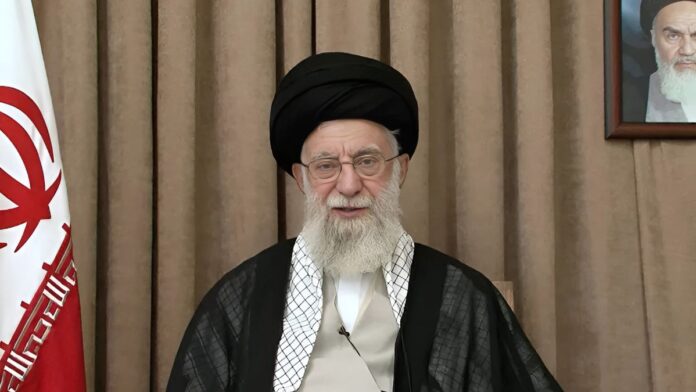

The flag-draped casket of Ayatollah Ali Khamenei was put on public display in Tehran on July 3, with millions of Iranians expected to line the streets of the capital beginning on July 4 for the first day of a six-day state funeral that will conclude with his burial in Mashhad on July 9. The ceremony — delayed four months by the war that killed him — arrives at a moment of maximum geopolitical sensitivity: Iran and the United States are in indirect peace talks that have been paused for the duration of the funeral, Iran’s new supreme leader has not been seen in public since the first day of the war, and the country’s chief negotiator is simultaneously calling on Iranians to avenge Khamenei’s death and negotiating an agreement to end the conflict that caused it.
The Casket Arrives in Tehran
The flag-draped casket of Ayatollah Ali Khamenei was put on display in Tehran Friday with millions expected to attend his dayslong funeral. Ceremonies will take place across three major Iranian cities — Tehran, Qom and Mashhad — as well as the important Shiite holy cities of Karbala and Najaf in Iraq.
The multi-day funeral schedule runs from July 4 through July 9. Ceremonies begin with Khamenei’s body lying in state at Tehran’s Grand Mosalla Prayer Complex, allowing millions of people to pay their respects before the public procession. Following the Tehran events, the funeral convoy will travel to Qom before continuing to the Iraqi holy cities of Najaf and Karbala. The body will then return to Iran for burial in Mashhad — Khamenei’s hometown and Iran’s second-holiest city — on July 9.
Iranian authorities have completed extensive preparations, mobilising thousands of police officers, emergency workers and volunteers to manage the crowds and ensure public safety throughout the six-day event. Tehran’s municipality is preparing to absorb close to 20 million people and nearly two million vehicles. The airspace above Tehran has been completely closed during the funeral period.
The Question That Cannot Yet Be Answered
The most closely watched aspect of the funeral — by foreign intelligence agencies, diplomatic analysts and journalists worldwide — is whether Iran’s new Supreme Leader, Mojtaba Khamenei, will appear publicly.
Mojtaba, 56, succeeded his father as Supreme Leader but has not been seen or directly heard from in public since the conflict broke out on February 28 — the same day the US-Israeli airstrike killed his father and wounded him. He also lost his wife in the same strike.
His appearance — or absence — carries enormous political significance. A visible, publicly authoritative Mojtaba Khamenei would signal that Iran’s leadership structure has stabilised, that the new supreme leader is physically recovered and politically in command, and that the regime’s institutions have survived the war intact. His absence, or a visibly diminished public appearance, would fuel speculation about the durability of the post-war Iranian government and could complicate the peace negotiations by raising questions about who is ultimately authorising Iran’s negotiating positions.
Senior officials from around 40 countries are slated to attend the funeral ceremonies, with government representatives from some 30 countries confirmed. Pakistan’s Prime Minister Nawaz Sharif — whose country has emerged as a key mediator in the US-Iran talks — will travel to Iran to offer condolences. Senior Chinese parliamentary official He Wei, India’s deputy foreign minister Shri Pabitra and the state governor of Bihar, Syed Ata Hasnain, will also attend.
The Contradiction at the Heart of the Funeral
Iran’s chief negotiator Mohammad Bagher Ghalibaf — who is simultaneously Iran’s parliament speaker and the man leading its diplomatic engagement with the United States — has used the occasion to call on Iranians to avenge Khamenei’s killing. “The nation’s call for vengeance must ring in the ears of the whole world,” he said in a statement published by Iran’s state news agency.
That language sits in direct tension with the diplomatic track Ghalibaf is also leading. The same man calling for vengeance is the same man who was in Doha this week discussing frozen Iranian assets, Hormuz shipping routes and the framework for a permanent peace deal with US envoys Steve Witkoff and Jared Kushner, via Qatari mediators.
The tension is not unique to Ghalibaf. It reflects the structural duality of Iran’s political moment: a government that must simultaneously mourn a martyred leader, maintain domestic political legitimacy through expressions of resistance, and negotiate a peace agreement that requires pragmatic compromise. These are not easily reconcilable objectives, and the next six days of public funeral ceremonies will amplify the language of resistance at precisely the moment when diplomacy most requires de-escalation.
What Mediators Have Said
Qatari and Pakistani mediators confirmed that the next meetings between Iranian and US negotiators will be scheduled “at the earliest possible time” after funeral commemorations conclude. The Pakistan Foreign Office stated: “Parties have agreed to continue discussions over the coming period, with the next meeting to be set at the earliest possible time following the funeral processions of the former Iranian Supreme Leader.”
Trump said there was progress in the Doha talks, telling reporters “the denuclearisation of Iran is moving along well.” Qatar also said “positive progress was made.” But the key issues — Iran’s nuclear enrichment programme, the release of frozen Iranian assets, and the long-term governance of the Strait of Hormuz — remain largely unresolved. The 60-day negotiating window has effectively been shortened by the funeral pause, military exchanges and precondition-setting, leaving very limited time for the hardest questions.
Robert Murrett, a former US Navy Vice-Admiral and academic who studies Iran, told CBS News that “many of us expect that there will be extensions after the initial 60-day period.” The original timeline was always optimistic. Whether both sides agree to extend it — or whether one side uses the expiry of the 60 days as a political pressure point — will be a critical test of the ceasefire framework’s durability.
What the Crowds Signal
The Iranian government hopes to see millions flood the streets of the capital beginning today in scenes reminiscent of the burial of the late Supreme Leader Ayatollah Ruhollah Khomeini in 1989. During Khomeini’s funeral, eight people were trampled to death amid large crowds. In a separate ceremony commemorating Qassem Soleimani, more than 24 people were killed in a stampede. The scale of the mass crowds Iran is attempting to manage over six days — potentially the largest state funeral in the country’s history — creates real logistical and safety risks that authorities have been planning for since the funeral was first announced.
Whether the crowds materialise at the scale Iran’s government is projecting will itself be read as a signal — about public sentiment, regime legitimacy, and the degree to which ordinary Iranians, despite the war’s costs, continue to associate themselves with the Islamic Republic’s political identity. The government is using the funeral to project resilience. The turnout will provide a real-time measure of how far that projection corresponds to reality.