
The Indian government is spending $9 billion to build a megaport, international airport, and new city on Great Nicobar Island — a remote, ecologically exceptional island in the Andaman Sea that is home to some of Earth’s most intact tropical forest and one of its most isolated indigenous communities. The project is designed to counter China’s Indian Ocean influence. Critics warn that the cost may be a civilisation that has survived for millennia.
On a remote island in the Andaman Sea, bulldozers are tearing into pristine forests that are home to one of Earth’s most isolated people — part of India’s ambition for a $9 billion megaport, airport and city. Designed to rival China’s investments around the Indian Ocean, New Delhi’s colossal project will be built on Great Nicobar Island, a site offering a naval presence far closer to Southeast Asia than India’s mainland.
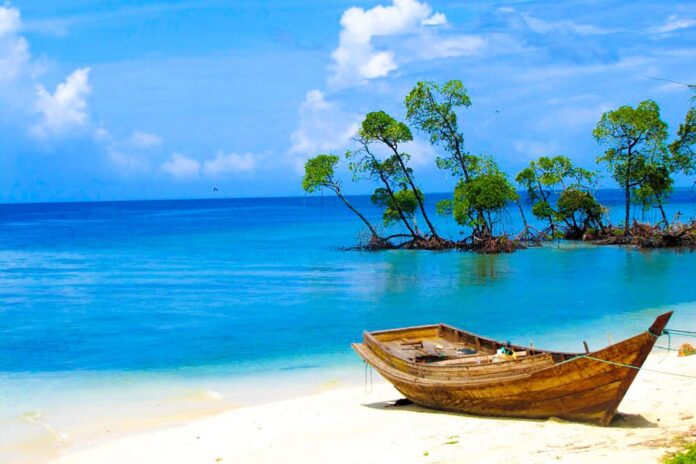
The island in question sits at the southern tip of India’s Andaman and Nicobar archipelago — a chain of 836 islands stretching 800 kilometres through the Bay of Bengal and Andaman Sea. Great Nicobar is the southernmost and largest of the Nicobar group. Its nearest significant neighbour is not an Indian city but the Indonesian island of Sumatra, visible on clear days from Great Nicobar’s southernmost headlands.
Its location is precisely what makes it strategically valuable to India — and precisely what makes its development so consequential for the global shipping lanes that run through the waters around it.
What India Is Building — and Why
Authorities promise sweeping economic transformation at the entrance to one of the world’s busiest waterways — the Strait of Malacca, through which up to 30 percent of global trade passes.
The first $4 billion phase on Great Nicobar — construction of a port at Galathea Bay and airport at Campbell Bay — should be completed within three years, according to the archipelago’s governor, former navy admiral Devendra Kumar Joshi. Once finished, the container port will handle more than 20 million twenty-foot equivalent units, making it one of India’s three largest ports. “In the long run, it may well be competing to become the container handling hub in the entire Indo-Pacific region,” Joshi said, rivalling Singapore and Malaysia’s Port Klang.
The strategic rationale for the project is explicit and does not hide behind commercial justification alone. Designed to rival China’s investments around the Indian Ocean, New Delhi’s colossal project will be built on Great Nicobar Island, a site offering a naval presence far closer to Southeast Asia than India’s mainland. Secretive military moves are also afoot, with plans for upgraded or new runways for both military and civilian use. “All of them will be dual-use runways, used by military and for commercial flights,” Joshi said.
The dual-use framing is the key to understanding what the project actually is. A commercial megaport competing with Singapore for Indo-Pacific container business is one thing. A military-civilian dual-use facility with extended runways capable of handling heavy-lift aircraft, positioned near the Strait of Malacca at the junction of the Indian Ocean and the Andaman Sea, is a different thing — a strategic asset that would give India the ability to monitor and, if necessary, interdict traffic through one of the world’s most critical maritime passages.
China has spent years building port facilities across the Indian Ocean — in Pakistan, Sri Lanka, Bangladesh, Myanmar, and Djibouti — in what Indian strategic analysts call a “String of Pearls” strategy that gradually encircles India with Chinese-aligned maritime infrastructure. Great Nicobar is India’s counter-move: a facility that places Indian military and commercial capabilities at the heart of the waterway through which Chinese trade flows to Europe.
What India Is Destroying
The ecological case against the Great Nicobar project is substantial and documented.
Spread across 166 square kilometres, the project in India’s Andaman and Nicobar archipelago is slated for completion over three decades, with its first phase due by 2028.
The 166 square kilometres of development footprint encompasses some of the most ecologically exceptional land in the Indian subcontinent. Great Nicobar is designated a UNESCO Biosphere Reserve. It contains tropical rainforest of exceptional biodiversity, classified as among the most ecologically intact remaining in the Indo-Pacific. Galathea Bay — where the port is being built — is one of the most important nesting beaches for leatherback sea turtles in the Indian Ocean. The leatherback is the world’s largest turtle and a critically endangered species.
The construction of a port at Galathea Bay would eliminate the nesting beach or make it functionally unusable. Leatherback turtles are famously fidelitous to nesting sites — females return to the beach where they hatched. Destroying the beach does not redirect the turtles; it removes a population from the global breeding pool.
The clamor to protect nature has grown sharper as India sees a rise in heatwaves, glacial floods and extreme rainfall in recent years. The irony is significant: India is simultaneously experiencing the consequences of climate change and ecological degradation, and building infrastructure that adds to that degradation for strategic reasons.
The Shompen: One of Earth’s Most Isolated Peoples
Among the most serious concerns raised by the project is its impact on the Shompen — a hunter-gatherer community that has lived on Great Nicobar for thousands of years and that has had minimal contact with the outside world.
Rights group warns that the island’s Indigenous groups face “genocide in the name of ‘mega-development.'”
The Shompen are classified by India’s government as a “Particularly Vulnerable Tribal Group” — a designation acknowledging their exceptional vulnerability to contact with the outside world. Previous episodes of external contact have resulted in catastrophic mortality from diseases to which isolated populations have no immunity. The 2004 Indian Ocean tsunami killed a significant number of Shompen; the survivors are estimated at fewer than 300 individuals.
A construction project involving tens of thousands of workers, heavy machinery, airport operations, and eventually a functioning city introduces vectors of contact with the outside world that cannot be controlled or limited once begun. The prospect of disease transmission alone — COVID-19, influenza, measles, tuberculosis — represents an existential threat to a population of this size with no acquired immunity to common pathogens.
Beyond disease, the construction of a city and port on their island would destroy the forest and coastline that the Shompen depend on for food, water, and the materials of their material culture. Their world would be replaced by an industrial port facility. The rights group’s language — genocide in the name of development — reflects a specific legal concept: the destruction of a group not through deliberate mass killing but through the deliberate destruction of the conditions necessary for the group’s survival and reproduction.
The Modi Government’s Position
“The Great Nicobar Island Project, which is of strategic, defence and national importance, transforms the region into a major hub of maritime and air connectivity in the Indian Ocean region,” the prime minister has said.
The government’s position frames the project as both a strategic necessity and an economic opportunity. The environmental clearances required for a project of this scale and location have been granted, though environmental advocates have challenged the adequacy of the assessments. The clearances allow construction to proceed; the challenges have not stopped the bulldozers.
A developer argues the purported benefits of the Great Nicobar Infrastructure project reflect a flawed understanding of “development.” Residents are not the primary beneficiaries. “It’s a model that sees money-generation as the only way forward.” The price of that extraction isn’t taken into account.
The critique is one that applies to a specific model of development that has been contested across India and across the world: the treatment of natural and cultural assets as inputs to be consumed in the production of economic output, without adequate accounting for what is lost in the process. When a nesting beach that has hosted leatherback turtles for thousands of years is converted into a container port, the calculation that makes that exchange seem rational is one that assigns the beach near-zero value and the port very high value. Both assignments are contestable.
The China Comparison
The framing of Great Nicobar as a counter to Chinese Indian Ocean investments deserves examination beyond its strategic logic.
China’s “String of Pearls” port investments — in Hambantota in Sri Lanka, Gwadar in Pakistan, Kyaukpyu in Myanmar — have themselves been controversial. Critics have described them as “debt trap diplomacy” — ports built on Chinese loans that, when countries cannot repay, convert to Chinese control. The Hambantota port in Sri Lanka was leased to China for 99 years after the Sri Lankan government struggled to service its debt.
India’s argument is that it needs its own strategic port presence to balance China’s. That argument has a strategic logic. But the instrument used to achieve it — clearing tropical rainforest, displacing an indigenous community with no alternative territory, destroying leatherback nesting beaches — is one that mirrors rather than counters the extractive model it is competing against.
What Happens Next
Phase one construction — the port at Galathea Bay and the airport at Campbell Bay — is targeted for completion by 2028. The bulldozers are already working. The forest is already being cleared. The legal challenges are working through India’s court system but have not stopped construction.
The Shompen are still there. For now.
The port, when finished, will be one of the largest in the Indian Ocean. It will give India a strategic presence at the Strait of Malacca. It will reduce India’s dependence on foreign transhipment hubs for its growing container trade. It will provide the Indian Navy with extended-range air and naval capabilities in the most strategically important maritime zone in Asia.
And it will have replaced a world that took millions of years to build with infrastructure that took three years to construct. Whether that exchange was worth making — and for whom — is a question that outlasts the project’s completion.
LoudFact.com is an independent global news and explainer platform. This report is based on AFP reporting from Campbell Bay, NPR/WGLT, Dawn.com, South China Morning Post, Pakistan Today, and the Express Tribune as of May-June 2026.