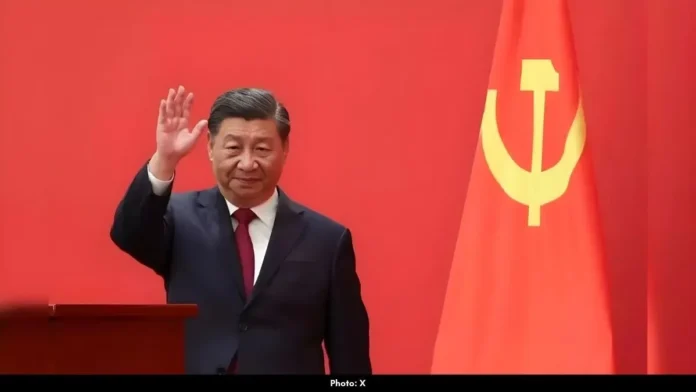

Chinese President Xi Jinping landed in Pyongyang on June 8 for a two-day state visit with Kim Jong Un — his first trip to North Korea since 2019 and his first overseas visit of 2026 — arriving five days after Kim unveiled a new nuclear fuel facility and in the context of deepening North Korea-Russia ties that China has been watching with growing unease.
Chinese President Xi Jinping has arrived in Pyongyang, marking a rare state visit to North Korea for a leader who has steadily cut down his travels in recent years.
The two-day state visit beginning on Monday, June 8, marks Xi’s first trip to North Korea in the last seven years, at the invitation of Kim. It will also be Xi’s first foreign trip this year, aimed at deepening relations, promoting development, and contributing to “peace, stability, development, and prosperity in the region and the world.”
The arrival scene in Pyongyang was precisely choreographed, as such visits always are in North Korea. A cheering crowd dressed in festive attire welcomed the Chinese leader at Pyongyang’s main square. The streets of the capital were lined with Chinese and North Korean flags. Kim Jong Un received Xi at the airport with full military honours. The images broadcast by North Korean state television showed two leaders projecting an alliance that, whatever its private tensions, remains diplomatically indispensable to both.
Why Xi Chose North Korea First
The sequencing of Xi’s diplomatic calendar carries significant meaning. In the months before this visit, Xi hosted US President Donald Trump in Beijing and Russian President Vladimir Putin for a state visit. He received multiple other heads of state and government. His first overseas trip of 2026 was not to a European capital, not to a major Southeast Asian partner, not to a Gulf state. It was to Pyongyang.
The visit comes at a critical time when China seeks to reaffirm its alliance with North Korea amid Pyongyang’s growing military cooperation with Russia and stalled denuclearization talks with the United States.
The Russia-North Korea dynamic is central to understanding the visit’s timing. Since the Ukraine war began in February 2022, Russia and North Korea have developed a military and economic partnership that goes significantly beyond the Cold War-era relationship. North Korea has supplied Russia with munitions, artillery shells, and reportedly personnel for operations in Ukraine. Russia has in turn provided North Korea with oil, food, and — US intelligence assessments suggest — technical assistance for its missile and satellite programmes.
For Beijing, which has long viewed itself as Pyongyang’s primary diplomatic and economic lifeline, the Russia-DPRK relationship represents a quiet but real challenge to its influence.
China’s concern is not primarily that North Korea is arming Russia. It is that the depth of the Russia-North Korea relationship creates channels for technology transfer, economic support, and political influence that reduce Kim’s dependence on Beijing. A less dependent North Korea is a less predictable North Korea — and one whose actions, including nuclear escalation, cannot be moderated through the economic leverage China has historically wielded.
What Xi Said Upon Arrival
Chinese leader Xi Jinping called for deepening “strategic coordination and cooperation” with North Korea shortly after receiving a pomp-filled welcome to mark his first visit to the secluded nation in seven years. The two sides should inject “powerful momentum” into their ties, Xi said during a meeting Monday with Kim as he kicked off his two-day state visit, according to a readout released by Chinese state media Xinhua. China was ready to expand cooperation in areas like economics and trade, agriculture, health, construction, science and technology, he added.
The language of “strategic coordination and cooperation” and “powerful momentum” is the vocabulary of the China-North Korea relationship’s treaty framework. The 65th anniversary of the Sino-Korean Treaty of Friendship, Cooperation, and Mutual Assistance — China’s only formal mutual defence treaty — provides the ceremonial occasion for the visit. The practical business is reasserting Beijing’s primacy in Pyongyang’s diplomatic hierarchy.
The economic dimensions listed — trade, agriculture, health, construction, science and technology — reflect the specific areas where China-North Korea cooperation has been rebuilt since the pandemic-era border closures ended. Trade between the two increased to US$2.79 billion last year, the highest since the coronavirus pandemic and approaching pre-pandemic levels in 2019. Passenger train services between the two countries resumed in March, marking the end of a six-year suspension due to the pandemic. This was followed by the resumption of direct flights by Air China between the capitals.
The economic recovery in China-North Korea ties provides the framework within which Xi’s political messages are delivered. Trade relationships create leverage. Food and energy dependence creates influence. Resumed transportation links create physical connectivity that China can use.
The Nuclear Context: Kim’s Facility Announcement
The visit arrived just five days after Kim Jong Un toured a new nuclear bomb fuel production facility and announced plans to expand North Korea’s arsenal “at an exponential rate.” The timing is significant in both directions.
For North Korea, Xi’s arrival so shortly after the nuclear disclosure demonstrates that China’s response to Kim’s nuclear expansion is engagement, not isolation or condemnation. There is no credible signal from Beijing that China is willing to impose the kind of economic pressure on North Korea that would meaningfully constrain its nuclear programme. China’s consistent position has been that denuclearisation must be achieved through diplomacy rather than pressure — and it has defined “diplomacy” in ways that have never actually constrained Kim’s nuclear development.
Xi’s visit has sparked speculation about whether he aims to act as a mediator between Trump and Kim Jong-un. That speculation has a basis: China has previously played a facilitative role in US-North Korea contact, and the current moment — with the US focused on the Iran war and Trump having made previous contact with Kim — creates a window in which Chinese mediation could be valuable.
Whether Kim is interested in any form of engagement with the US under current conditions is a separate question. His unveiling of a new nuclear facility five days before hosting Xi does not suggest a leader preparing to negotiate away his deterrent.
What Kim Wants From This Visit
Kim intends to use the summit to project confidence and defiance. By appearing alongside the leader of the world’s second-largest economy, Kim demonstrates that North Korea is not diplomatically isolated. This projection of strength is intended to signal to the international community that Pyongyang maintains a reliable and powerful ally in Beijing.
North Korea’s core interest in this visit is legitimacy. The images of Xi and Kim together — broadcast globally by both Chinese and North Korean state media — communicate to multiple audiences simultaneously:
To the United States: North Korea has a major power patron and cannot simply be isolated or pressured into concessions. To China: North Korea’s strategic position remains strong enough that it can set terms of engagement rather than simply receive Chinese instructions. To the Russian partnership: China’s arrival does not diminish Russia’s importance to Pyongyang, but demonstrates that Kim maintains multiple powerful relationships. To the North Korean domestic audience: the country’s leadership has secured the respect and attention of the world’s most powerful nations.
The presence of President Xi in Pyongyang validates Kim’s domestic and international standing, reinforcing the narrative that North Korea’s strategic choices are supported by a major global power.
The Broader Strategic Picture
Xi’s Pyongyang visit is not occurring in isolation. It is the latest move in a pattern of Chinese diplomatic engagement that has been deliberately comprehensive in the first half of 2026. Xi hosted Trump. He hosted Putin. He hosted multiple regional leaders. Now he visits Kim. The pattern describes a China that is positioning itself as the indispensable diplomatic interlocutor between all the major actors in the current international order.
That positioning has specific value in the context of the Iran war. China has been involved in the Iran ceasefire diplomacy alongside Pakistan. Its relationship with Russia gives it channels to Moscow. Its relationship with North Korea gives it leverage in the Pacific. And its relationship with the United States — complex, competitive, partially cooperative — gives it relevance in Washington’s own strategic calculations.
Whether this comprehensive engagement strategy produces concrete diplomatic outcomes — a North Korea nuclear agreement, a more durable Iran ceasefire framework, a negotiated end to the Ukraine war — is another question. But the strategic logic of maintaining access to all sides is clear, and the Pyongyang visit is its latest expression.
What Happens Next
The two-day visit continues through June 9. Formal agreements on economic cooperation, health, agriculture, and technology exchange are expected to be signed. Xi may deliver a speech to a mass celebration — a format North Korea has used for previous high-level visits. The joint statement, when released, will be watched closely for language on nuclear issues: whether China explicitly endorses or implicitly tolerates North Korea’s expansion, or whether it includes any formulation that constrains it.
Following the visit, China’s diplomatic focus will shift back toward the Iran war and its ceasefire negotiations — where Beijing’s role as a co-sponsor of the five-point peace initiative gives it a stake in the outcome that extends beyond geopolitics into the energy markets that China depends on. The Pyongyang visit is a chapter in a longer story about China’s positioning in a world of multiple simultaneous crises.
LoudFact.com is an independent global news and explainer platform. This report is based on reporting from CNN, Al Jazeera, Tempo.co, CryptoBriefing, InformedClearly, and News Directory 3 as of June 8, 2026.