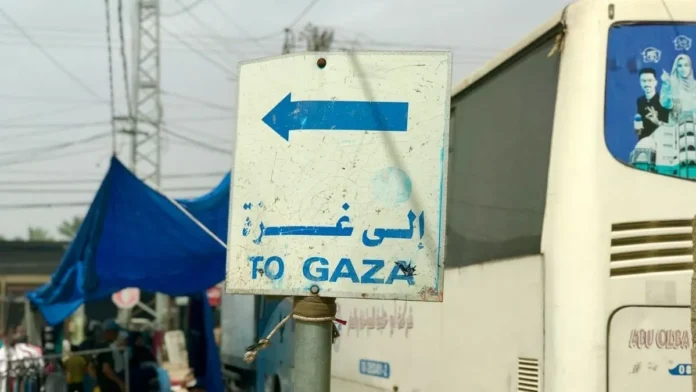

Less than 24 hours after President Trump announced what he called a historic agreement for Hamas to fully disarm in Gaza, Israeli and Hamas officials offered starkly different accounts of the deal’s terms, underscoring how far apart the two sides remain even as Trump continued planning new strikes on Iran and touted progress on the Gaza front.
What Happened
Trump said the United States had reached an “understanding” with Israel to begin implementing a peace deal requiring Israeli forces to withdraw from Gaza as Hamas gives up its weapons, though he stopped short of detailing the specific sequence of the reciprocal steps involved. The US-backed Board of Peace, the international body overseeing the broader Gaza peace process, subsequently issued a revised 15-point ceasefire roadmap.
The revised roadmap did little to resolve the underlying disagreement. An Israeli official rejected key elements of the reported framework, insisting that “complete disarmament” of Hamas remains a precondition for any further steps, and stating that Israeli forces would not withdraw from what has been termed the Gaza “yellow line” until demilitarization is fully completed.
Hamas offered a competing account. Senior Hamas official Ghazi Hamad told CNN that Israel must first cease fire entirely, halt targeted killings in Gaza, withdraw troops to the yellow line, and allow a surge of humanitarian aid consistent with an earlier October ceasefire agreement, before Hamas would proceed with its side of the arrangement. A separate senior Hamas official said the group would only disarm if Israel fully upholds its own ceasefire commitments first.
Why It Matters
The dueling accounts illustrate a fundamental sequencing dispute that has repeatedly stalled progress throughout the nine-month Gaza peace process: both Israel and Hamas are effectively demanding the other side act first, a standoff that has proven difficult to resolve at every previous stage of the ceasefire’s implementation. Trump’s announcement, while significant in establishing that both sides have engaged with a specific disarmament framework for the first time, has not yet closed that gap.
United Nations Secretary-General António Guterres called the announced agreement “the only good news in recent days,” while also calling for fighting to stop “on all fronts” in the region, a comment reflecting both cautious hope and the UN’s continued concern that the broader Middle East conflict, encompassing Gaza, Iran, and related regional flashpoints, remains far from resolved.
The disagreement also matters because it plays out against a backdrop of continued US military action against Iran. Trump indicated the United States would be “hitting them very hard” going forward, and US officials said Friday that new strikes on Iran were being planned for as soon as this coming weekend, illustrating how the Gaza process is unfolding alongside, rather than in place of, an active and expanding regional conflict.
Context and Background
The Gaza ceasefire underlying this week’s disarmament announcement was brokered roughly nine months ago, halting large-scale fighting after the war triggered by Hamas’s October 7 attack. The “yellow line” referenced by both Israeli and Hamas officials refers to a demarcation established under that earlier ceasefire agreement, delineating the extent of Israeli troop withdrawal from Gaza.
Trump’s Board of Peace has faced repeated challenges translating the initial ceasefire into concrete governance and security arrangements for Gaza throughout the past nine months, with disarmament negotiations representing the most persistently unresolved element of the broader 20-point peace framework Trump has championed since the ceasefire began.
Egypt, Qatar, and Turkey have served as key mediators throughout the process, credited by Trump with helping broker this week’s disarmament announcement, though the fact that Israel and Hamas offered conflicting interpretations of the deal’s terms within a day of the announcement suggests mediators may not have secured full agreement from both parties before the announcement was made public.
Analysis
Middle East analysts note that the pattern seen this week, an optimistic US announcement followed swiftly by conflicting accounts from the parties actually expected to implement it, has recurred at multiple points throughout the Gaza peace process, suggesting that public announcements of progress should be treated as a starting point for further negotiation rather than a finalized agreement.
Regional observers point to the specific sequencing dispute, over whether disarmament or ceasefire compliance and withdrawal should come first, as the central obstacle likely to determine whether this week’s announcement produces genuine progress or becomes another stalled milestone in a long and difficult process. Neither side has shown clear willingness to move first without firm guarantees regarding the other’s subsequent compliance.
Some analysts also note the awkward timing of Trump’s Gaza announcement alongside continued and expanding US military action against Iran, suggesting that presenting Gaza progress and Iran escalation as parallel, rather than connected, tracks of policy may complicate the administration’s broader regional messaging, even if the two conflicts remain technically separate.
What Happens Next
The Board of Peace’s revised 15-point roadmap is expected to serve as the basis for continued negotiations between Israeli and Hamas representatives, mediated by Egypt, Qatar, and Turkey, in the coming days. Whether either side is willing to make the first concrete move, either toward disarmament or toward ceasefire compliance and troop withdrawal, will likely determine whether this week’s announcement translates into tangible progress.
Continued US military action against Iran, including the strikes officials indicated could come as soon as this weekend, will remain a significant variable shaping the broader regional environment in which the Gaza negotiations are taking place.