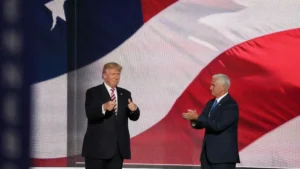
US President Donald Trump says Washington is engaged in “very friendly negotiations” with Iran after pausing military strikes last week, raising hopes that weeks of escalating attacks could give way to renewed diplomacy. Speaking to supporters in Michigan on Monday, Trump said there was “a good chance” of progress in talks aimed at ending months of fighting, but reiterated his warning that military action could resume if negotiations fail.
Prime Minister Benjamin Netanyahu visited the White House Tuesday for his first in-person talks with US President Donald Trump since the Iran war began in February, and later described their meeting as “excellent” and “one of the best we’ve ever had.” The White House succinctly called the talks productive and positive.
The meeting took place behind closed doors in the Oval Office, with reporters not invited in and without a press conference afterwards. Netanyahu entered the White House through a side entrance that was only partially visible to reporters, and left without fanfare some 90 minutes later.
What Trump Said After the Meeting
“It was a very good meeting, the tremendous relationship between our two Countries continues,” Trump said of Israel. “There was nothing definitive reached other than I insisted that negotiations with Iran continue to see whether or not a Deal can be consummated.”
Trump said he pushed for continued negotiations but left open other options. He said in a post on Truth Social following the meeting that a deal “will be a preference. If it cannot, we will just have to see what the outcome will be… Last time Iran decided that they were better off not making a deal, and they were hit with Midnight Hammer — That did not work well for them.”
What Netanyahu Brought to Washington
The president has several times described June’s Memorandum of Understanding between the US and Iran as over, and repeatedly threatened to launch heavier attacks on the Islamic Republic, but suspended two weeks of daily attacks at the weekend, and has also said this week that there is a good chance of progress in negotiations.
Netanyahu’s office said the leaders discussed Iran, Gaza and broader regional developments and agreed to maintain close coordination, adding that the prime minister emphasized Israel’s security needs in the context of negotiations.
Netanyahu is known to favour continued and intensified military pressure on Iran over a diplomatic settlement — his longstanding position is that Iran must be permanently prevented from acquiring nuclear weapons, and that the military campaign has set back Iran’s nuclear programme in ways that diplomacy alone would not have achieved.
His visit to Washington, analysts noted, may have been less about accelerating a deal and more about ensuring that any deal that emerges includes the specific Iranian concessions — on ballistic missiles, nuclear enrichment and proxy forces — that Israel regards as the minimum acceptable terms.
What Iran Said and Why It Matters
Iran has publicly denied holding direct talks with Washington at all.
The denial is significant in both its content and its diplomatic function. If Iran is engaging in indirect talks — through Qatar, Pakistan or other intermediaries — the public denial preserves Tehran’s domestic political position, allowing the government to assert it is not capitulating to American pressure while simultaneously exploring whether terms acceptable to both sides are available. The same dynamic characterised Iran’s approach to the 2015 nuclear deal negotiations, where talks were held through intermediaries for months before direct contact was acknowledged.
Whether Iran’s public denial reflects the actual state of diplomatic engagement, or whether it is a face-saving formulation that conceals ongoing contact, is something only mediators and intelligence agencies can know with confidence.
Why Trump’s Leverage May Be Waning
Former US officials said that Iran probably sees Trump’s leverage waning as the November midterm elections approach. Some top Republican officials are already urging Trump to end the conflict.
The November 2026 midterm elections are now approximately 100 days away. The political pressure that petrol at $4.10 per gallon generates for incumbents is real and well-documented in American electoral history. Several senior Republican senators — in the same caucus that blocked the Senate resolution rebuking Trump’s Iran war powers — have privately or publicly urged him to find a diplomatic exit from a conflict that is costing American consumers every time they fill up.
Iran’s reading of this dynamic — that Trump needs a deal more than Iran does as the election approaches — is likely to shape Tehran’s negotiating posture. If Iran believes it can extract better terms by waiting, it will wait. Whether that calculation is correct will depend on whether Trump responds to the political pressure by intensifying the military campaign to demonstrate resolve, or by moderating it to create diplomatic space. The four-day strike pause suggests, for now, the latter.