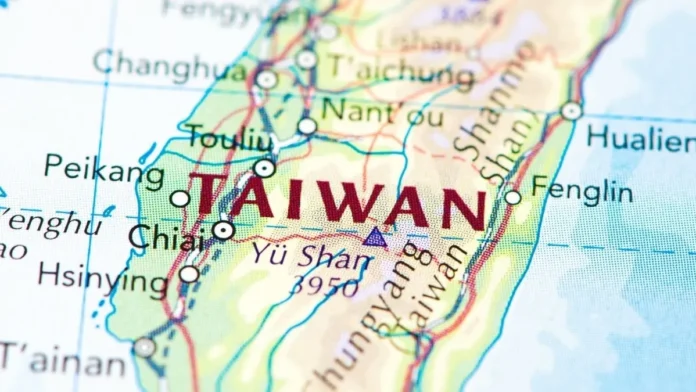

Taiwan launched 36 rockets from US-supplied HIMARS mobile artillery systems into the waters of the Taiwan Strait on June 10 — the first time the American-made system has been live-fired in the body of water that directly separates the island from mainland China — in a demonstration of military readiness that arrives days after Xi Jinping’s return from Pyongyang and amid a suspended US arms sale.
Taiwan’s military fired rockets in China’s direction from “shoot-and-scoot” mobile launchers on Wednesday in a demonstration of how it might try to repel a Chinese attack. While the U.S.-supplied system known as HIMARS has been tested before, the latest live-fire exercise was the first time its rockets were fired into the waters of the narrow Taiwan Strait that separates the self-governing island from China.
Taiwan launched 36 rockets from US-supplied High Mobility Artillery Rocket Systems (HIMARS) into the Taiwan Strait on June 10, marking the first time the island has live-fired American-made missile launchers in waters directly facing China.
The distinction between previous HIMARS tests and Wednesday’s exercise is significant and deliberate. Taiwan’s military has possessed and tested HIMARS since receiving the first batch of the US-supplied systems. But those earlier tests were conducted on Taiwan’s southern Pacific coast — not in the strait, not in waters facing the mainland, not in a direction pointing toward Chinese territory. The choice to conduct Wednesday’s live-fire exercise in the Taiwan Strait is a political and military signal as much as a technical demonstration.
What HIMARS Is and Why Taiwan Wants It
HIMARS, short for High Mobility Artillery Rocket System, is a truck-mounted rocket system that shoots and moves, making it extremely hard to pin down. That mobility is what makes it strategically significant for Taiwan. An island preparing for a potential amphibious invasion needs weapons that can hit coastal landing zones and then relocate quickly before the enemy can respond.
The HIMARS is one of the most proven systems in modern warfare. Its deployment in Ukraine — where it has been used to strike Russian logistics hubs, ammunition depots, and command posts at ranges of up to 80 kilometres using GMLRS rockets — demonstrated its battlefield effectiveness and its contribution to Ukraine’s ability to conduct a sustained defensive campaign against a much larger adversary.
For Taiwan, the weapon’s utility against a Chinese amphibious invasion attempt is specific and well-understood by military planners. A Chinese invasion of Taiwan would require landing troops and vehicles on Taiwan’s beaches. Those landing zones, and the naval vessels supporting them, would be within HIMARS range from multiple positions on Taiwan’s western coast. A system that can fire and relocate in under three minutes is extraordinarily difficult to destroy before it fires again.
Taiwan’s defense budget has climbed to over 3% of GDP. On the missile front, Taiwan aims to grow its anti-ship missile inventory to more than 1,800 units by 2029. Part of that buildup includes 450 Boeing Harpoon missiles that Taiwan secured in early June 2026, with an additional 400 units in the delivery pipeline.
The Harpoon missiles — anti-ship weapons designed to strike naval vessels — complement the HIMARS capability. Where HIMARS can target landing zones and coastal positions, Harpoons can target the ships delivering troops and equipment. Together, they form a layered anti-invasion capability designed to make any Chinese amphibious operation prohibitively costly.
Wednesday’s Specific Exercise
“Due to the current enemy threat, we will continue HIMARS training with unwavering determination to protect Taiwan as the nation’s strongest force,” army Sgt. Wang Ming-hui said. The military said it used reduced-range practice rockets that don’t fly very far from the coast before falling into the water. The HIMARS was the centerpiece of the drill. After receiving a firing order, the vehicles manoeuvred into position and launched their rockets with bright flashes within three minutes, demonstrating their mobility.
The “reduced-range practice rockets” detail is operationally significant. Taiwan used training ammunition designed to fall into the sea near the coast rather than full-range munitions that could travel toward Chinese territory. The purpose was demonstration of capability — showing the speed of deployment, the accuracy of the firing sequence, and the mobility of the platform — rather than a live engagement.
The three-minute deployment-to-firing timeline is the operational achievement being demonstrated. In a real invasion scenario, Chinese forces would have approximately three minutes from detecting a HIMARS launch to locating, targeting, and destroying the system before it could relocate. The evidence from Ukraine suggests that three minutes is generally not enough time.
The Xi-Trump Context: Arms Sales on Hold
The U.S. announced plans in December to sell 82 more HIMARS systems to Taiwan as part of a major arms deal, but that package appears to have been put on hold after President Donald Trump met Chinese leader Xi Jinping in Beijing last month.
This detail is among the most strategically significant in the entire story. The Trump-Xi summit in Beijing earlier in 2026 — one of the diplomatic engagements in Xi’s sequence of meetings with Trump, Putin, and then Kim — produced what appears to have been an informal understanding that the US would pause the additional HIMARS sale as part of managing bilateral tensions.
If accurate, it means that Xi’s diplomacy with Trump produced a tangible military concession from Washington — fewer HIMARS delivered to Taiwan — even as Taiwan is demonstrating its existing HIMARS capability in the Taiwan Strait. The signal from Taipei is deliberately calibrated: even if the additional 82 systems are on hold, Taiwan is demonstrating that what it already has is being trained, deployed, and used in the most operationally relevant context possible.
China’s Response
China has not, at the time of publication, issued a formal official response to Wednesday’s exercise. The Chinese government’s standard formulation — that Taiwan is an inalienable part of China’s territory and that any weapons sales or military cooperation with Taiwan violates the One China Principle — provides the framework for whatever response Beijing eventually issues.
The timing of the exercise — two days after Xi returned from Pyongyang and days before the World Cup generates a global media attention shift — suggests that Taiwan’s military planners chose the moment deliberately. The exercise is visible enough to register in Beijing and Washington as a serious signal; it is not so provocative as to require an immediate military response.
What Happens Next
Taiwan’s military will continue integrating HIMARS into its broader layered defence architecture. The anti-ship missile buildup — targeting 1,800 units by 2029 — represents a multi-year effort to make the cost of any attempted invasion prohibitively high.
China will continue its own military capability development, including the exercises and demonstrations near Taiwan that have intensified in frequency over the past several years. The Taiwan Strait remains one of the world’s highest-risk flashpoints — a narrow body of water over which 36 HIMARS rockets just demonstrated, with precision and speed, that the island on its eastern shore is neither defenceless nor passive.
LoudFact.com is an independent global news and explainer platform. This report is based on reporting from NPR/WVXU, the Washington Post, ABC News, the Washington Times, and CryptoBriefing as of June 10, 2026.