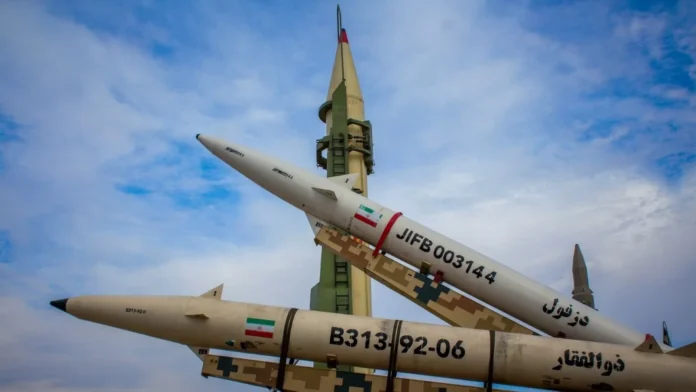

In the largest single Iranian ballistic missile salvo of the ceasefire period, Iran fired seven missiles toward Kuwait and Bahrain on June 5 after US forces shot down Iranian drones near the Strait of Hormuz and struck Iranian radar installations — with all missiles intercepted or failing to reach their targets, but the exchange marking a significant escalation that drew regional condemnation and a renewed Iranian threat to close the strait.
US forces intercepted multiple Iranian ballistic missiles and drones launched by Iran toward the Strait of Hormuz and Gulf neighbors, June 5. Iran fired seven ballistic missiles toward Kuwait and Bahrain hours after US Central Command shot down four Iranian one-way attack drones that were launched toward the Strait of Hormuz. The attack drones posed an immediate threat to regional maritime traffic. US forces subsequently struck Iranian coastal surveillance radar sites in Goruk and on Qeshm Island to defend against further maritime attacks.
Initial assessments indicate six of the missiles launched by Iran were intercepted and a seventh did not reach its intended target. There are currently no reports of harm to US personnel, and Iranian claims of damaging US 5th fleet headquarters in Bahrain are false. CENTCOM forces remain vigilant and postured to continue responding to unwarranted Iranian aggression in self-defense.
The sequence of events on June 5 followed the same tit-for-tat pattern that has characterised the ceasefire period since April 8, but with a significant difference in scale: seven ballistic missiles fired simultaneously at two countries represents the largest single Iranian salvo against Gulf states since the conflict began. That six were intercepted and one failed is operationally reassuring. That Iran launched them at all — at two sovereign states, in a coordinated strike package — represents a deliberate escalation of the conflict’s geographic and military dimensions.
What Happened: The Hour-by-Hour Sequence
The June 5 exchange began with Iranian drones, not missiles. CENTCOM announced that four Iranian one-way attack drones had been launched toward the Strait of Hormuz, describing them as posing an “immediate threat to regional maritime traffic.” US forces shot all four down.
Rather than ending the exchange at that point, US forces then struck two Iranian facilities: coastal surveillance radar sites at Goruk and on Qeshm Island. CENTCOM described the strikes as defensive — removing Iranian eyes in the strait that could be used to direct further maritime attacks.
Iran fired missiles at Kuwait and Bahrain, with the former calling it a “flagrant violation of its sovereignty.” CENTCOM referred to it as the latest example of “unwarranted Iranian aggression.”
Iran’s seven-missile salvo arrived hours after the radar site strikes. The IRGC characterised the launches as strikes against “enemy bases in the region” in retaliation for what it described as US aggression against Iranian territory at Goruk and Qeshm Island.
The Kuwaiti Army posted on X: “The armed forces detected and responded at dawn today to 7 hostile ballistic missiles within Kuwaiti airspace, which were intercepted over several residential areas, resulting in the fall of some debris. ‘The Iranian criminal aggression caused material damage with no human casualties.'”
The “fall of some debris” noted by the Kuwaiti military is itself significant. Even intercepted ballistic missiles leave remnants that fall to earth — metallic fragments that can and do cause property damage and, if unlucky, casualties. That no human casualties were reported in Kuwait is fortunate. That debris from Iranian missile intercepts fell over Kuwaiti residential areas illustrates why the Gulf states caught in this conflict are bearing costs that their populations did not choose.
The Radar Strikes: What the US Hit and Why
The US strikes on Iranian surveillance radar sites represent a different category of target than the mine-laying boats, drone launch sites, and Qeshm Island communications towers that have been hit in previous exchanges.
Coastal surveillance radar systems are the eyes and ears of Iran’s maritime interdiction capability. They allow the IRGC Navy and Revolutionary Guard coastal forces to track vessel movements in and around the strait, identify targets, and direct attack assets toward specific ships or formations. Destroying these systems degrades Iran’s ability to conduct the kind of coordinated maritime attack that has been one of its primary tools for enforcing the Hormuz closure.
The targeting of surveillance infrastructure — rather than missiles or drones — represents a strategic choice: rather than simply intercepting Iranian projectiles, US forces are attempting to degrade the command-and-sense infrastructure that makes sophisticated Iranian maritime operations possible.
Iran’s response — seven ballistic missiles in a coordinated salvo — suggests the IRGC does not view the loss of radar sites as a proportionate exchange.
Regional Condemnation: A New Development
Kuwait and Bahrain condemned the Iranian missile and drone strikes, calling them a violation of their sovereignty and a threat to regional security. Egypt, Jordan and Qatar also issued condemnations on Saturday.
The condemnations from Egypt, Jordan, and Qatar are significant in a way that Kuwait and Bahrain’s are not — those two countries are directly attacked and their condemnations are expected. Egypt, Jordan, and Qatar are not direct targets. Their condemnations represent a widening of the Arab political consensus against Iranian military action beyond the immediate Gulf Cooperation Council framework.
Qatar’s condemnation is particularly notable. Doha hosts the US military’s Al Udeid Air Base — the largest US air base in the Middle East and a primary operational hub for CENTCOM’s Iran war operations. Qatar has also been one of the primary diplomatic intermediaries in both the Iran ceasefire negotiations and the Lebanon diplomatic track. Its willingness to publicly condemn Iranian missile strikes on its neighbours, while maintaining its mediator role, reflects the difficult position small Gulf states occupy throughout this conflict.
Iran’s Warning: Complete Hormuz Closure
Iran warned that its enemy faces a “complete closure” of the Strait of Hormuz if attacks continue.
Iran has made this threat before. The pattern is consistent: US strikes on Iranian territory trigger Iranian missile or drone attacks on Gulf states, which trigger further US defensive strikes, which trigger the Hormuz closure warning. The warning has not yet been executed — the strait remains partially open to some traffic under Iranian oversight — but each cycle of escalation brings the threat closer to operational reality.
Mohsen Rezaei, a military adviser to Iranian Supreme Leader Mojtaba Khamenei, told CNN the US-Iran negotiations “are at a deadlock and Trump must break this deadlock.”
The framing from Iran’s side is significant: the adviser to the new Supreme Leader is publicly stating that negotiations are deadlocked and that the responsibility for breaking the deadlock lies with Trump. This is simultaneously a diplomatic statement — Iran is signalling it is not walking away from talks — and a threat — if Trump does not break the deadlock, the military escalation continues.
What the US Has Not Done
Perhaps as significant as what has happened is what the US has chosen not to do. Trump has threatened strikes on Iranian power plants multiple times and extended the deadline multiple times. Those strikes have not happened. The administration has consistently chosen measured, infrastructure-targeting defensive strikes over the kind of escalatory actions — strikes on Iranian cities, Iran’s remaining nuclear facilities, or leadership targets — that would make a diplomatic resolution significantly harder.
Trump said “one way or the other, it’s finished,” explaining that his goal is to prevent Iran from getting a nuclear weapon. “It’s either finished with a piece of paper, or finished a more difficult way, although you could say a much easier way.”
The “more difficult way / much easier way” formulation is Trump’s shorthand for a full military solution — the elimination of Iran’s nuclear programme by force. That it is simultaneously described as “more difficult” (diplomatically, globally, regionally) and “easier” (in terms of certainty of outcome) reflects the genuine internal tension in the US position. A negotiated deal requires Iran to accept conditions it has resisted for three months. A military solution requires escalation beyond current levels to a point of comprehensiveness that produces lasting deterrence.
What Happens Next
The June 5 exchange represents Day 99 of the war. Negotiations are described as “at a deadlock” by Iran’s side. Trump has not signed the MOU. The House of Representatives has voted to end the war. The Senate has not acted. The Strait of Hormuz remains partially closed. Kuwait’s airport has been struck twice. And Iran has now fired seven ballistic missiles at two countries in a single night.
The trajectory of the next week will determine whether the war’s 100-day mark is reached with a diplomatic breakthrough — a signed MOU, a beginning of Hormuz mine removal — or whether it is reached with a continuing military escalation that brings the conflict closer to a resumption of large-scale operations.
LoudFact.com is an independent global news and explainer platform. This report is based on CENTCOM official statements, reporting from Business Standard, Al Jazeera, CBS News, CNN, UPI, Mediaite, and The National as of June 5-6, 2026.