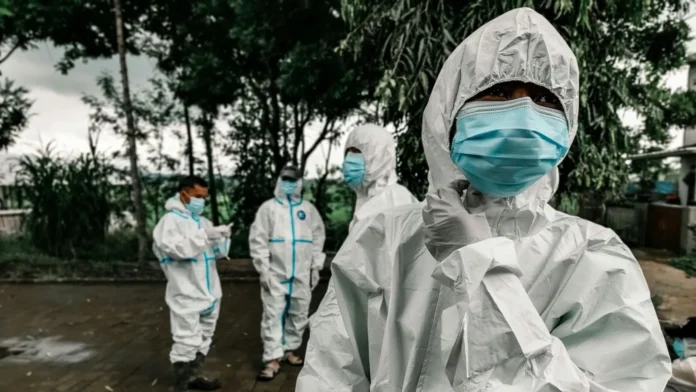

The World Health Organisation’s emergencies chief confirmed on Tuesday that eight in ten new Ebola cases in eastern Democratic Republic of Congo are now emerging from unknown chains of transmission — the starkest sign yet that the 2026 outbreak has exceeded the tracking capacity of the public health response mounted to contain it.
The announcement came as the outbreak crossed the threshold of 2,000 confirmed cases and 754 confirmed deaths, and as the medical humanitarian organisation Médecins Sans Frontières warned that the number of cases had tripled in just five weeks at a pace it described as unprecedented. The WHO estimates the actual incidence of the disease may be two to four times higher than the official figures suggest.
The WHO’s Most Alarming Assessment Yet
“Perhaps the most alarming finding is that many of the newly reported deaths are people who died in their communities without ever reaching a health facility and without receiving care,” said Dr Chikwe Ihekweazu, executive director of the WHO’s Health Emergencies Programme, speaking to reporters in Geneva after returning from Bunia — the capital of Ituri province and the worst-hit city in the outbreak.
“And as of today, 80% of new cases are outside our contact lists and so are coming to us from unknown chains of transmission,” Ihekweazu said. The outbreak, he added, “continues to outpace the response efforts.”
The significance of the 80% figure cannot be overstated in epidemiological terms. Contact tracing — the process of identifying every person who has had close contact with a confirmed Ebola case, notifying them, monitoring them and isolating them if they develop symptoms — is the primary tool for breaking chains of Ebola transmission in the absence of a vaccine.
When 80% of new cases come from outside the contact lists maintained by the response team, it means that contact tracing has effectively failed as the primary containment mechanism. The outbreak is spreading through channels that the response does not know about.
What the Numbers Show
More than 2,000 Ebola cases, including 754 deaths, have been recorded in the DRC, according to the latest figures released by Congolese health authorities Wednesday. The outbreak has now spread to five provinces in the central African country.
In less than five weeks, the number of confirmed cases has tripled, while the number of deaths has increased more than fivefold, MSF said in a statement. The pace of acceleration reflects not just the ongoing transmission of the virus through the original Ituri epicentre, but the emergence of new clusters in previously unaffected provinces — a pattern that the previous week’s confirmation of cases in new health zones had already signalled.
The WHO estimates that the actual incidence may be two to four times higher than official figures suggest. That estimate — if the lower bound is accurate — would place the real case count above 4,000 at a minimum, with the upper bound above 8,000, at a time when only 2,000 cases have been officially confirmed. The gap reflects the number of people dying in communities without ever reaching a health facility — individuals who are never tested, never isolated and whose contacts are never traced.
Why People Are Dying Outside Health Facilities
People who die outside the health system cannot be isolated, treated or have their contacts traced promptly, increasing the risk of further transmission. The pattern of community deaths without health facility contact reflects the specific conditions in eastern DRC that have made this outbreak uniquely difficult to manage.
Ituri province is a conflict-affected area where armed group activity has restricted health worker access, forced the closure of health facilities and generated large-scale population displacement. People who have been displaced by violence may be reluctant to seek care at health facilities they do not recognise or trust.
Healthcare workers — five of whom have been infected in the current outbreak — face security risks as well as PPE supply constraints. And the fundamental mistrust of health authorities that drove communities to attack isolation tents at the start of the outbreak has not been fully overcome.
The consequence is exactly what Ihekweazu described: people falling ill in their homes, dying without medical contact, being buried by families who do not know the standard Ebola safe burial procedures, and generating new chains of transmission that are invisible to the formal response system until a new case appears weeks later.
MSF’s Warning
Global medical charity Médecins Sans Frontières said in a July 15 statement that the outbreak “continues to outpace response efforts” and called for increased international support.
“In just two months, the current Ebola disease outbreak, caused by the Bundibugyo virus, has become the third largest, and the fastest growing, Ebola outbreak on record,” MSF said. The organisation described the acceleration as unprecedented in Ebola outbreak history and called for a fundamental rethinking of the response strategy — moving beyond a reactive containment model toward a proactive community engagement model that reaches people before they develop symptoms rather than after.
The First Clinical Treatment Trial
There is a rare piece of potentially positive news embedded in an otherwise alarming picture. The first clinical trial of an antiviral drug for the Bundibugyo strain began last week after researchers launched a highly anticipated study in the hope of fighting the virus. The trial is testing remdesivir — the antiviral drug that showed some efficacy against Ebola Zaire in earlier trials — along with two monoclonal antibody candidates. Results from the trial’s first phase will not be available for several months.
The absence of an approved vaccine remains the central constraint on the response. The three experimental vaccine candidates in development — from IAVI, Moderna and the University of Oxford — are not expected to produce licensed products before 2027 at the earliest. Until then, the response depends entirely on surveillance, contact tracing, isolation and safe burial — the same tools that are now failing against an outbreak where 80% of new cases come from sources the response system cannot track.
The Trajectory From Here
At the pace documented by MSF — cases tripling in five weeks — a projection forward is alarming. If the outbreak continues to triple every five weeks, the 2,000 confirmed cases of mid-July would become 6,000 by late August and 18,000 by early October. That trajectory would exceed the 2014-2016 West Africa epidemic — the largest in history — before the end of 2026.
That outcome is not inevitable. The 2014 epidemic eventually came under control through a combination of massive international response scale-up, community engagement, and — crucially — the deployment of the Ervebo vaccine, which does not work against Bundibugyo. The absence of a vaccine makes the 2026 response dependent entirely on the operational effectiveness of surveillance and containment measures that are currently, by the WHO’s own assessment, being outpaced.