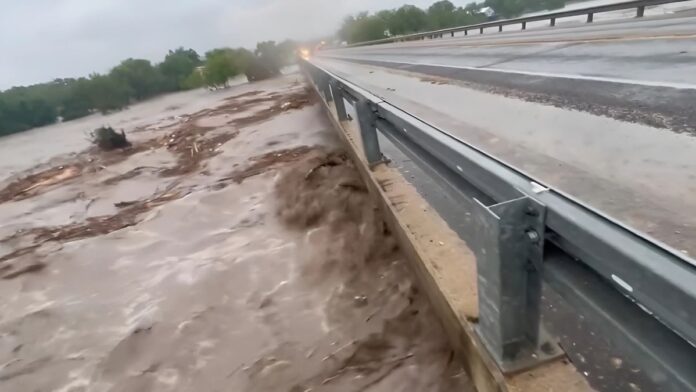

The Guadalupe River in Texas Hill Country flooded catastrophically on Thursday, July 16, 2026 — rising 32 feet in just four hours at the Center Point gauge, triggering flash flood emergencies across five counties, killing at least two people, and prompting more than 230 water rescues across Kerr, Uvalde, Blanco, Gillespie and Kendall counties.
The flooding came just over a year after the July 4, 2025 Guadalupe River disaster killed more than 130 people — including 25 children and two counsellors at Camp Mystic — in what became the deadliest flash flood in modern Texas history. The river has returned to nearly the same levels, at almost the same time of year, sending a region still psychologically recovering from last summer’s trauma into a second emergency.
What Happened Thursday Morning
The National Weather Service declared a flash flood emergency in multiple Texas counties early Thursday morning — Uvalde, Blanco, Gillespie, Kendall and Kerr counties — as heavy rain that had been falling since Monday night concentrated into catastrophic flooding on the Guadalupe and Pedernales rivers.
At Center Point, the Guadalupe River rose 32 feet in four hours and was expected to reach a crest comparable to last year’s flood levels. The Guadalupe River at Comfort rose more than 34 feet in less than two hours, reaching major flood stage Thursday morning.
At a news conference on Thursday evening, Texas Gov. Greg Abbott confirmed at least two people had died due to the flooding — a man swept away in his RV near Comfort and a second person near Uvalde. He also confirmed over 230 rescues had been made and over 1,300 first responders had been deployed.
The NOAA said the Guadalupe River at Comfort in Kendall County was observed at as high as 37 feet Thursday morning — well over the 28 feet of a major flood stage. Abbott said that crest was higher than last year’s historic flooding and is in the top 3 crests in the history of that area.
The Memory That Makes This Different
The flooding of the Guadalupe River on July 16, 2026, is not simply a weather event. It is the return of a catastrophe. The 2025 floods killed more than 130 people in Texas on the Fourth of July weekend, including 25 campers, two counselors and the owner of Camp Mystic along the Guadalupe River.
Forecasters with the NWS said in their alert that the flood wave is expected to reach levels similar to those of the catastrophic July 4, 2025, Guadalupe River flood in some areas, and warned that flash flooding was occurring across the area.
The Camp Mystic area — where children died last summer when the river rose without warning in the night — flooded again on Thursday. Summer youth camps in the Hill Country remained “super vigilant” of the situation after last year’s deadly flooding. At least one camp, Camp La Jita, proactively evacuated due to the flash flooding risk. Officials confirmed that all campers along the Guadalupe River in Kerr County were safe.
Just last week, Texas Public Radio reported how Hill Country residents were working to recover from the emotional aftermath of the July 4 floods. “One thing I appreciate about just Kerr County and the surrounding areas is that they made huge strides in the very beginning to understand that mental health is a huge portion of how we’re going to heal as a community,” therapist Sarah Stricker told TPR.
The Sirens That Worked — and One That Didn’t
After last summer’s disaster, Texas invested in flood warning infrastructure specifically designed to prevent people from being caught unaware on the Guadalupe River. Flood sirens, installed after last year’s flooding, activated for the first time as floodwaters rose overnight.
Flood sirens in the region worked, Abbott said, with the exception of one that was delayed by five or ten minutes early Thursday morning.
The fact that only two deaths have been confirmed — compared to more than 130 in last year’s event — reflects both the effectiveness of the siren system and the improved emergency response protocol that Texas developed in the aftermath of 2025. Abbott reassured Texas residents that the state is more prepared to save lives from floodwater than it was last year. “We’re better prepared than we have ever been to deal with weather events in general, but rainfall events and flooding events in particular,” Abbott said.
The Rescues — Human Stories From the Water
Texas Game Wardens say they participated in more than 40 rescues involving people trapped in submerged vehicles and flooded homes. Among those brought to safety was a young child carried through floodwaters by first responders. In nearby Bandera, volunteers with the Cajun Navy also joined the response, helping move a herd of horses out of rising floodwaters and onto safer ground.
Video showed a large structure swept away in Guadalupe River floodwaters, hitting a bridge in Kerrville. Footage circulating on social media showed the river running as a brown torrent through normally calm stretches of Hill Country, overwhelming bridges, filling low-lying roads and encroaching on properties that had been rebuilt or elevated since last summer.
“It flooded today,” said Stuart Gross, the code enforcement officer in the town of Ingram, just outside of Kerrville. “It was crazy.”
The Climate Pattern Behind Recurring Extreme Floods
The return of catastrophic flooding to the Guadalupe River basin one year after last summer’s tragedy raises questions that go beyond emergency preparedness. Flash floods in the Texas Hill Country are not new — the region’s geology of thin soils over limestone creates conditions for rapid runoff that has produced destructive floods throughout recorded history. But the frequency and severity of extreme rainfall events in central Texas has increased measurably in recent decades.
South-central Texas has been battered by heavy rain since Monday night, with more than 2.5 million people in the bull’s-eye for additional rounds of torrential rain through Friday. The extended duration and geographic spread of the event — more than three days of accumulating rainfall across a large catchment area — reflects the kind of slow-moving, moisture-laden weather system that climate scientists have identified as becoming more common in the warming atmosphere.
Abbott issued disaster declarations for multiple counties. The governor and NWS warned that flood risks were not over and would continue overnight into Friday, underscoring that Thursday’s tragedy may not be the final chapter of this event.