
In the 70-day history of the Iran war, Thursday night produced the most extraordinary single sequence of events: Iran launched anti-ship ballistic missiles at the United States Navy; the United States struck the IRGC’s naval headquarters; and the President of the United States described the exchange as a “love tap” while insisting the ceasefire is still in effect.
What Iran Fired
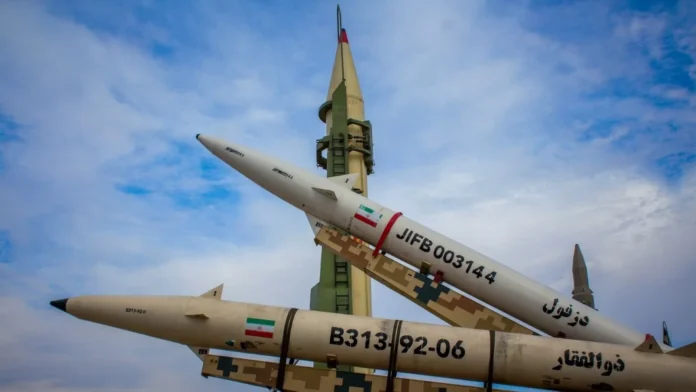
Iranian forces attacked US naval ships late Thursday, including with “anti-ship ballistic and cruise missiles” and “loitering” drones, according to the Islamic Revolutionary Guard Corps.
Anti-ship ballistic missiles are among the most advanced and dangerous anti-naval weapons in any state’s arsenal — designed specifically to strike moving warships and capable of defeating most conventional ship-based defences through their speed and trajectory. Iran deploying them against Arleigh Burke-class destroyers is the most serious kinetic escalation of the entire conflict.
The Arleigh Burke-class ships, just over 500 feet long and displacing 8,200 to 9,700 tons, have a range of defensive armaments. They carry high-end, multi-million-dollar Standard missiles that can deal with incoming ballistic or cruise missiles. The Sea Sparrow missile system can also deal with shorter-range threats.
If incoming targets get past those systems, US destroyers also carry the Phalanx Close-In Weapons System, a radar-guided 20mm Gatling gun that can fire 4,500 rounds a minute. CENTCOM did not specify what weapons were used to stop Thursday’s Iranian attack. But Trump gave a flowery description of how the missiles and drones were brought down. “Missiles were shot at our Destroyers, and were easily knocked down.”
Where the US Struck
The US Central Command said it targeted military facilities responsible for launching missile, drone and small boat attacks against American warships transiting the Strait of Hormuz. A US official told CNN that strikes were carried out in multiple locations including Bandar Abbas and Qeshm.
A spokesperson for Iran’s armed forces said US airstrikes hit civilian areas along the coasts of Qeshm Island, Bandar Khamir and Sirik. “Bandar Abbas is the naval headquarters for the Iranian Revolutionary Guard Corps and it is strategically located right at that bend in the Strait of Hormuz, so these are significant targets,” CNN military analyst Cedric Leighton said.
Bandar Abbas is not an arbitrary target. It is the IRGC Navy’s primary headquarters — the base that coordinates the mine-laying, the gunboat operations, the small boat swarms, and the anti-ship missile launches that have been the primary Iranian tools in the Hormuz standoff. Striking it is operationally significant.
The “Love Tap” and Why Both Sides Want It That Way
“Just a love tap:” Trump insisted the fraught truce with Tehran was still holding, referring to the US salvo overnight as a “love tap.” “The ceasefire is going. It’s in effect,” he told ABC News in a phone interview on Thursday. Earlier that day, the US president threatened to strike Iran “a lot more violently” if leaders do not accede to a proposal to end the war.
“Love tap” is Trump managing the narrative of an escalation that neither side wants to formally acknowledge as a ceasefire breakdown. By calling it a love tap, Trump signals to Tehran that the US considers the exchange proportional and contained — not a resumption of Operation Epic Fury. By saying “the ceasefire is in effect,” he creates the shared fiction that both sides need to continue the MOU negotiation.
Iran’s cooperation with that fiction is visible in its own statements: the IRGC described its attack as a “defensive response,” not an offensive operation to end the ceasefire. Both sides are maintaining the ceasefire label on exchanges that include anti-ship ballistic missiles and strikes on naval headquarters — because both sides need the MOU to survive.
The price of Brent crude oil increased by 0.2% at $100.3 early Friday. However, the shift was limited compared to swings earlier this week, indicating traders are confident the US-Iran ceasefire will hold.
Markets have absorbed anti-ship ballistic missiles and IRGC headquarters strikes and moved Brent by 0.2%. The market’s verdict is the clearest signal of all: everyone believes the love tap is a love tap, the ceasefire holds, and the MOU is still alive.