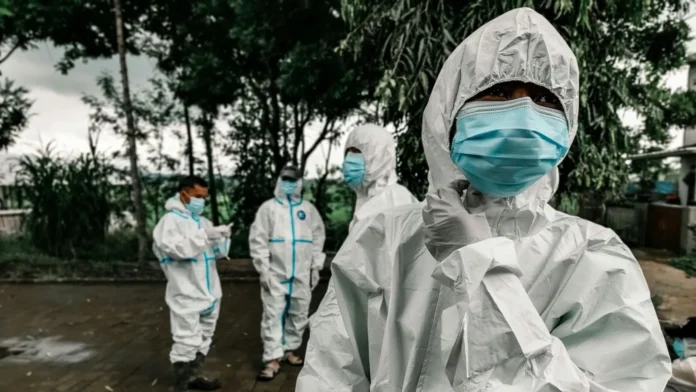

The Ebola outbreak in the Democratic Republic of Congo, caused by the Bundibugyo strain of the virus for which no approved vaccine or treatment exists, has reached 1,460 confirmed cases and 452 confirmed deaths as of July 3, 2026, according to the World Health Organization’s latest situation report.
The US Centers for Disease Control and Prevention has warned in a formal modelling analysis that without large-scale and sustained public health interventions, the outbreak could exceed 20,000 cases within the next three months alone — a scale that would surpass the 2014-2016 West Africa Ebola epidemic that killed over 11,000 people and remains the largest outbreak ever recorded. The Africa CDC director has said more than 26,000 contacts remain untraced, and that the outbreak had more momentum at the time of detection than the 2014 epidemic did.
The Latest Numbers
As of July 3, 2026, the Ebola disease outbreak caused by Bundibugyo virus is affecting the DRC and Uganda. The DRC reported a total of 1,460 confirmed cases, with 641 currently hospitalised in isolation. A total of 452 related deaths have been confirmed so far, representing an increase of 54 new confirmed cases and 14 new deaths since the last update. Among individuals who tested positive for Bundibugyo virus, 213 have recovered. Ituri province remains the most affected, with 1,333 cases, including 380 deaths, reported from 24 of its 36 health zones.
As of July 1, Uganda reported a total of 20 confirmed cases including two deaths. The last confirmed case in Uganda was reported on June 21, and no new cases have been reported since then — a sign that Uganda’s aggressive containment response is holding. Fifteen Ugandan cases have recovered. Among the confirmed cases, 15 had travel links to DRC and five were associated with local transmission events.
In Europe, two cases have been reported — one in France and one in Germany, with both cases imported from areas affected by the ongoing outbreak in DRC. The ECDC considers the likelihood of infection for people living in the EU/EEA to be very low, while continuing to monitor the situation closely.
The CDC’s Warning
The US Centers for Disease Control and Prevention has released its most stark assessment yet of the outbreak’s potential trajectory. Urgent action is needed to slow the spread of this outbreak and prevent it from becoming as large as, or larger than, the 2014-2016 West Africa outbreak, the CDC stated plainly at a June 5 press briefing.
Jason Asher from the CDC’s Center for Forecasting and Outbreak Analytics laid out the modelling at a press briefing: “If only 20% of cases enter isolation within two days of symptom onset, more than 20,000 cases are projected” within the next three months. Those 20,000 cases would occur in just three months, according to projections. If the outbreak continues beyond that, the numbers could climb much higher, which would make this the worst Ebola outbreak on record. About 28,000 cases occurred in the 2014-2016 outbreak in West Africa.
The CDC’s modelling ran multiple scenarios combining different assumed death counts — 50, 100 or 200 as of May 24 — with four isolation levels — 20%, 50%, 70% or 95%. In more than two-thirds of the simulations, under the scenario in which only 20% of cases isolated within two days, the outbreak exceeded 20,000 cases over three months.
The Untraced Contacts Crisis
The most operationally alarming figure in the Africa CDC’s assessment is the number of untraced contacts. Africa CDC Director-General Jean Kaseya told Al Jazeera that tens of thousands of people who may have been exposed to Ebola had not yet been traced or contacted. “The contact tracing is a major indicator and a major issue. We are missing more than 26,000 people, and we don’t know where they are, and we don’t know if they are contaminating other people.”
Contact tracing — the process of identifying everyone who has been in close contact with a confirmed Ebola case and monitoring them for symptoms — is the single most important tool for controlling Ebola in the absence of a vaccine. In the 2014 West Africa epidemic, the collapse of contact tracing systems under the weight of a rapidly expanding outbreak was the primary driver of the exponential case growth that produced tens of thousands of infections.
The fact that 26,000 contacts are currently untraced in the DRC outbreak is a direct warning signal. It means that there are potentially hundreds or thousands of Ebola-exposed individuals currently moving freely through communities, interacting with others, potentially developing symptoms — and not being monitored or isolated.
The Vaccine and Treatment Gap
The fundamental challenge complicating every aspect of the response is the absence of approved medical countermeasures. The Bundibugyo strain, first identified in 2007, is one for which there is no vaccine and no certified treatment. The Ervebo vaccine — which is highly effective against the Zaire strain and was deployed successfully in recent DRC Ebola outbreaks — has been assessed as providing insufficient evidence of protection against Bundibugyo, and the WHO has recommended against its use in the current outbreak.
Three experimental vaccine candidates are now being fast-tracked: from IAVI, Moderna and the University of Oxford. The Coalition for Epidemic Preparedness Innovations announced funding allocations in June — $3.2 million to IAVI, $50 million to Moderna, and $8.6 million to Oxford. WHO-sponsored clinical trials of three therapeutic candidates — the antiviral remdesivir, and the monoclonal antibody therapies MBP-134 and maftivimab — have also begun under the PARTNERS trial protocol.
A vaccine at best may be nine months away, per WHO estimates — a timeline that, under the CDC’s worst-case scenario, means the outbreak could be far larger before any approved preventive tool becomes available. This places the entire weight of the response on surveillance, contact tracing, isolation and safe burial — the same tools that proved insufficient to contain the 2014 West Africa epidemic in its early months.
The USAID Factor
Jeremy Konyndyk, president of Refugees International and a veteran of the Ebola response during the 2014 West Africa epidemic, has warned that the US response capacity has been structurally weakened by the Trump administration’s dismantling of USAID last year, combined with ongoing CDC funding constraints. “If I compare this to past outbreaks, this one has more momentum at time of detection than the huge West Africa outbreak in 2014 did,” Konyndyk told NPR. “We are just in a much, much weaker position now to respond.”
The CDC, for its part, has emphasised its active engagement with the response and its determination to bring the outbreak under control. CDC responders are in DRC, and the agency has made clear that the modelling is intended to catalyse action, not to describe an inevitable outcome. “Despite the dire warnings, it’s not too late to act,” CDC Director Pillai said. “We’ve responded to Ebola outbreaks before. We know how to end this.”