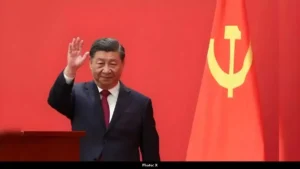

The hashtag #WelcomeTrumpToChina was the top trending topic on China’s social media platform Weibo on Wednesday as US President Donald Trump’s plane touched down in Beijing. Many of the comments were positive, such as “Welcome!” and “Cooperation could lead to win-win!” — the latter an oft-repeated diplomatic phrase from the Chinese government about the importance of mutually beneficial outcomes.
Trump’s Chinese nickname “Chuan Jianguo” was also popping up across Chinese social media. Literally “Trump the Country Builder,” it is a mocking suggestion that the US president’s isolationist foreign policy and divisive domestic agenda has helped Beijing overtake Washington on the global stage.
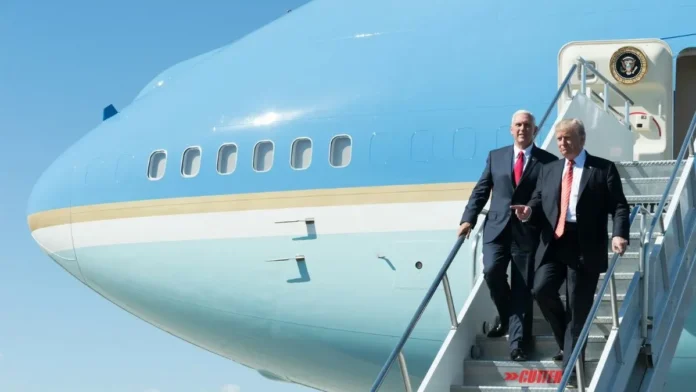
Trump landed in Beijing aboard Air Force One around 7:50 p.m. local time. Three hundred Chinese children dressed in blue and white uniforms waved American and Chinese flags as Trump descended the steps of the plane. He was greeted by Chinese Vice President Han Zheng, who is widely seen as Xi’s envoy for diplomatic events and who last year attended Trump’s presidential inauguration.
The Iran Contradiction Before Anyone Said a Word
Trump downplayed how much he needs Beijing in ending the war, telling reporters on Tuesday before his flight: “I don’t think we need any help with Iran.” Trump is expected to encourage Xi to push Iran to reopen the strait, and to agree to a peace deal. “I would expect the president to apply pressure,” the US official said.
The contradiction is pure Trump negotiating strategy: publicly deny needing something you are privately asking for, to preserve the appearance of strength while pursuing the engagement you require. “I don’t think we need any help” is what Trump says publicly when he is about to ask for exactly that help in private. Xi knows this.
Every Chinese official in the room knows this. The question is whether the gap between Trump’s public denial and his private ask gives Xi a specific opening to extract maximum concessions for minimum Iran delivery.
What Beijing Residents Think
The Beijingers CNN spoke to voiced little appetite for China becoming more involved to end the Iran war. “China has always stayed neutral,” said Liu, who works in Beijing’s beauty-equipment industry. “If they want to fight, that’s their business, it has nothing to do with us.” Several residents said they believed the American president was arriving in Beijing from a weakened position. “He’s in a pretty difficult situation right now, with the war in Iran,” said Li, a programmer.
“Pretty difficult situation.” That phrase — from a Beijing programmer speaking anonymously to CNN — captures the popular Chinese reading of the summit’s power dynamics with more precision than most analytical commentary. Trump arrives at a historic low in domestic approval, with gas at $4.40+, a ceasefire on “massive life support,” and a counter-proposal from Iran he called “garbage.”
Xi receives him with a $10 trillion economy that absorbed the Hormuz shock more effectively than any other major economy, a rare earth arsenal that has twice made Washington fold, and the Iran diplomatic relationship that gives Beijing its indispensable mediator position.