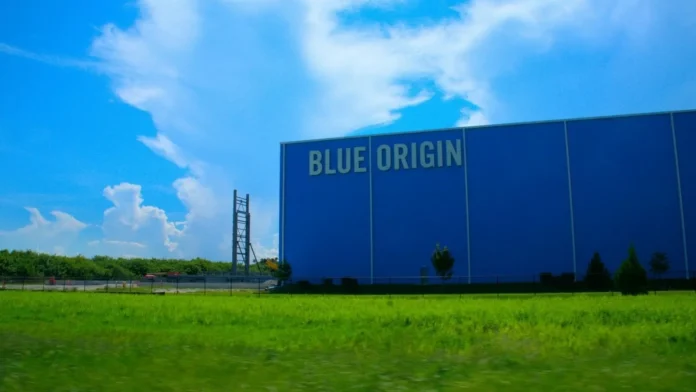

Blue Origin’s New Glenn rocket exploded during a ground test at Cape Canaveral on May 28, destroying the 322-foot vehicle two days before launch and significantly damaging the company’s only Florida launch complex — a disaster that throws NASA’s Artemis lunar programme timeline into serious doubt and strengthens SpaceX’s already dominant position in the commercial space sector.
At 9:00 p.m. EDT on May 28, a New Glenn rocket, built by the Jeff Bezos-owned Blue Origin aerospace company, ate itself in a massive fireball during a test of its seven first-stage engines. The giant explosion hurled flames, gas, and debris hundreds of feet in the air, utterly destroying the 322-foot rocket and partly destroying the launch complex itself. “All personnel are accounted for and safe,” wrote Bezos in a post on social media.
A static test fire of the vehicle’s engines at Launch Complex-36 (LC-36), located at Cape Canaveral Space Force Station in Florida, was the rocket’s last major milestone before a liftoff targeted for June 4. During that test, however, an explosion destroyed the rocket and severely damaged launch infrastructure on the ground.
The explosion — caught on video and shared widely across space industry channels — has drawn immediate responses from across the aerospace community. The European Space Agency chief described it as “a huge setback for the space community.” And the shockwaves, as one analyst observed, will reverberate all the way to the Moon.
What New Glenn Was Supposed to Do
New Glenn is Blue Origin’s heavy-lift orbital rocket — the company’s answer to SpaceX’s Falcon 9 and Falcon Heavy. Named after astronaut John Glenn, the rocket stands 322 feet tall and is designed to carry significant payloads to low Earth orbit, the Moon, and beyond. It represents years of development and billions of dollars of investment by Blue Origin since the project was announced in 2016.
Blue Moon Mark 1 (MK1) was the rocket’s last major milestone before the liftoff targeted for June 4. The NG-4 vehicle — the fourth New Glenn in the series — was being readied for a launch that would have been a significant demonstration of the rocket’s readiness for NASA’s most critical payloads.
Just two days before the explosion, NASA also announced that it had inked an agreement with Blue Origin to launch a pair of New Glenns that would carry rovers to the lunar surface which would be awaiting crews of Artemis III, IV, V, and beyond. Those deals too may be in trouble.
The timing of NASA’s announcement — just 48 hours before the explosion — makes the loss more painful. The agency had publicly committed to Blue Origin as a critical component of its lunar infrastructure strategy, only to see the rocket it was counting on reduced to debris at the test stand.
The Artemis Programme: What Is Now at Risk
NASA’s Artemis programme — the effort to return astronauts to the Moon and establish a sustained presence there — is one of the most ambitious and logistically complex undertakings in space history. It depends on a web of contractors providing different components: SpaceX’s Starship as one human landing system, Blue Origin’s Blue Moon lander as another, and New Glenn as the heavy-lift vehicle for key payloads.
“NASA’s plans for a Moon base are heavily dependent on using the New Glenn booster,” says John Logsdon, a space policy expert. “This incident suggests that those plans at this point are basically an aspiration rather than being realistically achievable in the next few years.”
The company was slated to test a cargo version of the Mark II in a lunar landing mission before the end of 2026. That mission is now in jeopardy. The timeline that would lead to Artemis III — the mission that would land astronauts on the lunar surface — already faced significant pressure before the explosion. NASA had been targeting 2028 for that landing, a date that most space analysts considered optimistic. After May 28, it has become considerably more so.
The Launch Pad Problem
One of the most significant practical consequences of the explosion is the damage to Blue Origin’s only Florida launch complex.
Rebuilding from the Thursday disaster will not be easy. Unlike SpaceX, which has three different launch pads in Florida, Blue Origin only has launch complex 36. A full assessment of the damage to the pad has not been conducted yet, but photographic and video images reveal that the mobile tower that brings the rocket out to the pad, stands it upright and connects fuel lines and communications, has been damaged significantly.
The destruction of the mobile tower and pad infrastructure means Blue Origin cannot conduct another launch from LC-36 until repairs are complete. Those repairs will take months at minimum — and the full extent of the damage, which includes potential damage to ground support systems and the pad structure itself, has not yet been assessed.
Blue Origin faces months of delays after the rocket explosion, bolstering SpaceX’s dominance.
For a company that was already widely seen as lagging behind SpaceX in both launch cadence and commercial momentum, the explosion could not have come at a worse time. SpaceX’s Starship programme — despite its own early test explosions — has progressed steadily toward operational capability. The gap between the two companies, which Blue Origin had been trying to close, just widened considerably.
SpaceX: The Beneficiary
The explosion’s most immediate beneficiary is SpaceX. The commercial launch market that Blue Origin was targeting — both for government contracts and for commercial satellite operators — now has one fewer serious competitor. SpaceX’s Falcon 9 and Falcon Heavy, which between them have conducted more launches than any other rocket family in history, face less competitive pressure than they did before May 28.
For NASA, SpaceX’s Starship is the alternative to Blue Origin for several Artemis payloads. But Starship is itself still in development, having completed integrated flight tests that demonstrated the vehicle’s basic functionality while identifying issues that require addressing before it can carry humans or precious NASA payloads. The Artemis programme was never designed to depend entirely on SpaceX — the dual-vendor approach that included Blue Origin was specifically intended to reduce single-point-of-failure risk.
That risk mitigation strategy has been severely damaged by Monday’s explosion.
What Investigation and Recovery Look Like
The Federal Aviation Administration will oversee the investigation into the cause of the explosion, as it does for all anomalies involving commercial launch vehicles at US launch sites. Blue Origin will conduct its own parallel investigation. Until both investigations are complete and the FAA authorises a return to flight, Blue Origin cannot conduct another New Glenn launch.
Previous major launch vehicle explosions — including SpaceX’s Falcon 9 pad explosion in 2016, which destroyed an Amos-6 satellite and damaged LC-40 at Cape Canaveral — provide a reference point. That explosion grounded SpaceX’s Falcon 9 for several months before the vehicle returned to flight. The pad at LC-40 required extensive repairs. Blue Origin’s recovery will follow a similar trajectory, with a timeline measured in months, not weeks.
The explosion could affect NASA’s Artemis lunar programme, which depends in part on Blue Origin’s rockets and landers. NASA has tasked Blue Origin and SpaceX with developing lunar landers to transport astronauts and equipment to the Moon as part of plans to build a lunar base.
What Happens Next
Blue Origin’s immediate priorities are completing the damage assessment at LC-36, beginning the accident investigation, and communicating with NASA and other customers about the impact on manifested missions. The company will need to make decisions about whether to accelerate production of a replacement New Glenn vehicle, whether to seek alternative launch sites for interim capacity, and how to manage its commercial commitments during a return-to-flight period of uncertain duration.
For NASA, the explosion adds to the already-complex picture of managing Artemis programme dependencies across multiple contractors. The agency will need to assess which planned missions can be accommodated by alternative providers, which face unavoidable delays, and how the timeline to a crewed lunar landing — already under significant pressure — must be adjusted.
Jeff Bezos, in his initial response to the explosion, confirmed that no personnel were harmed and expressed confidence in the investigation process. Whether that confidence translates into a rapid return to flight, or whether Blue Origin’s position in the space industry is fundamentally altered by what happened at LC-36 on the night of May 28, will be determined in the months ahead.
LoudFact.com is an independent global news and explainer platform. This report is based on reporting from Space.com, Time Magazine, The Shillong Times, RocketSTEM, and Gulf Business as of May 29 – June 2, 2026.