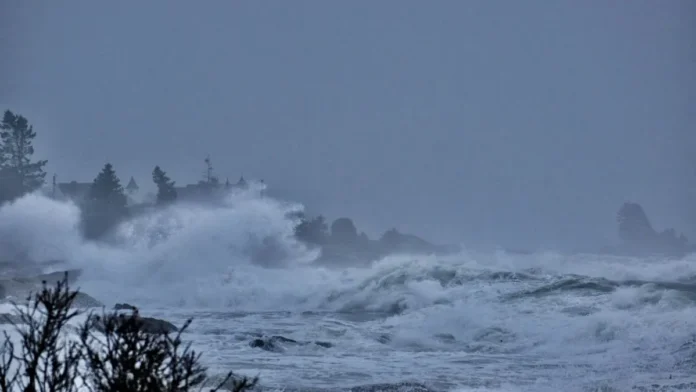

The 2026 Atlantic hurricane season begins officially on June 1, with NOAA forecasting a below-normal season for the first time in years — driven by the arrival of an El Niño weather pattern that tends to suppress Atlantic storm development. But forecasters and emergency managers are warning that a below-normal forecast does not mean a safe one.
NOAA’s outlook for the 2026 Atlantic hurricane season, which runs June 1 to November 30, predicts a 35% chance of a near-normal season, a 10% chance of an above-normal season, and a 55% chance of a below-normal season. The agency is forecasting a total of 8-14 named storms with winds of 39 mph or higher. Of those, 3-6 are forecast to become hurricanes with winds of 74 mph or higher, including 1-3 major hurricanes — Category 3, 4 or 5 with winds of 111 mph or higher. NOAA has a 70% confidence in these ranges.
The 2026 forecast represents a significant departure from recent years. The 2024 and 2025 Atlantic hurricane seasons were both above normal, producing significant storm activity and, in 2025, a destructive season that included multiple landfalling systems. After years of above-normal forecasts driven by record warm Atlantic sea surface temperatures and La Niña conditions, 2026 is being shaped by different atmospheric forces.
Why This Year Is Expected to Be Quieter: El Niño
The primary reason for the below-normal forecast is a shift in the Pacific Ocean’s climate pattern.
NOAA’s Climate Prediction Center said there is at least an 82% chance El Niño will arrive by July. Scientists are still monitoring conditions that will help them determine how strong it will be.
El Niño — characterised by the warming of surface waters in the central and eastern tropical Pacific — has a well-documented suppressing effect on Atlantic hurricane activity. The mechanism is indirect but consistent: warmer Pacific waters drive changes in the atmosphere’s upper-level circulation that increase wind shear over the Atlantic and Caribbean. Wind shear — the difference in wind speed and direction at different altitudes — disrupts the vertical structure of developing tropical systems, preventing them from organising into full hurricanes.
In simple terms: when El Niño strengthens, the Atlantic gets windier at altitude, and storms struggle to develop. The inverse — La Niña, which dominated the past two hurricane seasons — reduces shear and allows storms to build more freely, contributing to the above-normal seasons of recent years.
NOAA forecasters have released their seasonal outlook for the 2026 Atlantic hurricane season, and the numbers are in line with outlooks released by The Weather Company and Colorado State University. The convergence of multiple independent forecasting teams on a similar outlook adds credibility to the prediction.
The “It Only Takes One” Warning
The most important sentence in NOAA’s announcement was not about the forecast numbers. It was this:
“Even though we’re expecting a below-average season in the Atlantic, it’s very important to understand that it only takes one,” said NOAA administrator Neil Jacobs. “We have had Category 5 storms make landfall in the past during below-average seasons.”
This warning is not rhetorical. It is historically documented. Hurricane Andrew — which caused catastrophic damage in South Florida in 1992 — struck during a below-normal season. Hurricane Charley — which ravaged Florida’s Gulf Coast in 2004 — also occurred in a season that underperformed relative to predictions.
A below-normal season means fewer total storms, on average, form and develop. It does not mean the storms that do develop will be weaker. It does not mean that populated coastlines are protected from a direct hit. And it does not account for the variability in where storms track — a single major hurricane making landfall in a densely populated area can produce far more damage and loss of life than an above-normal season in which all storms track out to sea.
The Colorado State Perspective
Forecasters at Colorado State University included percentages in their forecast in April. According to CSU, there is a 20% chance of a landfalling hurricane along the Gulf Coast, from the Florida Panhandle to Brownsville, Texas, this season. That’s below the average of 27%.
A 20% probability of a Gulf Coast landfalling hurricane is lower than usual — but it is not negligible. For the communities along that coastline, it means that one in five seasons with a similar forecast produces a direct hit. The relevant question is not whether a particular year falls below historical averages, but whether the preparations that would make landfall survivable are in place.
The first major hurricane forecast of 2026 was released Thursday. Phil Klotzback, a senior research scientist at CSU’s Department of Atmospheric Science and lead author of the report, said that the 2026 Atlantic season seems to be following a trajectory similar to the seasons of 2006, 2009, 2015 and 2023. Of those analogue seasons, some were genuinely quiet; others produced significant storm activity despite below-normal forecasts.
Technology Advances in 2026
NOAA’s Atlantic Oceanographic and Meteorological Laboratory is using machine learning to quality-control data collected from tail Doppler radar — a specialised radar system mounted on the back of NOAA’s “Hurricane Hunter” aircraft. This new method gathers more than 25% more meteorological data than the current method and leads to more high-quality data to support structure and wind analysis by forecasters.
NOAA’s Office of Water Prediction high-resolution Flood Inundation Mapping services provide emergency managers visualisations of those streets and neighbourhoods likely to go underwater. These services cover 60% of the US population and will expand to nearly 100% by late September 2026.
The technological advances in hurricane forecasting and emergency management represent genuine progress. Track forecasts — predicting where a storm will go — have improved dramatically over the past two decades. Intensity forecasting — predicting how strong a storm will become — has improved more slowly, but machine learning applications are beginning to close that gap.
Preparedness: The Message That Never Changes
Every year, NOAA’s hurricane season forecast is accompanied by preparedness messaging — and every year, the message is the same: the time to prepare is before a storm threatens, not after.
“With the most advanced forecast modeling and hurricane tracking technologies, NOAA and the National Weather Service are prepared to deliver real-time storm forecasts and warnings,” said Commerce Secretary Howard Lutnick.
The practical preparedness steps — assembling emergency supply kits, knowing evacuation routes, having a family communication plan, reviewing insurance coverage — are independent of the seasonal forecast. They are relevant whether the season produces three storms or thirty.
For residents of Florida, the Gulf Coast, the Atlantic Coast, the Caribbean, and Central America, June 1 marks the official start of a period of elevated risk that runs through November 30. The NOAA forecast suggests that period may be quieter than recent years. It does not guarantee safety. And for the communities in the path of whatever storms do develop, the difference between a prepared response and an unprepared one will matter far more than the seasonal outlook that was published today.
What Happens Next
The first storms of the 2026 season are not yet visible in the Atlantic. The peak of the season — when sea surface temperatures are at their highest and atmospheric conditions are most favourable for development — typically runs from mid-August through mid-October. Whether the El Niño that NOAA expects to arrive in July is strong enough to materially suppress that peak activity will become clear as the summer progresses.
NOAA will issue an updated seasonal outlook in August, incorporating actual observed conditions through the first weeks of the season. That update will provide a refined picture of what the remainder of the season is likely to produce.
For now, the season has begun. The forecast is cautiously reassuring. The preparation should be unconditional.
LoudFact.com is an independent global news and explainer platform. This report is based on NOAA’s 2026 Atlantic Hurricane Season Outlook released May 21, 2026, and reporting from CBS News, The Weather Channel, and Fox 26 Houston as of June 1, 2026.