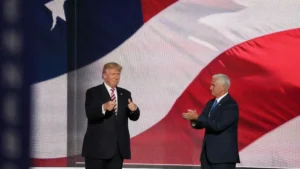
President Donald Trump addressed the nation in primetime from the East Room of the White House on July 16, announcing the release of newly declassified documents he said revealed that China had carried out “the largest compromise of election data in history” — illicitly acquiring 220 million US voter files and attempting to manipulate American elections over multiple election cycles. Within hours, independent fact-checkers, former intelligence officials and journalists who reviewed the actual declassified documents had found a significant gap between what Trump claimed and what the documents showed.
The primetime address was structured to build political momentum for the SAVE America Act, the administration’s sweeping election reform legislation. What the documents showed about China was considerably more ambiguous.
What Trump Said
In his remarks, the president said that he would immediately declassify the release of “critical intelligence, revealing shocking vulnerabilities in our election infrastructure.” Trump said the declassified information shows “shocking vulnerabilities in our election infrastructure.”
Trump said that China conducted a massive hacking of voter registration information. “The People’s Republic of China carried out what is believed to be the largest compromise of election data in history, resulting in China’s illicit acquisition of 220 million US voter files.” The obtained data included names, home addresses, phone numbers and political party preferences of US voters.
Trump also said the FBI found China attempted to manufacture ballots in favour of Biden, that Chinese operatives wanted to harm Trump so he would be forced to resign or be defeated in his reelection bid, and that the “deep state” had suppressed this information from him during his first term.
What the Declassified Documents Actually Show
Trump’s claim contradicts reviews that have found no evidence of significant interference in the 2020 election. FactCheck.org reviewed the actual declassified documents released alongside the speech and found a material gap between the claims and the evidence.
Indeed, one of the declassified documents that the White House released on July 16 said that, in early 2022, a Chinese actor had downloaded state voter information from 2013 to 2021 that was available on commercial US sources, FactCheck.org reported. The critical phrase is “available on commercial US sources.” Voter registration data — names, addresses, phone numbers, party affiliations — is widely available in the United States. Many states sell or freely provide their voter rolls to political parties, campaigns, researchers and commercial data brokers. Far from representing a hack of protected systems, the download described in the document appears to refer to the acquisition of data that is legally available to anyone willing to pay for or request it.
A similar assessment had been included in a classified Intelligence Community assessment on “foreign threats” to the 2020 election that was given to Trump, as well as administration and congressional leadership, on January 7, 2021. The national director of intelligence at the time was John Ratcliffe, who now serves as CIA director. A declassified version was released in March 2021. In other words, the substance of the China election interference claims Trump presented as newly revealed had previously been shared with him and with congressional leaders during his first term.
What the SAVE America Act Would Do
The president said that Congress needed to pass the SAVE America Act, describing its voter ID requirements as “simple.” The bill’s ID rules would be stricter than those in most of the 36 states that already have a form of voter ID. Trump’s speech was structured to create the political environment for passing that legislation, which has struggled to clear the Senate.
The SAVE America Act would impose a national voter ID requirement more stringent than those in most states, restrict access to absentee voting, require proof of citizenship for voter registration and create new criminal penalties for election officials who fail to maintain voter rolls in accordance with federal standards. Senate Majority Leader John Thune has repeatedly said the bill does not have enough Republican votes to pass in its current form.
The architecture of the speech — a primetime address, declassified documents, dramatic claims about Chinese aggression — was designed to create public pressure that would move Republican senators who have been resistant to the bill’s more aggressive provisions.
What Intelligence Experts Said
Legal Insurrection, a conservative legal commentary site, offered a notably critical assessment of its own political alignment: “The documents showed absolutely no such thing, the thing Trump claims China has (the lists of voters) is openly and publicly available on the websites of the US Government. The intelligence reports he declassified say exactly the opposite of what was claimed.”
Multiple former US intelligence officials speaking to news outlets noted that voter registration data has been a target of foreign acquisition by multiple countries for years — but that acquiring publicly available commercial data is categorically different from hacking protected electoral infrastructure. The distinction matters for assessing the seriousness of the Chinese activity and for determining what legislative response, if any, is proportionate.
What China Said
China denied the claims. Beijing’s foreign ministry spokesperson said the claims were “groundless” and accused the Trump administration of using false allegations to build domestic political support. China has previously denied involvement in attempts to interfere with US elections. The US intelligence community’s consensus assessment has consistently been that Russia was the primary foreign actor in the 2016 election, while assessing more limited Chinese activity in subsequent cycles.
What Happens Next
Trump ordered the Department of Justice to prosecute those believed to be involved in suppressing the election interference information — an instruction that would require identifying specific individuals who made specific classification or briefing decisions during the Biden administration, and proving that those decisions constituted criminal rather than professional conduct.
The SAVE America Act faces a Senate vote in the coming weeks. Whether Trump’s speech and the declassification move the political needle sufficiently to overcome the resistance of the 50 or more Republican senators currently needed to pass it without Democratic support will determine whether the primetime address achieves its primary legislative objective.