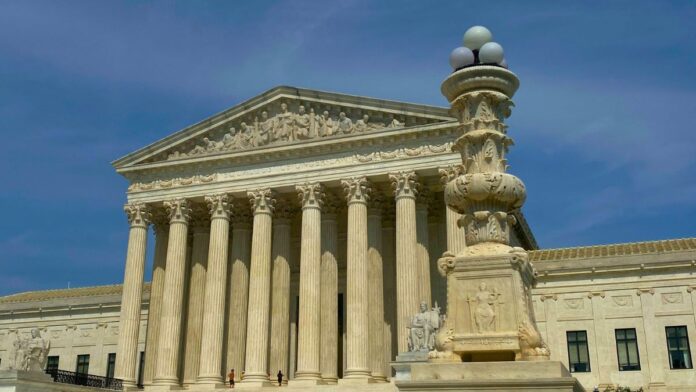

WASHINGTON, D.C. — In a seismic shift for judicial power, the U.S. Supreme Court today limited federal judges’ authority to issue nationwide injunctions against presidential policies, handing President Donald Trump a major victory in his bid to enforce a divisive executive order curtailing birthright citizenship.
The 6-3 ruling, split along ideological lines, allows the administration to partially implement the order within 30 days but sidestepped a constitutional showdown over the 14th Amendment itself.
The Core Ruling
Justice Amy Coney Barrett authored the majority opinion, declaring: “Universal injunctions likely exceed the equitable authority that Congress has given to federal courts”. The decision:
- Blocks nationwide injunctions issued by lower courts against Trump’s executive order.
- Permits enforcement in 28 states not party to the lawsuits after a 30-day stay.
- Leaves birthright citizenship intact in 22 Democratic-led states that sued.
Further, the Court did not rule on the constitutionality of Trump’s order, which seeks to deny citizenship to children of undocumented immigrants and temporary visa holders, leaving that battle for future litigation.
🚨 SCOTUS REINS IN ROGUE JUDGES 🚨
The Supreme Court FINALLY ruled that the rogue judges imposing universal injunctions against President Trump do not have the authority to do so!
Huge win for President Trump. pic.twitter.com/tEwQzLRw5L
— TJ Roberts (@realTJRoberts) June 27, 2025
Fierce Dissents and Warnings

The liberal justices issued blistering dissents:
Justice Sonia Sotomayor called the ruling “a travesty for the rule of law,” warning: “No right is safe in this new legal regime… Tomorrow, a different administration may try to seize firearms or prevent worship”.
Justice Ketanji Brown Jackson separately condemned the majority for enabling “unchecked, arbitrary power” and creating “an existential threat to the rule of law”.
What Happens Next
30-day countdown: The administration cannot enforce the order until late July, allowing legal challenges to refocus on state-specific or class-action suits.
Class actions as alternatives: Justices Kavanaugh and Alito suggested class certifications under “Rule 23” could achieve nationwide relief, but cautioned against lax standards.
Political fallout: Trump immediately hailed a “GIANT WIN” on social media and scheduled a press conference with Attorney General Pam Bondi.
Historical Context
Trump’s executive order, signed on his first day of his second term, directly challenges the 14th Amendment’s guarantee that “all persons born or naturalized in the United States… are citizens,” a principle upheld since 1866. Federal judges in Washington, Maryland, and Massachusetts had universally blocked the order as “blatantly unconstitutional”.
Why This Reshapes Presidential Power
The ruling neuters a key tool used against recent administrations:
Nationwide injunctions halted Obama’s immigration policies, Trump’s transgender military ban, and Biden’s student debt relief.
Future impact: Presidents may now enforce contentious policies regionally while lawsuits proceed, increasing pressure on opponents to file state-specific or class-action cases.
“The Court grants the Government’s request for a partial stay but only to the extent the injunctions are broader than necessary to relieve each plaintiff.” – Justice Amy Coney Barrett, Majority Opinion
The Unresolved Constitutional Question
Despite the procedural focus, the dissent stressed the order’s radical implications:
Textual clash: The 14th Amendment contains no exceptions for parents’ immigration status.
Precedent: The Supreme Court affirmed birthright citizenship in United States v. Wong Kim Ark (1898), never been overturned.
Reactions
Supporters: Senator Chuck Grassley (R-IA) praised curtailing “judicial overreach” and vowed to push legislation solidifying the limits.
Critics: Immigrant advocates warn of “two-tiered citizenship” and rushed lawsuits in non-protected states.
Timeline of Key Events
Jan 20, 2025: Trump signs executive order ending birthright citizenship.
Jan 25, 2025: Federal judges in WA, MD, MA issue nationwide injunctions blocking the order.
Mar 13, 2025: DOJ appeals to Supreme Court, targeting injunctions (not merits).
May 15, 2025: Rare oral arguments held on emergency request.
Jun 27, 2025: Supreme Court limits injunctions; 30-day stay begins.
The Path Forward
Legal challenges will now pivot to:
- State-specific lawsuits in the 28 states where the order may soon take effect.
- Class-action certifications to seek broader relief.
- Constitutional showdowns in lower courts – teeing up a future Supreme Court battle over the 14th Amendment.
The decision marks a tactical win for Trump but sets the stage for a more profound clash over citizenship, executive power, and the courts’ role as a constitutional check.