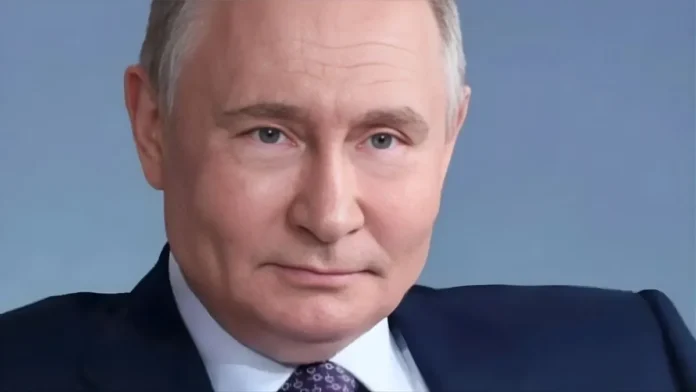

Russian President Vladimir Putin made his first-ever visit to the disputed Kuril Islands on Thursday, drawing a formal protest from Japan, which also claims the territory, as the trip coincided with major Russian Pacific Fleet exercises and a warning from Putin that Russia would begin seizing European vessels if its own ships come under threat.
What Happened
Putin visited Iturup, the largest of the Kuril Islands’ four southernmost isles, touring a fish-processing plant, a hospital, and a school, and briefly speaking with local residents alongside Sakhalin Region Governor Valery Limarenko. Russian state media reported he was given caviar during the visit to the fish plant.
The trip followed his appearance the previous day aboard the missile cruiser Varyag during the final stage of Russia’s Pacific Fleet exercises, drills the Russian Defense Ministry said involved dozens of warships and aircraft and more than 13,000 servicemen.
Japanese Prime Minister Sanae Takaichi condemned the visit, calling it “unacceptable” and stating it “offends the sentiments of the Japanese people,” adding that it “made it more difficult to restore relations in the medium to long term.” Japanese Foreign Minister Toshimitsu Motegi separately said Japan “strongly protests” the visit, reiterating that the islands, which Japan calls the Northern Territories, are “Japan’s inherent territory both historically and from the perspective of international law.”
Speaking aboard the Varyag before the Iturup visit, Putin addressed European Union plans to seize Russian “shadow fleet” tankers, warning that Russia would respond by seizing European vessels if its own ships were targeted. He separately described the current status of the Kuril Islands as “enshrined in international documents as a reality that arose following the outcome of World War II,” while claiming Moscow remained open to seeking a resolution toward an eventual peace treaty with Japan.
Why It Matters
The visit represents a significant symbolic escalation in the decades-long territorial dispute between Russia and Japan, given that it marks the first time a sitting Russian president has visited the islands, a step beyond the more limited precedent set by a 2015 visit from then-Prime Minister Dmitry Medvedev, which also drew Japanese protest at the time.
The dispute over the Kuril Islands, seized by the Soviet Union in the final days of World War II, has prevented Russia and Japan from signing a formal peace treaty ending their wartime hostilities for more than 80 years, despite a 1956 joint declaration that formally ended the state of war between the two nations without resolving the underlying territorial question.
The timing of Putin’s threat to seize European vessels, delivered just before his landmark visit to the disputed islands, links two separate points of tension, the Pacific territorial dispute with Japan and the broader confrontation between Russia and Western nations over sanctions and shipping enforcement tied to the Ukraine war, into a single, coordinated show of resolve.
Context and Background
Japan formally renounced “all right, title and claim to the Kuril Islands” under the 1951 Treaty of San Francisco but did not recognize Soviet, and later Russian, sovereignty over the specific four southernmost islands it calls the Northern Territories, a distinction that has underpinned Japan’s continued territorial claim in the decades since.
The Institute for the Study of War, a Washington-based think tank, assessed that Putin’s visit was likely timed in part as a response to Japan’s recently published 2026 defense white paper, suggesting the visit was intended partly to undermine Prime Minister Takaichi’s broader position on the territorial dispute domestically.
Tokyo had previously noted that Russia introduced restrictions on sea navigation for foreign military and civilian ships around the southern Kuril Islands earlier this year, part of a broader pattern of Russia reinforcing both its military presence and administrative control over the islands in recent years.
Analysis
Regional security analysts note that Putin’s decision to combine the Kuril Islands visit with major Pacific Fleet exercises involving more than 13,000 servicemen represents a deliberate signal of Russia’s continued military commitment to the islands, going beyond symbolic diplomatic messaging to include a substantial demonstrated naval presence in the immediate area.
Geopolitical analysts point to the linkage between Putin’s shadow fleet vessel-seizure threat and his Kuril Islands visit as evidence of a broader Russian strategy of projecting resolve simultaneously across multiple fronts of tension with the West and its allies, using each dispute to reinforce Moscow’s posture in the others even where the underlying issues are not directly connected.
Some analysts caution that while the visit is unlikely to trigger immediate military escalation given the islands’ current firm Russian administrative control, it nonetheless further diminishes prospects for near-term progress toward the long-sought Russia-Japan peace treaty, extending a diplomatic stalemate that has already persisted for more than eight decades.
What Happens Next
Japan’s government is likely to continue pursuing diplomatic protest through official channels, though it has limited practical leverage to alter Russia’s administrative control over the islands given the current geopolitical environment and Russia’s demonstrated military commitment to the territory.
The broader dispute over shadow fleet vessels and European sanctions enforcement is likely to remain a parallel and evolving source of tension, with Putin’s specific threat to seize European ships adding a new potential flashpoint to watch in the ongoing standoff between Russia and Western nations over sanctions compliance.