
Canadian defense planners have reportedly examined a highly unlikely but extreme scenario: how Canada might respond if the United States were ever to launch a military invasion.
According to reports citing defense analyses, the modeling assumes U.S. forces would rapidly overpower Canada’s conventional military positions — potentially within days — forcing a shift to alternative forms of resistance.
What the Scenario Involves
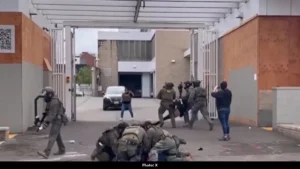
The reported planning envisions that after conventional defenses are breached, Canada’s response would rely on decentralized resistance. This could include small, irregular units conducting hit-and-run attacks, sabotage, and the use of drones — tactics associated with asymmetric warfare rather than traditional state-on-state combat.
Such scenarios are typically developed as theoretical exercises rather than operational plans, designed to stress-test assumptions and identify vulnerabilities.
Allies, Not Adversaries
Canada and the United States are among the world’s closest military allies, cooperating through NATO and NORAD, and have not fought each other since the War of 1812. There is no indication that either government believes an armed conflict is likely.
Analysts note that militaries routinely model extreme contingencies, even against friendly nations, as part of comprehensive defense planning.
Why the Issue Surfaced Now
The reports have drawn attention amid heightened political rhetoric in the United States, including statements by former President Donald Trump that critics say have raised questions about alliance commitments and use of force.
While officials have not confirmed any intent or expectation of conflict, such rhetoric can influence how planners frame hypothetical risks.
Asymmetric Warfare as a Last Resort
Defense experts say planning for decentralized resistance does not imply intent to fight allies, but reflects lessons learned from recent conflicts where conventional forces were quickly defeated and resistance shifted to irregular methods.
These scenarios are often used to examine civilian resilience, infrastructure protection, and continuity of government under worst-case conditions.
Why It Matters
The fact that such a scenario is being discussed publicly underscores how geopolitical uncertainty can ripple even among long-standing allies. While the prospect of U.S.–Canada conflict remains remote, the episode highlights how defense planning increasingly accounts for improbable but high-impact events.
What Comes Next
Neither Ottawa nor Washington has formally commented on the reported modeling. Defense experts expect both governments to continue emphasizing alliance cooperation while quietly maintaining contingency planning as standard military practice.