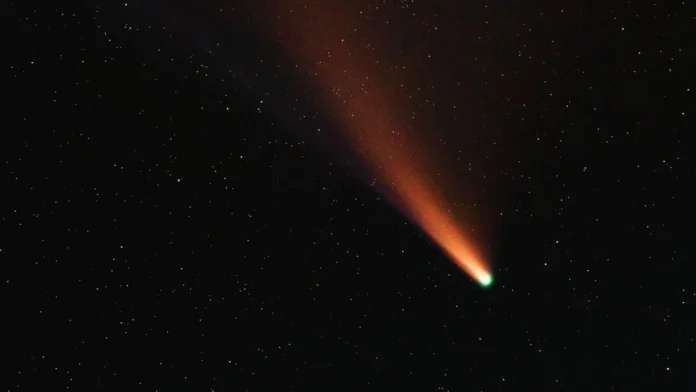

Astronomers have confirmed that a newly discovered comet — designated 3I/ATLAS — is an interstellar object: a visitor from outside our solar system, only the third such confirmed object ever detected. Discovered by the ATLAS survey telescope in Hawaii, 3I/ATLAS is travelling at roughly 67 kilometres per second, a speed far beyond what could be sustained by any object gravitationally bound to our Sun. It is now the subject of intense study by observatories worldwide, and preliminary data suggest it may be the largest interstellar object ever observed — potentially large enough to become visible to the naked eye from the southern hemisphere before the end of summer.
The Discovery
The comet was discovered by the Asteroid Terrestrial-impact Last Alert System (ATLAS) telescope in Hawaii, giving rise to its name. Exactly where the comet came from within the Milky Way remains a mystery, as CBS News reported Thursday.
The object’s interstellar origin was confirmed rapidly through measurements of its velocity and trajectory. An object in our solar system follows a predictable path determined by the Sun’s gravity. Objects that exceed the solar system’s escape velocity — travelling fast enough that the Sun’s gravity cannot hold them — must have come from elsewhere. At 67 kilometres per second, 3I/ATLAS is moving well above that threshold. Combined with the hyperbolic shape of its trajectory — which curves around the Sun and then departs on a path that will take it out of the solar system entirely — the evidence for its interstellar origin is unambiguous.
The designation “3I” indicates it is the third confirmed interstellar object ever detected. The first was ‘Oumuamua, discovered in 2017 — an elongated, reddish object whose nature prompted significant scientific debate. The second was Comet Borisov, discovered in 2019 — a more conventional-looking comet that allowed astronomers to study its composition in detail. 3I/ATLAS is only the second confirmed interstellar object to show the characteristics of a comet: a visible coma — the hazy cloud of gas and dust surrounding the nucleus — and potentially a tail.
What Makes It Different From Oumuamua and Borisov
The detection of 3I/ATLAS so quickly after its approach reflects the improvement in sky survey technology since 2017. ‘Oumuamua was detected only after it had already passed its closest point to the Sun and was heading away — limiting the time astronomers had to study it. Comet Borisov was spotted earlier but remained relatively faint. 3I/ATLAS has been detected earlier in its approach, giving astronomers a significantly longer observation window.
Preliminary estimates of the object’s size, derived from its brightness and distance, suggest it may be the largest interstellar visitor ever detected — though the precise diameter depends on the object’s reflectivity, which is not yet precisely measured. The presence of a coma — confirmed in early observations — indicates that the nucleus is releasing gas and dust as it is heated by the Sun, a characteristic of cometary bodies containing volatile ices. This makes it physically distinct from ‘Oumuamua, which showed no such outgassing and whose nature remains scientifically contested.
Where It Is and Where It Is Going
At the time of writing, 3I/ATLAS is approaching the inner solar system. Its trajectory will bring it to its closest point to the Sun — perihelion — before it begins its departure, following a hyperbolic path that will take it out of the solar system and into interstellar space once more.
Astronomers worldwide have turned telescopes toward the object to collect as much data as possible during its brief transit. The comet is currently a target for professional observatories and citizen astronomers alike, with new data being collected daily.
The most anticipated moment for public observation is September 2026, when the comet’s brightness is expected to peak. Current projections — subject to revision as more data is gathered — suggest the comet may reach a magnitude visible to the naked eye from the southern hemisphere. Whether it will be as dramatic as the most spectacular historical comets depends on factors including the size and activity level of the nucleus that will only become clearer as it approaches.
What 3I/ATLAS Can Tell Scientists
The significance of 3I/ATLAS for planetary science extends well beyond the spectacle of seeing an object from another star system pass through our own.
The chemical composition of the comet’s coma — which can be measured through spectroscopic analysis — will provide information about the chemistry of the star system from which it originated. The elements and molecules released by a comet as it heats reflect the conditions under which it formed, potentially billions of years ago in a planetary system around another star. Comparing the composition of 3I/ATLAS with comets native to our own solar system will allow astronomers to probe whether the same basic chemistry is universal or whether different planetary systems produce compositionally distinct bodies.
The trajectory of the object — its precise approach angle and speed — can in principle be traced back to identify roughly which direction in the galaxy it came from, and potentially to identify candidate star systems it may have passed through in the past. The same analysis cannot definitively identify its origin, as interstellar objects travel for millions or billions of years and can be gravitationally deflected many times, but it constrains the possibilities.
What Comes After
The observation campaign for 3I/ATLAS is expected to intensify over the coming months. Major observatories including the Hubble Space Telescope and the James Webb Space Telescope are expected to target the object. Ground-based facilities in both hemispheres are already tracking it.
The discovery of three interstellar objects in nine years — ‘Oumuamua in 2017, Borisov in 2019, and now 3I/ATLAS in 2026 — has shifted scientific thinking. When ‘Oumuamua was discovered, interstellar objects had been theoretically predicted but never confirmed. The discovery rate since then suggests that objects transiting from other star systems through ours may be far more common than previously assumed — and that with improving survey technology, further interstellar visitors will be detected with increasing regularity.
Whether 3I/ATLAS will be visible to southern hemisphere observers without a telescope in September remains to be confirmed as orbital refinements continue. What is already clear is that it represents a rare opportunity to study material from another planetary system — and one that will not return.