
Ukraine’s President Volodymyr Zelenskyy has fired the country’s popular defence minister, who pushed for innovation on the battlefield through the use of drones and turned the tables on Russia. The dismissal of Mykhailo Fedorov — a 35-year-old former IT entrepreneur who served as Ukraine’s Minister of Digital Transformation before being appointed Defence Minister six months ago — sparked an outcry from the public and protests in Kyiv.
The firing has exposed a fault line in Ukraine’s military establishment that has been building for months: a contest between a generation of technology-focused reformers who believe that drone warfare, AI and digital procurement are the future of Ukraine’s defence, and a generation of traditional military generals who believe the war must be fought on conventional terms. At a moment when Russia is killing dozens of Ukrainian civilians per week with ballistic missiles, the question of which vision prevails is not academic.
What Fedorov Did and Why He Was Fired
Fedorov is seen by Ukrainian lawmakers, soldiers and civil society activists as one of the most effective wartime officials. He pushed for the use of sophisticated drone warfare in Russia’s war on Ukraine. His tenure coincided with a dramatic shift in Ukraine’s favour on the battlefield.
Reports say Fedorov was ousted for clashing with seasoned military generals as he attempted to enact change within Ukraine’s defence structure. In his short tenure, Fedorov helped Ukraine gain the upper hand on the battlefield amid its conflict with the Kremlin.
Speaking to reporters in Kyiv on Thursday, he gave an impassioned defence of his ministry’s accomplishments and hit out at the country’s old-school military chief, Gen. Oleksandr Syrsky, for blocking attempts to modernise. “Instead of figuring out how to defeat Russia asymmetrically, which is the army chief’s task,” he said, “he has figured out how to divide the country.” “The war has completely changed,” he added.
Fedorov said Zelenskyy offered him an adviser role “or to find some other way to remain part of the team,” but he declined the offer.
Who Has Replaced Him — and What That Signals
Zelenskyy on Thursday issued a plea for “unity” within the military’s ranks. He then appointed Yevgeniy Khmara — head of Ukraine’s SBU security service — as acting defence minister.
Zelenskyy is expected to nominate Ihor Klymenko, Ukraine’s current interior minister — a former police general with traditional ideas — to replace Fedorov. The Interior Ministry manages units in Ukraine’s National Guard.
The contrast between Fedorov’s profile — a young tech entrepreneur who built the drone war — and Klymenko’s profile — a former police general with traditional ideas — captures the nature of the political shift that Zelensky’s reshuffle represents. The appointment of a traditional security apparatus figure to the defence role signals that the president has sided with the military establishment in the ongoing clash between reformers and generals.
The Protests in Kyiv
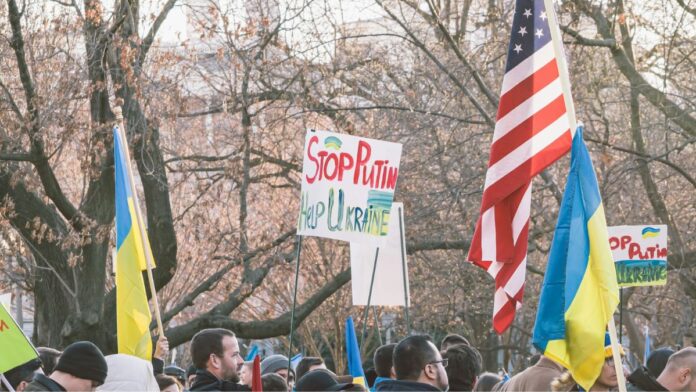
More than a thousand people were seen taking part in a rally in Kyiv’s central square, waving Ukrainian and European Union flags and reportedly chanting “shame” and “bring Fedorov back.”
Ukrainians protest for a second day, calling to replace army chief. “Political crisis and protests in Ukraine as Zelenskyy defends sacking defence minister,” The Guardian reported.
The protests — rare in a country under active military invasion — reflect a specific and politically significant demographic: Ukraine’s urban, educated, technology-adjacent population, which has been the social base for Fedorov’s modernisation drive and which sees his firing as a victory for the conservative military establishment over the innovation agenda that gave Ukraine its most significant battlefield advantages of the past two years.
The Broader Government Reshuffle
Zelenskyy announced the start of the government reshuffle on July 12, saying the changes are needed to implement an updated political strategy. He said the reshuffle also is intended to renew the Cabinet of Ministers and said responsibility for key areas of foreign policy would be assigned to officials with substantial experience who are capable of implementing what is agreed at the leaders’ level.
The reshuffle is Ukraine’s fourth since Russia launched its full-scale invasion — a level of governmental turnover that reflects the political pressures of wartime leadership: balancing military needs, international relationships, domestic politics and the personal loyalty structures that sustain any wartime government’s cohesion.
What It Means for Ukraine’s War Strategy
Dan Rice, president of American University Kyiv and a former special adviser to the commander-in-chief of Ukraine’s armed forces, told RFE/RL that Fedorov could be moved to another senior role, including potentially as prime minister or Ukraine’s ambassador to the United States. “I think he’s done an amazing job in a very short period of time,” Rice said of Fedorov. “I think he has a chance to help Ukraine-US relations tremendously. But time will tell what President Zelenskyy wants.”
Ukraine faces a specific strategic challenge in the months ahead: Russia is continuing to fire 100 ballistic missiles per month at Ukrainian cities, and Ukraine’s Patriot interceptor shortage — the shortage that killed 59 civilians in Kyiv this week alone — has not been resolved. Whether the ministry that Fedorov built and the drone industrial base he cultivated can continue to function under a traditional military leadership, or whether the cultural shift that produced Ukraine’s drone war advantage is reversed by the reshuffle, will become clear in the months ahead.