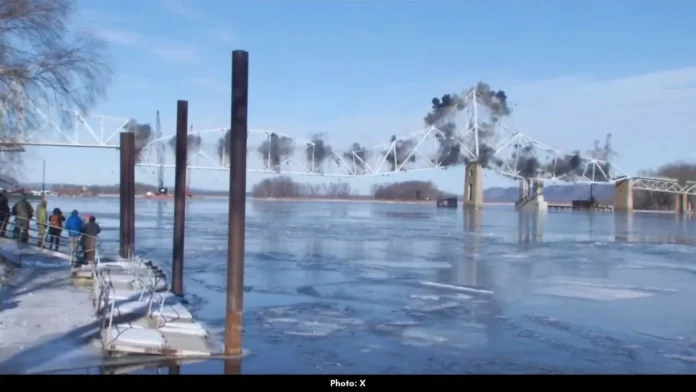

U.S. and Iowa authorities on Friday carried out a controlled implosion of the nearly 100-year-old Black Hawk Bridge, which spans the Mississippi River and connects Lansing, Iowa, to Wisconsin. The demolition cleared the way for a modern replacement bridge, marking the end of a landmark structure that served the region for decades.
Residents and officials gathered along the snow-covered riverbank to watch as carefully placed explosives brought down the bridge’s center span and one truss, sending smoke and water spray into the air. The bridge had been closed since October, ending daily service for about 2,100 vehicles that crossed the river.
In case you missed it live, here's the moment the bridge over the Mississippi River in Lansing imploded.https://t.co/G7MCxpEzFd pic.twitter.com/YxIZRHgZuC
— Iowa's News Now (@iowasnewsnow) December 19, 2025
How the Black Hawk Bridge Was Imploded
Officials said the implosion was the most efficient and safest method to remove the bridge’s largest sections. Explosives severed key structural supports, causing the center span and a truss to collapse into the Mississippi River, where they came to rest partially submerged.
Onlookers cheered as black smoke and white spray marked the dramatic fall. Lansing Mayor Michael Verdon, watching from a nearby houseboat dock, described the moment as “bittersweet,” saying the bridge had long been a familiar part of the town’s skyline.
A second implosion for the bridge’s eastern ramp was scheduled later the same day. The western portion will be dismantled manually in the future due to its proximity to homes and railroad tracks.
What Happens Next
The Iowa Department of Transportation said some smaller sections had already been removed manually, while additional dismantling will continue in the coming months. The new bridge, with an estimated cost of $140 million, is expected to open in 2027.
In the meantime, drivers will rely on a ferry service to cross the Mississippi River. Residents have also said they plan to salvage pieces of the old bridge for keepsakes and to create a tribute honoring its history.
Why the Bridge Was Replaced
Built in 1931, the Black Hawk Bridge was the only river crossing for roughly 30 miles in each direction. Its narrow lanes made it difficult for large trucks, and barge strikes against its piers had occurred over the years.
Despite its distinctive design and long service, officials said the bridge no longer met modern safety standards. The replacement bridge will be wider and safer for both vehicle traffic and river navigation.
Lansing, home to fewer than 1,000 residents, has a long history as a river town, shaped by steamboats, fur trading, and fishing—making the bridge’s removal an emotional moment for the community.