
New US government price data shows annual inflation accelerating to 4.2% in May 2026 — the highest reading since April 2023, up sharply from 3.8% in April and 2.4% in February before the Iran war began — as Iran-war energy costs spread from gasoline into virtually every category of consumer spending, placing the Federal Reserve in the stagflationary trap it has been trying to avoid.
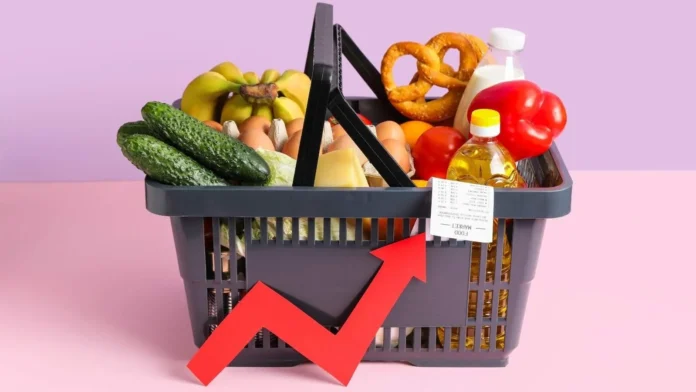
Rising gasoline prices, fueled by the US war with Iran, have driven inflation to its highest level in more than three years. A report released yesterday by the Labor Department showed consumer prices in May were up 4.2% from a year ago. That is the largest annual increase since April 2023.
The monthly progression of US inflation since the Iran war began is a precise record of what happens to consumer prices when the world’s most critical oil chokepoint is closed for 100 days:
- February 2026 (before the war): 2.4% annual inflation
- March 2026 (one month in): 3.3%
- April 2026 (two months in): 3.8%
- May 2026 (three months in): 4.2%
Each monthly increment — 0.9 points, 0.5 points, 0.4 points — documents the war’s accumulating economic impact. The pace of the monthly increments has been slowing, which might suggest a ceiling is being approached. But the absolute level — 4.2% and still above the Federal Reserve’s 2% target by more than two percentage points — is the highest since the tail end of the post-pandemic inflation surge.
What Is Driving the Rise
The Iran war’s inflation impact operates through a specific and well-documented transmission mechanism.
Step 1: Oil prices. The Strait of Hormuz’s closure has removed approximately 20% of global oil supply from normal transit. Brent crude has been above $100 per barrel since mid-March. At current prices, every barrel of oil costs approximately $25-30 more than it did before February 28.
Step 2: Gas prices. Higher crude prices translate directly into higher gasoline prices. National average US gas prices have been above $4.42 per gallon for weeks and are now above $4.56 — a level that makes the war’s cost visible and unavoidable to every American who drives or buys products that are transported by road.
Step 3: Energy costs more broadly. Higher oil prices affect not only gasoline but diesel (which powers trucks, trains, and farm equipment), jet fuel (which affects airline prices), heating oil (which affects household energy bills in northern states), and natural gas (which has also risen in price due to LNG supply disruption from the Hormuz closure).
Step 4: The cost of everything else. Energy is an input in virtually every economic activity. When energy costs more, so does transporting goods, manufacturing products, heating offices and warehouses, and running the equipment that produces everything from food to pharmaceuticals. Those cost increases propagate through supply chains into the consumer prices that the CPI measures.
Step 5: Core inflation. The May 2026 CPI data shows that core inflation — which strips out the volatile food and energy categories — has also risen, to approximately 3.5%. This means that energy price increases are now embedded in the broader price level, not just in the headline energy categories.
The Federal Reserve’s Impossible Position
The Federal Reserve’s dual mandate — maximum employment and stable prices — is under simultaneous stress from both directions in June 2026.
Stable prices: Inflation at 4.2% is more than double the 2% target. The standard monetary policy response to above-target inflation is to raise interest rates — making borrowing more expensive, reducing spending, and slowing price increases.
Maximum employment: The Iran war has created significant economic uncertainty. Consumer confidence has fallen. Business investment has been reduced by geopolitical uncertainty. The combination of higher energy costs and weaker growth momentum — a pattern economists call stagflation — means the economy is already showing signs of slowing. Raising interest rates into that environment risks tipping a slowdown into a full recession.
The Fed’s problem is that both sides of its mandate are pulling in opposite directions simultaneously. It cannot cut rates to support growth without allowing inflation to run even hotter. It cannot raise rates to fight inflation without accelerating the economic slowdown.
The resolution of this dilemma depends primarily on one variable that the Federal Reserve does not control: whether the Strait of Hormuz reopens. A diplomatic resolution that reopens the strait and begins normalising oil prices would reduce the energy-driven component of inflation within weeks, giving the Fed the space to cut rates if growth requires support. Without that resolution, the Fed is managing a stagflationary situation with insufficient tools.
The Political Arithmetic
The inflation number matters in ways beyond its economic impact because it is politically visible.
Rising gasoline prices, fueled by the US war with Iran, have driven inflation to its highest level in more than three years.
Gas prices are the most politically visible price in the American economy. Unlike other consumer prices, gasoline prices are displayed prominently on roadside signs that millions of Americans pass every day. A national average above $4.56 per gallon means that every trip to a filling station is a reminder of the war’s economic cost.
The House of Representatives voted 215-208 to end the Iran war on June 3. That vote reflected the political pressure accumulating from exactly this kind of consumer pain. The midterm elections are in November. The inflation data being published in June 2026 will be the economic context in which every Republican member of Congress who voted to authorise or continue the war will face their constituents.
Trump’s escalation — two consecutive nights of bombing, a threat to seize Iranian oil infrastructure — is not the economic response to 4.2% inflation. It is a continuation of the military campaign that produced it. Whether that escalation produces a deal quickly enough to reverse the inflation trend before it becomes an irreversible political liability will be one of the defining questions of the war’s next phase.
What Would Change the Number
The single fastest path to lower US inflation is the same as the single fastest path to a lower oil price: the Strait of Hormuz reopens and oil flows normalise.
Energy economists have estimated that a credible, verified reopening of the strait would begin lowering oil prices within days — even before the first tanker actually transits. The mere news of an agreement that would reopen the strait within 30 days would reduce the risk premium built into oil futures, bringing prices down toward $80-85 per barrel from their current levels above $100.
At $80 per barrel, US gas prices would likely fall toward $3.50-3.75 per gallon. Core inflation would take longer to respond — the energy cost increases already embedded in the price level would unwind gradually — but the trajectory would reverse.
The deal that would produce that reversal — the MOU that negotiators have drafted — remains unsigned. And overnight, Trump escalated the bombing campaign rather than signing it. The next 24 hours will tell whether the escalation is the pressure that finally produces a deal — or the action that makes a deal impossible.
LoudFact.com is an independent global news and explainer platform. This report is based on NPR Up First, the US Bureau of Labor Statistics CPI data for May 2026, Reuters, and Radio Free Europe/Radio Liberty as of June 11-12, 2026.