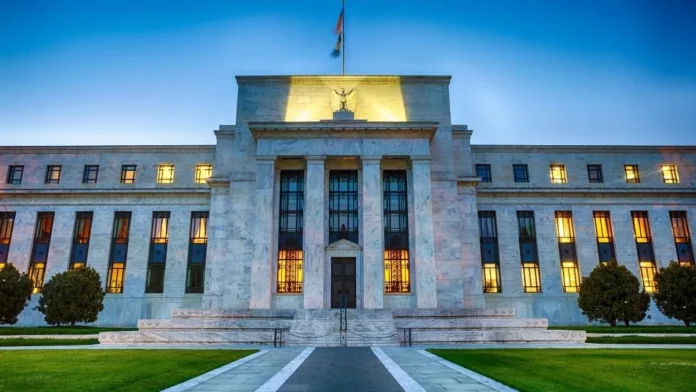

Alan Greenspan, who chaired the Federal Reserve for nearly 19 years under four US presidents and became, for a time, the most celebrated central banker in the world, died on June 22 at his Washington home from complications of Parkinson’s disease. He was 100.
Alan Greenspan, who steered the Federal Reserve for nearly two decades, through some of the longest economic booms in U.S. history, has died. Greenspan died Monday at his home in Washington. He was 100. Greenspan was the rare celebrity among central bankers, lionized for his economic stewardship in the 1990s. At a time when it seemed every barbershop had a television tuned to the stock market channel, ordinary Americans hung on the Fed chairman’s every word. His reputation was tarnished, however, by the global financial crisis that struck a decade later.
Greenspan died at his home due to complications of Parkinson’s Disease, Mitchell said in a statement reported by NBC News, where she is the chief Washington and foreign affairs correspondent.
The arc of that single sentence — from the rare celebrity status of an institution typically defined by deliberate obscurity, to the reputational reckoning that followed two years after his departure — is the central, unresolved tension of Greenspan’s entire public life. Few American economic policymakers have been so thoroughly celebrated in their moment and so thoroughly re-examined afterward.
Alan Greenspan was a towering figure who led the US @federalreserve for almost two decades.
I mourn his passing and express my condolences to all who knew him. https://t.co/3l0KeVnUl9 pic.twitter.com/xfygCefqmt
— Christine Lagarde (@Lagarde) June 22, 2026
From Juilliard to the Fed
Greenspan was born in New York City on March 6, 1926, to Herbert Greenspan, a stockbroker, and Rose Greenspan, a homemaker, according to the New York Times. His parents divorced when he was five, partly due to financial stress stemming from the aftermath of the 1929 stock market crash, the Times noted.
As a child, Greenspan exhibited mathematical talent, with the Times noting he could add three-digit sums in his head at age five. As a teenager, he pursued musical interests, studying the clarinet at Juilliard before studying economics at New York University, where he eventually earned a bachelor’s, master’s and doctoral degree.
Greenspan played the clarinet and saxophone and briefly attended the Juilliard School. He played in Woody Herman’s jazz band (as did another future White House official, Leonard Garment), before he enrolled in New York University, earning bachelor’s and master’s degrees in economics by 1950. He eventually received his Ph.D. in 1977 — at age 51.
The 27-year gap between his master’s degree and his doctorate — completed only after he had already served as chairman of the White House Council of Economic Advisers under President Ford — is one of the more unusual academic trajectories among major American economic policymakers, reflecting a career built substantially through private consulting and political advisory work rather than a conventional academic path.
The Rand Connection
While studying economics, Greenspan became a devotee of novelist Ayn Rand, with an NYU alumni magazine reporting that he met regularly with her “objectivist salon” in her Manhattan apartment.
Greenspan had been a member of Rand’s inner circle, contributing chapters to her book, Capitalism: The Unknown Ideal. When Greenspan joined the Ford administration as an economic adviser, Rand attended his swearing-in ceremony. “Greenspan said that Ayn Rand put the moral foundation under capitalism for him,” said Rand’s biographer, Anne Heller.
Greenspan believed bankers didn’t need heavy-handed regulation because their own self-interest would prevent them from taking undue risks.
This is the philosophical thread that connects Greenspan’s earliest intellectual formation to the policy choices, decades later, that would come to define his most contested legacy. The “objectivist” conviction that rational self-interest would naturally discipline financial markets without heavy government intervention was not a passing youthful enthusiasm — it remained, by his own and his biographers’ accounts, the load-bearing philosophical foundation of his entire approach to monetary policy and banking regulation.
The Maestro Years
In August 1987, President Ronald Reagan appointed Greenspan to succeed Paul Volcker as Chair of the Federal Reserve Board of Governors. Just two months into his tenure, Greenspan faced his first trial by fire: the “Black Monday” stock market crash of October 19, 1987. Greenspan acted swiftly, flooding the banking system with liquidity and preventing a broader economic collapse. This quick-footed response set the tone for the next 18 and a half years, establishing him as a masterful crisis manager.
Much of his tenure was marked by falling unemployment. Traditionally, central bankers respond to low unemployment by raising interest rates to ward off inflation. But Greenspan broke with that tradition and kept borrowing costs low. “He was willing to watch and wait as the unemployment rate drifted lower and lower and lower and lower, and we still had no inflation,” recalled Princeton economist Alan Blinder, who served under Greenspan on the Fed’s governing board.
Greenspan was so respected during his many years as head of the world’s most influential central bank that by the time he stepped down in 2006, he had presided over a surge in stock prices and a 10-year economic boom that began in March 1991 after an economic recession. He also led the economy through the 1997–1998 Asian and Russian financial contagion, the collapse of the dot-com stocks bubble in 2000, and the turbulent economic aftermath of the September 11, 2001, attacks.
In 1996, Greenspan delivered the phrase that would outlive virtually every other piece of central bank communication from his entire tenure. In 1996, Greenspan famously coined the phrase “irrational exuberance” to describe bubbles fueled by unbridled investor optimism, alluding to that era’s craze for internet company stocks. The warning that exuberant investors might not be quite rational sent temporary shivers through global stock markets. But Greenspan’s own stock continued to climb.
“Fedspeak” and the Cult of Cryptic Authority
Greenspan was a talented jazz musician who studied clarinet and saxophone at Juilliard. But it was economics that made him a rock star and a symbol of the widely-shared prosperity at the end of the 20th century.
Known for his “Fed speak”—arcane, ambiguous public statements delivered to avoid roiling the markets prematurely—Greenspan understood the weight of his words better than anyone.
As Fed chair, Greenspan also became known for offering often cryptic economic commentary that lawmakers, economists and investors scrambled to interpret. At the same time, he championed what he described as a shift away from less informative Fed statements before the 1980s, pushing for greater transparency by central bankers. “You don’t want to surprise the markets unless there is a purpose to it,” Greenspan said in a Federal Reserve oral history in 2009. “Too often in the past we would surprise markets with no particular purpose, which was not good.”
The Greenspan marriage was, in its own way, a small piece of Washington folklore. He was married to NBC news anchor Andrea Mitchell, who announced his death in a statement, and the two made a somewhat unlikely power couple. Comedian Jay Leno once joked during a White House Correspondents Association dinner that Mitchell, not then-first lady Hillary Clinton, was married to “the most powerful man in the world.”
The Reckoning
Greenspan, however, suffered a reputational blow not long after his term ended in 2006, when the US housing market collapsed, triggering the worst economic recession since the 1930s. Critics pointed to his policies that fuelled a series of asset price bubbles and laid the groundwork for the 2007–2009 financial crisis.
Many have argued that the “easy-money” policies of the Fed during Greenspan’s tenure, including the practice known as the “Greenspan put,” were a leading cause of the dot-com bubble and subprime mortgage crisis (the latter occurring within a year of his leaving the Fed), which, said The Wall Street Journal, “tarnished his reputation.”
Greenspan himself later acknowledged that “I made a mistake” in assuming the nation’s banks, whose stability undergirds the financial system and the entire economy, could essentially regulate themselves.
“I think the deification that came just before the financial crisis was never really deserved, and I think the lambasting that he took after he left was never fully deserved either,” Stephen Oliner, a former senior Fed official, told the Reuters news agency.
Oliner’s careful framing — that neither the pre-crisis deification nor the post-crisis condemnation was fully warranted — captures the genuine ambiguity that economic historians have continued to wrestle with in the years since: how much of the 2008 crisis traces directly to Greenspan’s specific policy choices versus the broader, global structural forces — the savings-rate imbalances between developing and developed economies that Greenspan himself pointed to — that no single central banker, however influential, could have fully controlled.
The Final Years
During Trump’s second term, in January 2026, Greenspan signed a joint statement with a handful of other former Fed and Treasury officials to denounce a criminal probe of Fed Chair Jerome Powell. “The reported criminal inquiry into Federal Reserve Chair Jay Powell is an unprecedented attempt to use prosecutorial attacks to undermine that independence,” read the statement, backed by Greenspan and more than a dozen other signatories.
That January 2026 statement — issued less than six months before his death, defending the institutional independence of the Federal Reserve against what he and his fellow signatories characterised as political pressure — places Greenspan’s final significant public act in direct continuity with the institution-building work that had occupied nearly two decades of his career, regardless of the controversies that surrounded specific policy choices made within it.
How He Will Be Remembered
“His extraordinary 18 years as chairman left behind an enduring legacy, and his dedication to the institution, the field of economics and public service continues to inspire generations of central bankers,” John Williams, president and CEO of the Federal Reserve Bank of New York, said.
Following his death, the Federal Reserve remembered Greenspan: “Under his leadership, the Federal Reserve achieved a sustained era of price stability that supported economic growth and helped anchor the public’s confidence in the institution”.
In their obituary of Greenspan, The New York Times called Greenspan as the “pre-eminent economic policymaker of his time” and a “skilled political operator.”
“He had ‘irrational exuberance’ for baseball, the Washington Commanders, tennis, golf, and music, especially jazz. He will be remembered for his brilliance and his kindness. Being his life partner was the joy of my life,” Mitchell said.
Greenspan’s death arrives at a moment when central bank independence and monetary policy decisions are, once again, deeply contested in American political life — the very issue his January 2026 statement defending Powell had addressed. The economist who spent nearly two decades shaping the institution’s modern role, and whose own legacy remains a genuine and unresolved subject of historical debate, leaves behind an institution still actively negotiating the same fundamental questions about independence, transparency, and accountability that defined much of his own tenure.
LoudFact.com is an independent global news and explainer platform. This report is based on reporting from NPR, CBS News, NBC News, CNBC, Al Jazeera, STL.News, and Wikipedia’s documentation of Alan Greenspan’s life and career as of June 22-23, 2026.