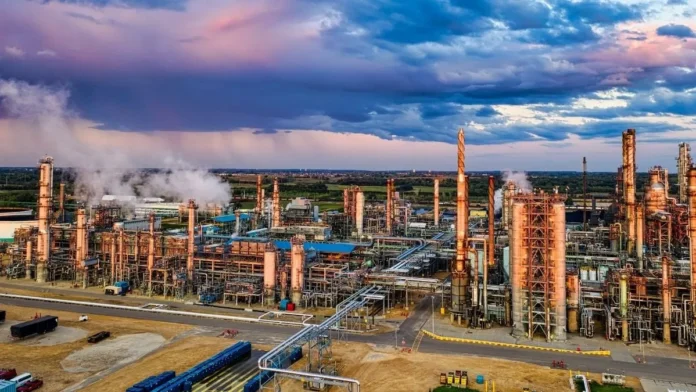

An explosion tore through Qatar’s Ras Laffan gas processing complex on June 21, killing 13 workers and injuring 66 — just two days after the facility resumed operations following months of repairs from an Iranian missile strike during the war. Qatar’s energy minister insists the blast was accidental, not sabotage, even as the timing underscores the lingering fragility of Gulf energy infrastructure in the war’s aftermath.
A huge blast at a Qatar gas hub killed 13 people and injured 66 others, the Gulf state’s energy minister said on Monday, one of the deadliest accidents at a Gulf energy facility.
He announced “the tragic loss of 13 lives of our people who hold Indian and Pakistani nationalities. 66 people have been reported injured and are receiving medical treatment, none of whom are in life-threatening condition.”
The human cost of this accident, beyond its scale, carries a specific dimension that recurs across so much of the Gulf’s energy infrastructure: The minister gave the toll and said the dead came from India and Pakistan. The nationalities of the 66 injured included people from Qatar and a variety of African and Asian nations, al-Kaabi said. The migrant labour force that builds, maintains, and operates the energy infrastructure underpinning much of the global economy bears, once again, the immediate physical risk of an industrial accident at one of the world’s most strategically significant facilities.
🇶🇦 Qatar’s deadliest industrial accident in years
A blast at Qatar’s Barzan gas facility killed 13 workers and injured 66.
Officials say it was a technical accident during a restart procedure, not sabotage or an attack.
The big question was whether it would hit global gas… pic.twitter.com/57XmZgW0sL
— Mario Nawfal (@MarioNawfal) June 23, 2026
What Happened — and the Timing That Will Invite Scrutiny
Qatar’s Energy Minister, Saad al-Kaabi, said on Monday that the blast at the Ras Laffan LNG complex was due to a “technical malfunction”, and ruled out any “hostile” action.
The explosion came as workers were restarting operations at the giant gas complex, which an Iranian attack in March put on hold. “This was an accident and not sabotage or hostile in nature … Plant production was intentionally completely stopped since December 2025 due to urgent maintenance requirements, it was first restarted again only two days ago,” al-Kaabi said.
An “operational incident” during the start-up of operations at Ras Laffan Industrial City led to an explosion and fire at the Barzan local gas supply centre on Sunday evening, operator QatarEnergy said.
The specific sequencing here — a facility damaged by direct Iranian military action in March, undergoing months of repair, restarted for the first time only two days before this explosion — is the central, unavoidable context that any assessment of this incident must reckon with, regardless of the minister’s explicit and repeated insistence that the cause was technical rather than hostile.
Why Qatar Is So Eager to Draw a Line
Kaabi said the status of the Strait of Hormuz and attacks on Gulf nations remained a “geopolitical, military issue” drawing a line between Sunday’s explosion which he said was “different.” “We have to take it in stride and move on and learn from it,” the minister added.
This is a deliberate and politically significant act of categorisation. Al-Kaabi is, in effect, asking the world — and Qatar’s own international gas customers — to treat this explosion as an isolated industrial safety incident, entirely distinct from the broader pattern of Iranian strikes on Gulf energy infrastructure that defined much of the recent war. Whether that distinction holds up under independent investigation will matter enormously for how this event is ultimately remembered: as a tragic but ordinary industrial accident, or as further evidence of the long-tail risks created by restarting damaged critical infrastructure too quickly under economic and political pressure to demonstrate post-war recovery.
The Scale of What Iran’s March Strike Already Did
QatarEnergy said strikes carried out by Iran damaged Trains 4 and 6, removing 12.8 million tonnes a year, equal to about 17 per cent of Qatar’s LNG exports from the market, and one of the two trains at the Pearl gas-to-liquids (GTL) complex. The company at the time said that the affected LNG trains would take three to five years to fully repair and that the Pearl GTL outage would last at least a year. QatarEnergy declared long-term force majeure on contracts with buyers in China, South Korea, Italy and Belgium. Mr Al Kaabi put annual lost revenue at $20 billion and estimated repairs would take three to five years.
A $20 billion annual revenue loss and a three-to-five-year repair timeline represent an extraordinary economic burden imposed on a single country’s energy sector by one military strike. Qatar’s eagerness to restart operations as quickly as conditions allowed — evident in the decision to bring the Barzan facility back online just two days before Sunday’s explosion — is entirely understandable given that financial context, even if it raises uncomfortable questions about whether restart timelines were appropriately calibrated against safety margins following months of damage and repair work.
Why This Matters Beyond Qatar
The blast in the Ras Laffan industrial area could cause further chaos in global energy markets, particularly as Qatar is one of the world’s top natural gas producers.
Qatar shut down its production after Iran’s grip on the Strait of Hormuz meant it couldn’t get shipments out to clients. With Iran loosening its grip as negotiations continue over a permanent end to the war, Qatar began work to try to restart its export terminal.
“Using satellite imagery, we have observed heat signals across multiple LNG trains at the North facility at Qatar’s Ras Laffan complex in recent months,” said Tom Marzec-Manser, director of Europe gas and LNG at Wood Mackenzie. “Since the middle of May, we have also witnessed heat at the South facility, which is where the two trains were damaged.” While a heat signature alone “does not imply outright LNG production”, it does show that QatarEnergy is preparing to restart as quickly as possible, he said. However, shipping will remain the bottleneck, Mr Marzec-Manser said. “Normal transit of the Strait of Hormuz has yet to be resumed and there are only so many vessels that can be loaded at once.”
Marzec-Manser’s independent satellite-tracking assessment provides important confirmation that Qatar’s restart efforts were genuinely underway and visible from space in the weeks before Sunday’s explosion — supporting the broader picture of a country racing, under real commercial and energy-security pressure, to bring back online a facility whose damaged infrastructure had cost it billions in lost revenue and forced it into long-term force majeure declarations with major Asian and European customers.
What Happens Next
QatarEnergy said the explosion had no impact on its LNG export operations or port infrastructure, seeking to reassure global markets over the continuity of gas supplies. The company said a technical investigation was continuing to establish the circumstances of the explosion.
Commissioned in 2022, the Barzan complex supplies pipeline gas domestically.
The distinction between the Barzan facility — which primarily serves Qatar’s domestic electricity and desalination needs rather than international LNG exports — and the export-focused LNG trains damaged in March’s Iranian strikes is operationally significant. It supports al-Kaabi’s contention that Sunday’s explosion will not directly disrupt Qatar’s international gas supply commitments, even as it adds another layer of risk and loss to a Gulf energy sector still working through the cumulative physical and financial damage of the recent war’s direct strikes on its critical infrastructure.
LoudFact.com is an independent global news and explainer platform. This report is based on reporting from Arab News, Al Jazeera, Türkiye Today, NBC News, Gulf News, and The National as of June 22, 2026.