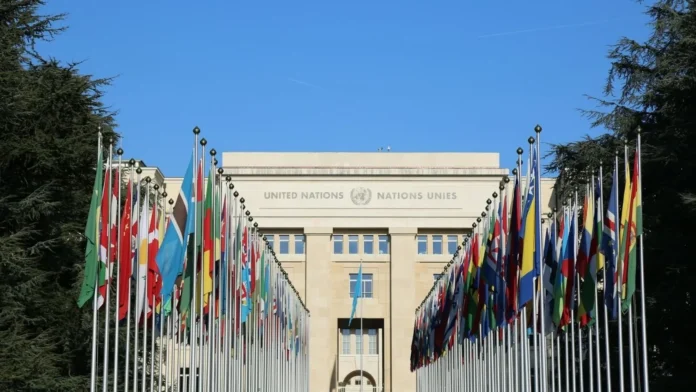

UN Human Rights Commissioner Volker Türk told the Human Rights Council in Geneva on June 15 — the same day the Iran war peace deal was announced — that drone strikes have killed more than 1,000 civilians in Sudan in the first five months of 2026, accounting for approximately 80% of all civilian deaths, in what the UN is describing as a sharp and dangerous escalation in the war’s fourth year.
Drone strikes killed more than 1,000 civilians in war-torn Sudan in the first five months of 2026, a senior United Nations official said Monday as the unmanned aerial vehicles turn the conflict deadlier for civilians. UN High Commissioner for Human Rights Volker Türk said his office has documented a “sharp increase” in drone attacks as well as rape and sexual violence in the Sudan war, now in its fourth year.
The timing of Türk’s statement deserves to be noted explicitly. He delivered it on June 15 — the day the Iran peace deal was announced, the day Trump flew to Evian for the G7, the day that dominated every front page and every broadcast. Sudan received a fraction of the coverage that the Iran deal received. One thousand civilians killed by drones in five months received less attention than a single Truth Social post.
More than 1,000 civilians were killed in drone strikes across Sudan between January and May 2026, according to the United Nations High Commissioner for Human Rights Volker Türk, who warned that the country’s nearly four-year war is becoming increasingly deadly for civilians.
The Scale of the Drone Campaign
UN High Commissioner for Human Rights Volker Türk said his office has documented a “sharp increase” in drone attacks as well as rape and sexual violence in the Sudan war, now in its fourth year. He said his office registered the killing of over 1,000 civilians by drone strikes between January and May this year. “In Sudan, the horrific conflict has expanded and escalated, marked by a sharp increase in the use of drone warfare,” Türk told the Human Rights Council in Geneva.
One thousand civilians in five months is approximately 200 per month — 7 per day — killed by aerial drone strikes in a country that has been in civil war since April 2023. The precision of the monthly rate understates the randomness of the deaths: a family at a market, a patient at a hospital, mourners at a cemetery.
The latest drone strike by the paramilitary group last week killed at least 15 people after hitting a cemetery and a gas station in the central city of el-Obeid, health officials said at the time.
ACLED recorded at least 2,670 drone-related deaths in 2025, including civilians and combatants, a 600% increase from the previous year. Drone attacks rose by 81% in 2025 compared to 2024, according to ACLED data.
The trajectory is not ambiguous. Drone use in Sudan’s war rose 81% in 2025 compared to 2024. Drone-related deaths rose 600% in the same period. The pattern in 2026 — 1,000 civilian deaths in five months — suggests the acceleration is continuing.
What Is Being Struck
Hospitals, schools, markets, dams, displacement camps, and other civilian sites have been hit by drone strikes.
The death toll is due to a “sharp” increase in the use of drone warfare in the country’s vicious civil war, UN High Commissioner for Human Rights Volker Türk said in a speech on Monday.
The targeting of hospitals, schools, markets, dams, and displacement camps represents a systematic attack on civilian infrastructure that goes beyond collateral damage in any reasonable characterisation. Displacement camps — where millions of people who have already been forced from their homes are concentrated — are civilian populations in the most concentrated and vulnerable form. Striking them is not incidental. It is the logic of a conflict that is using population displacement as both a tactic and an objective.
The attacks on civilians cannot be considered accidental, because they are part of a wider strategy, whereby civilian structures are considered legitimate targets of attack.
The conflict has created the world’s largest humanitarian crisis, with about 34 million people — almost two out of every three Sudanese — needing assistance, according to the U.N. The fighting has wrecked urban areas and has been marked by atrocities, including mass rape and ethnically motivated killings, that amount to war crimes and crimes against humanity, according to the U.N. and international rights groups. “Rape and sexual violence are rampant,” Türk said.
The Geographic Expansion
More than 1,000 civilians were killed by drone strikes between January and May, representing about 80 per cent of civilian deaths. Strikes have repeatedly hit markets, health facilities, and infrastructure, with attacks expanding beyond Darfur and Kordofan to Blue Nile, White Nile and Khartoum.
The geographic expansion is significant. Sudan’s drone campaign began concentrated in the regions of Darfur and Kordofan — the areas that have historically been most affected by the RSF’s operations. The expansion to Blue Nile, White Nile, and Khartoum means the war is no longer a regional conflict. It is reaching Sudan’s capital and its most populated river valley regions.
A drone campaign that reaches Khartoum — a city of five million people, the capital of a country of 45 million — is not a peripheral conflict. It is a war being conducted in the heart of one of Africa’s largest countries.
Both Sides Are Responsible
A UN fact-finding mission reports arbitrary detention, torture and enforced disappearances by both sides, urging an immediate end to violations of international law.
The drone campaign is not exclusively an RSF operation. The Sudanese Armed Forces — the government’s military — have also been conducting drone strikes, including in areas where the RSF is entrenched. Both sides in Sudan’s civil war have adopted the tactical logic of drone warfare: strikes on targets that ground forces cannot reach, at costs lower than manned aircraft, with reduced risk to the attacking force.
The bilateral use of drones against civilian infrastructure means that the conflict’s accountability question is genuinely complex: both sides bear responsibility for the civilian toll, even if the RSF’s strikes have been more consistently directed at non-military targets.
The International Community’s Non-Response
Sudan’s conflict has been condemned repeatedly by the UN Security Council, the African Union, and Western governments. None of those condemnations have produced action that has materially changed the conflict’s trajectory.
The UAE’s documented role in supporting the RSF — through weapons, ammunition, and financial support channelled via third countries — continues to complicate the international response. Countries that might otherwise press harder on Sudan are managing relationships with the UAE that they value for other reasons, including energy, investment, and regional security cooperation.
The Iran war — which consumed global diplomatic attention and media bandwidth from February through June 15 — provided another period of coverage competition in which Sudan’s escalating drone campaign was underreported relative to its severity.
That competition for global attention is not new for Sudan. It has been the defining feature of the conflict’s coverage since it began in April 2023: a catastrophe of enormous scale that consistently fails to generate the sustained international attention that its scale demands.
What Needs to Change
The specific policy changes that would reduce civilian drone deaths in Sudan are identifiable, if not politically easy:
An arms embargo, consistently enforced, that prevents both the SAF and RSF from receiving the drone components and systems they are using. The UAE’s arms supply to the RSF — documented by UN experts — is the most specific and actionable target.
A UN Security Council resolution that explicitly prohibits drone strikes against civilian targets and establishes a monitoring mechanism. Such a resolution requires unanimous consent — or at least no veto — from all five permanent members.
Sustained international media coverage that creates the political pressure for action. Without coverage, the politics do not move.
One thousand civilians dead. Twenty-six hundred killed in 2025. The drone use is accelerating. The coverage is not.
LoudFact.com is an independent global news and explainer platform. This report is based on reporting from PBS NewsHour, Al Jazeera, The National, the Washington Post, the Washington Times, the Bastille Post, and OkayAfrica as of June 15, 2026.