President Donald Trump declared the interim ceasefire between the United States and Iran “over” on Wednesday at the NATO summit in Ankara, Turkey — triggering the sharpest single-day movement in oil markets since April’s peak, a broad global equity selloff and the resumption of US military strikes against Iranian targets. The announcement, made on the sidelines of the two-day NATO summit, came hours after Iran attacked three ships in the Strait of Hormuz — including one belonging to an ally — and US Central Command confirmed it had struck more than 80 Iranian military targets overnight. The 60-day ceasefire framework signed at Versailles on June 17 had lasted 22 days.
What Trump Said and When He Said It
Oil prices surged nearly 6% after US President Donald Trump said Wednesday that the interim agreement with Iran is “over,” though he will allow talks to continue. Trump made the comments following US strikes on Iran in reaction to attacks on three ships in the Strait of Hormuz.
“For me, I think it’s over,” Trump responded when asked about the status of the ceasefire. “I don’t want to deal with them,” he said on the sidelines of the NATO summit in Ankara, Turkey. He added that US representatives could continue to negotiate, but cast profound doubt on the outcome. “They can talk, but I think they’re wasting their time,” he said. Trump later told reporters that the United States was preparing for another night of strikes against Iran.
The declaration followed US Central Command’s announcement that its forces had struck more than 80 targets in Iran overnight, including command-and-control networks, coastal radar installations, anti-ship missile capabilities and vessels operated by the Islamic Revolutionary Guard Corps. Washington also revoked a waiver that had allowed Iran to restart oil exports — a move that tightens the economic pressure on Tehran and signals a return to the pre-ceasefire economic posture.
The Immediate Market Response
The price of Brent crude oil jumped 5.6% to more than $78 a barrel. US benchmark crude surged 5.8% to $74.55 a barrel. The spike brought Brent briefly above $79 during early morning trading. Crude prices had declined recently from spikes well above $100 a barrel — reaching nearly $120 at the peak of the conflict — to around the levels they were at before the war began in late February. The sharp reversal on Wednesday underscored how sensitive oil markets remain to any perceived change in the trajectory of the conflict.
Stock markets fell globally in response. The S&P 500 fell 0.6% and the Dow Jones Industrial Average dropped 535 points, or 1%, in early trading. The Nasdaq composite was 0.4% lower. In Europe, Germany’s DAX shed 1.1%, France’s CAC 40 fell 0.9% and Britain’s FTSE 100 lost 0.8%. In Asia, Japan’s Nikkei 225 lost 2.1% and South Korea’s Kospi fell 5.4%. On Wall Street, companies with large fuel bills bore the heaviest losses — United Airlines lost 3.4% and Norwegian Cruise Line fell 2.1%. In bond markets, the yield on the 10-year Treasury rose to 4.57% from 4.55% late Tuesday, and from just 3.97% before the war with Iran began.
Gold dropped around 1.5% to approximately $4,050 — an unusual move in the middle of a geopolitical escalation, which analysts attributed to dollar strengthening and profit-taking after a sustained gold rally earlier in the conflict.
The Chain of Events That Produced Wednesday’s Declaration
Trump’s statement did not emerge from a vacuum. The sequence of events in the 22 days since the Versailles ceasefire signing was a steady accumulation of provocations that made the framework increasingly untenable.
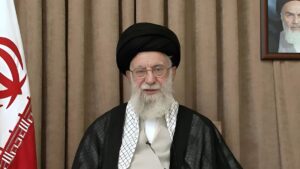
Iran attacked a Singapore-flagged cargo vessel in the Strait of Hormuz within days of signing the ceasefire. Iran launched missiles and drones at Bahrain and Kuwait. The IRGC warned ships to use only Iranian-designated routes through the strait. The IMO’s maritime evacuation plan was paused. The Switzerland technical talks stalled, then were paused for Khamenei’s six-day funeral.
The US and Iran continued exchanging military strikes throughout, with each side claiming the other had violated the ceasefire first. And on Tuesday night, as Trump was at the NATO summit in Ankara, Iranian forces attacked three more ships in the Hormuz — the final trigger for Wednesday’s declaration.
Robin Brooks, senior fellow at the Brookings Institution, told Marketplace: “This conflict is basically about cash and about control of the Strait of Hormuz.” The ceasefire had never resolved either of those questions. It had deferred them for 60 days. Those 60 days produced 22 days of military exchanges before the framework collapsed entirely.
The Oil Market’s Structural Response
The market response to Wednesday’s declaration reflects a structural shift in how traders assess the Hormuz risk premium. Before the war began in February, Brent crude traded near $57 per barrel. At the peak of the conflict, it reached nearly $120. The ceasefire had allowed it to fall back to the mid-$70s — roughly its pre-war level. Wednesday’s jump back toward $79 is not a return to the April peak, but it signals that the market is repricing the probability of a sustained Hormuz disruption upward once more.
“As such, geopolitical headlines will likely determine market sentiment over the coming hours. A further deterioration in the situation could weigh further on equity valuations along with rising stress in technology,” Ipek Ozkardeskaya of Swissquote said in a research note.
The revocation of the waiver allowing Iranian oil exports — which had begun to flow modestly following the ceasefire — will tighten global oil supply by removing the partial offset that Iranian barrels had provided. Whether that translates into a return to triple-digit oil prices depends primarily on whether the Strait of Hormuz is once again effectively closed or whether partial transit continues through the Omani southern corridor.
What Comes Next
Trump’s statement that he would allow negotiations to continue — even while declaring the ceasefire over — leaves a narrow diplomatic door open. Whether Iran chooses to walk through it depends on the calculations of a government that is simultaneously burying its supreme leader, navigating internal leadership uncertainty and weighing the costs of renewed full-scale military conflict against the prospect of a diplomatic settlement.
For global markets, the immediate question is whether Wednesday’s oil spike is a single-day event or the beginning of a sustained repricing. The answer depends on whether US strikes on Iran escalate in scale, whether the Strait of Hormuz returns to its conflict-era status of effectively closed, and whether any third-party mediator — Qatar, Pakistan, Oman — can reopen a diplomatic channel before the military exchange spirals beyond the point of easy reversal.