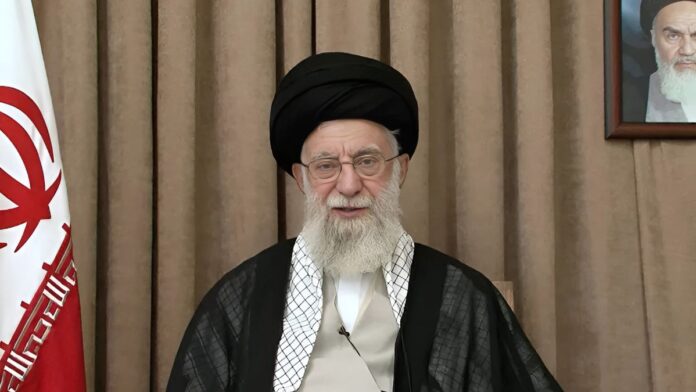

Ayatollah Ali Khamenei — Supreme Leader of the Islamic Republic of Iran for 36 years, killed in a joint US-Israeli airstrike on February 28, 2026 — was buried at the shrine of Imam Reza in Mashhad on Wednesday, July 9, following the most elaborate and logistically complex state funeral in Iranian history. The six-day ceremony drew millions of mourners across Iran and Iraq and was watched closely by foreign intelligence services worldwide.
What those services were watching for most intently — the public appearance of Iran’s new Supreme Leader, Mojtaba Khamenei — never came. The man who has been Iran’s highest constitutional authority since February 28 did not appear in public at any point during the entire six-day ceremony. He has now been unseen and unheard for 131 consecutive days.
The Burial in Mashhad
The body of Ali Khamenei arrived in Mashhad on July 9 following processions through Tehran, Qom, and the Iraqi holy cities of Najaf and Karbala. The burial ceremony was held at the shrine of Imam Reza — the eighth Imam in Shia Islam and the only Shia imam buried in Iran — a site of the deepest religious significance in Shia Islam and of profound personal significance for Khamenei, who was born in Mashhad in 1939 and spent his early years in the city.
The burial location was chosen to reinforce the dual dimension of Khamenei’s identity: as a political leader of the Islamic Republic and as a religious authority claiming a connection to the Shia imamate tradition. Burial near the shrine of Imam Reza — who is attributed with miraculous healing powers in Shia tradition — is considered one of the greatest honours within the tradition. More than 20 million people visit the shrine annually. Khamenei’s grave will become a permanent site of religious and political pilgrimage.
The Absence That Defined the Week
Throughout the six-day ceremony — Tehran, Qom, Najaf, Karbala, Mashhad — Iran’s new Supreme Leader Mojtaba Khamenei was absent from every public event. Three of his brothers — Mostafa, Meysam and Masoud Khamenei — appeared at the funeral ceremonies in Tehran, praying behind their father’s coffin at the Grand Mosalla. Their public presence made Mojtaba’s absence more conspicuous, not less.
Iranian officials have consistently attributed Mojtaba’s absence to the injuries he sustained on February 28 — the day his father was killed and he was reportedly wounded in the same strike, which also killed his wife. He has not been seen or directly heard from in public since the conflict began. Iranian state media has not published any interview, statement with audio or video, or public appearance. He has communicated only through written statements, never showing his face or using his voice.
The absence of the supreme leader from the most significant ceremonial occasion in the Islamic Republic’s 47-year history is without precedent. In Shia tradition, leading prayers for a deceased parent is among the most significant religious duties a son can perform. That Mojtaba did not lead — or attend — his own father’s funeral prayers suggests that his injuries are more severe, or his security situation more precarious, or his political position more uncertain, than Iranian officials have publicly acknowledged.
What Iranian Officials Have Said — and What Intelligence Analysts Believe
Iranian officials have worked to project an image of full recovery, claiming Mojtaba is directing Tehran’s negotiations with Washington. Supreme leader’s office officials told Iranian state media that he has been actively involved in strategic decisions throughout the war and ceasefire period. His written statements — released through official channels — have been consistent with the regime’s political positions.
But the gap between the claimed level of engagement and the complete absence from public view has generated sustained analytical uncertainty in Western and regional intelligence communities. The key question is not merely whether Mojtaba is alive — written statements and the functioning of the regime suggest he is — but whether he is physically and politically capable of exercising the constitutional authority of the supreme leader’s office in a crisis.
That question has become acutely urgent on July 9. Trump declared the ceasefire “over” on July 8. US Central Command struck 80+ Iranian military targets overnight. The Strait of Hormuz is once again contested. Iran is in the most significant security crisis in its modern history. And the man constitutionally responsible for making Iran’s most consequential military and diplomatic decisions has not been seen in 131 days.
The Three Who Appeared — and What Their Presence Signals
The appearance of Mojtaba’s three brothers at the funeral ceremonies provided one of the week’s most significant political signals. Their presence — Ali Khamenei’s surviving sons — demonstrated regime continuity and family solidarity at a moment when both were being watched closely. But it also highlighted that the Iranian government chose to present the Khamenei family’s face through Mostafa, Meysam and Masoud rather than through Mojtaba.
Also notable was the attendance of IRGC commander-in-chief Ahmad Vahidi, who only reemerged publicly for the first time in months when paying his respects at Khamenei’s coffin on July 3. His appearance — and the visible normalisation of senior IRGC commanders at the public ceremony — provided some reassurance that Iran’s military command structure has retained coherence even amid the leadership vacuum at the very top.
What Comes Next
With Trump’s ceasefire declaration on July 8, the diplomatic framework that gave Iran’s government cover to argue for continued negotiations while staging the funeral has collapsed. The question now facing whoever is effectively governing Iran — whether Mojtaba from a private location, a collective leadership within the IRGC and presidency, or some combination — is whether to de-escalate through a new diplomatic channel or escalate militarily in response to the resumed US strikes.
That decision, in the Islamic Republic’s constitutional structure, requires the supreme leader’s authority. Whether Mojtaba Khamenei can exercise that authority — publicly, credibly and with the institutional backing of the IRGC, the Guardian Council and the presidency — is the defining question of the next days and weeks. The world waited through a week of extraordinary ceremonies for an answer. It did not come. The answer may determine the course of the Middle East conflict for the rest of 2026.