
The Iran war entered its 65th day with a new escalation that is simultaneously a humanitarian mission, a military operation, and a diplomatic flashpoint. President Trump announced Sunday night that the US Navy would launch “Project Freedom” — an operation to guide the 2,000 vessels and 20,000 seafarers stranded in the Strait of Hormuz to safety, beginning Monday morning.
The Announcement
Trump said the US would “help free up” vessels stranded in the Gulf from Monday. The operation was dubbed “Project Freedom.” Trump gave few details about what could be a sweeping attempt to help hundreds of vessels and some 20,000 seafarers.
Trump said on Sunday that the US would “help free up” vessels stranded in the Gulf from Monday, but offered few details on how the operation, dubbed “Project Freedom,” would work.
The operational details are deliberately vague — which is itself a diplomatic calculation. Announcing the operation without specifying what it involves gives the US Navy flexibility to conduct it in whatever form CENTCOM determines is safest, while preventing Iran from specifically identifying which actions it would respond to as violations.
Iran’s Response
Iran quickly denounced the move as a ceasefire violation. Ebrahim Azizi, head of the national security commission of Iran’s parliament, said on X that any “American interference” in the strait would be seen as a ceasefire violation.
Tehran “will not back down from our position on the Strait of Hormuz, and it will not return to its prewar conditions,” Iran’s deputy parliament speaker, Ali Nikzad, said earlier Sunday.
Iran’s dual response — calling the operation a ceasefire violation while also declaring Hormuz will never return to its prewar conditions — is the clearest statement yet from Tehran that no diplomatic deal will restore the strait to the status quo ante. Iran’s position has hardened from “Hormuz will open when the blockade lifts” to “Hormuz will not return to prewar conditions regardless.”
Monday Morning Attacks
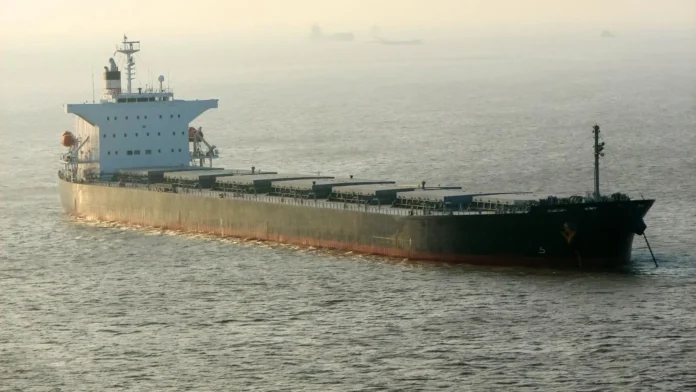
On Monday, the United Kingdom’s military said it had received reports of a tanker being struck by “unknown projectiles” off the coast of the UAE, hours after a bulk carrier reported being attacked by multiple small craft off Iran. Neither of the crews involved in the incidents was harmed, according to UK Maritime Trade Operations.
Two attacks within hours of Project Freedom’s launch — one in UAE waters, one off Iran — are either a demonstration of IRGC intent to enforce its position or an indication that the operational environment in the strait is too dangerous for unescorted vessel movements regardless of US guidance.
Why Markets Don’t Believe It Will Work
Oil prices have failed to ease despite Trump’s announcement. Brent crude, the international benchmark, was essentially flat on Monday morning. “Normalising the flow through the Strait of Hormuz will take more than what Project Freedom is offering, whilst the yawning gap in oil supply will take months to resolve,” analysts said.
“The market is becoming accustomed to some of Trump’s posts about progress on Iran negotiations proving premature later on,” Saul Kavonic, head of energy research at MST Financial, told Al Jazeera.
Goldman Sachs estimates that the closure of the waterway, which normally carries one-fifth of the world’s oil supplies, and attacks on energy infrastructure have reduced global daily production by 14.5 million barrels. Brent is up nearly 50 percent since the start of the war, and has not dropped below $100 a barrel for nearly two weeks.
The market logic is simple: Project Freedom moves stranded ships out of the strait. It does not reopen the strait to new commercial traffic. Even if 2,000 vessels are successfully guided to safety, Hormuz remains closed to the tankers that would need to load fresh oil at Gulf terminals and deliver it to refineries worldwide.
The supply gap — 14.5 million barrels per day — is not filled by evacuating the ships already caught in the closure. It requires new traffic flowing through a fully reopened strait.
Moody’s Analytics warned: “It doesn’t take much from this point for the global economy to sink into recession. We estimate something like $125 for Brent over a sustained period of time will push the global economy into some sort of recession.”
$125 Brent sustained. The peak this conflict has reached is $126. Moody’s recession threshold has already been briefly touched. The distance between the current trajectory and a global recession is measured in weeks, not months — unless Project Freedom or the diplomatic track produces a concrete Hormuz reopening within that window.