
Speaking at the St. Petersburg International Economic Forum on June 4, Vladimir Putin made an extraordinary public admission — that Ukrainian drones are successfully striking targets inside Russia “to our regret” — and pledged to strengthen Russia’s air defence systems in response. The concession, delivered at a showcase event already marked by a Ukrainian drone strike on a city oil terminal, represents the most significant public acknowledgment of Russian air defence vulnerability in the four-year war.
President Vladimir Putin said that Russia will strengthen its air defences to counter recent Ukrainian drone attacks, which have reached deep inside his country. Speaking in response to a question from The Associated Press during a meeting with heads of international news agencies, Putin acknowledged the damage from Ukrainian drone attacks. “To our regret, some of them break through,” Putin said of the drone strikes on his hometown of St. Petersburg. “Russia has an air defence system; we need to improve it, strengthen it, and we will do that.”
The wide-ranging media session came on the sidelines of the St. Petersburg International Economic Forum, his annual showcase for investment. Hours before the forum opened Wednesday, a Ukrainian drone attack set ablaze an oil terminal in the city and also hit a nearby naval base
The setting made the admission more significant than its content alone would suggest. Putin was at his own event — an event explicitly designed to project Russian power and confidence to an international business audience — and he was asked about the drone strike that had produced a column of black smoke visible across St. Petersburg the previous evening. He could have deflected. He chose not to.
“To our regret, some of them break through” is not the language of a leader whose air defences are functioning as advertised.
What the Admission Means for Russia’s Narrative
Throughout the four years of the Ukraine war, Russian state communications have maintained a consistent narrative about Russia’s military capabilities: that they are sophisticated, comprehensive, and sufficient to meet the threats Russia faces. The deployment of the S-400 air defence system, hailed as among the world’s most capable, has been central to that narrative.
The reality on the ground has complicated that picture. Ukrainian drones — evolving from commercial off-the-shelf components toward custom-built long-range systems in the Shahed-style drone class — have progressively demonstrated the ability to penetrate Russian air defences at ranges that Russian planners did not initially expect to need defending against.
Commenting on Russia’s use of its Oreshnik intermediate range ballistic missile, Putin said it was fired at targets that allowed it to test its capability and prepare for future combat use.
Putin’s defence of the Oreshnik missile — framing its deployment against Ukrainian targets as a capability test rather than a straightforward military act — reflects the same communicative approach: reframing a weapon’s use in terms that emphasise Russian capability rather than the specific military or humanitarian dimensions of its deployment.
The Oreshnik is a hypersonic ballistic missile for which Ukraine currently has no effective defence. Putin’s explicit characterisation of its combat use as a “test” is a deliberate message: Russia is expanding the range of capabilities it is willing to deploy, and it wants adversaries to know.
Russia’s Air Defence Gaps: What the Ukraine Campaign Has Revealed
Ukraine’s drone campaign against Russian territory has been running for more than three years — beginning with limited strikes on border regions and progressively extending to targets deeper inside Russia. The geographic progression of Ukrainian strikes maps directly onto the evolution of Ukraine’s drone programme.
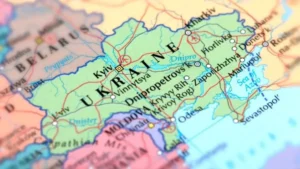
The St. Petersburg strikes represent the most distant successful attacks Ukraine has conducted on Russian urban and industrial infrastructure. St. Petersburg is more than 600 kilometres from Ukraine’s border — a distance that, in the early phases of the war, was considered well beyond Ukraine’s reach. Ukraine has now struck its oil infrastructure, its naval bases, and generated the kind of highly visible damage that Putin was forced to acknowledge at his own press event.
Russia’s air defence limitations in protecting its interior territory from drone strikes reflect several factors: the sheer volume and dispersion of Ukrainian launches, which require widespread coverage; the difficulty of detecting and intercepting small, low-flying drones with systems designed for higher-altitude threats; and the consumption of air defence assets on the front lines, where they are primarily needed, at the expense of depth coverage farther inside Russia.
The US-Iran war has added a further dimension. Russian military observers have been studying how US air defence systems — including Patriot — perform against Iranian drones and ballistic missiles in the Persian Gulf. The Iranian drone campaigns against US positions and Gulf allies, and the US defensive responses, have provided real-time data on the performance envelopes of the same systems Russia’s adversaries use. Putin’s pledge to “improve and strengthen” Russian air defences reflects an awareness that the current system has gaps that Ukraine has learned to exploit.
Putin on Ukraine Peace — and What He Meant
Beyond the air defence admission, Putin’s SPIEF press session addressed the Ukraine peace process with language that was simultaneously open in tone and restrictive in content.
Putin also said that Russia is open for a compromise on Ukraine in line with understandings reached at his summit with US President Donald Trump in Anchorage, Alaska, adding that Ukraine needs to accept them to make a deal to end the conflict, now in its fifth year.
Putin dismissed the idea that European Union countries could act as mediators in Russia-Ukraine peace talks, arguing that they were not neutral parties. “Mediation assumes neutrality. Where is the neutrality here?” he asked. “How can Russia trust people who have been harping about the need to inflict a strategic defeat on Russia for years?”
The rhetorical strategy is precise. Putin frames Russia as open for compromise — ready to deal. He frames the conditions for a deal as existing (the Anchorage framework). He frames the obstacle as Ukraine’s unwillingness to accept those conditions. And he pre-eliminates the most likely Western mediators by arguing they cannot be trusted.
The net effect is to position Russia as reasonable while making the path to talks maximally difficult: Ukraine must accept terms it has consistently rejected, without access to the Western mediators most aligned with its positions, through a framework whose content Russia controls the public narrative about.
What Happens Next
Putin’s air defence pledge — “we will improve and strengthen it” — will translate into procurement, deployment, and technical upgrade programmes that will unfold over months and years. In the immediate term, Russia’s air defence vulnerabilities over its interior territory remain the same as they were on June 3, when the oil terminal burned.
Ukraine’s drone programme, having demonstrated the ability to strike St. Petersburg, will not stop developing. The question for both sides is whether the military reality on the ground — Russian advances in eastern Ukraine, Ukrainian strikes deep in Russian territory — creates the conditions for a diplomatic process, or whether it simply extends a war of mutual attrition that neither side can win quickly.
Putin’s comment that Russia is open for compromise, and Zelensky’s letter proposing direct talks, emerged on the same day. Whether those parallel signals represent a genuine opening or simultaneous positioning by two leaders who are not ready to make the concessions that peace requires remains to be seen in the days ahead.
LoudFact.com is an independent global news and explainer platform. This report is based on AP pool reporting from St. Petersburg, and reporting from NPR, OPB, KUNR, and Boston 25 News as of June 4-5, 2026.