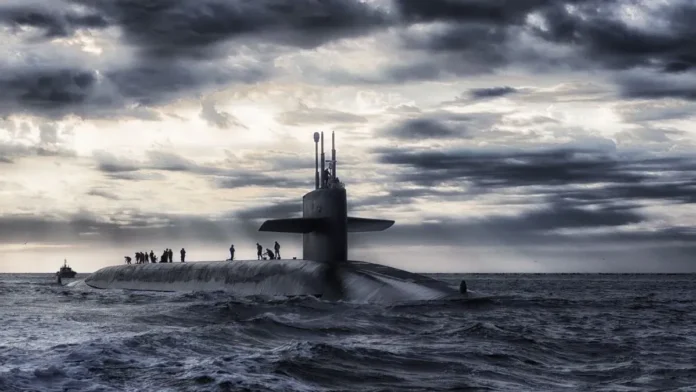

China’s People’s Liberation Army Navy conducted its first publicly acknowledged strategic submarine-launched ballistic missile test into the Pacific Ocean on July 6, 2026 — firing from a nuclear-powered ballistic missile submarine in the Bohai Sea to a designated impact area west of the Solomon Islands.
The dummy-warhead test, which China described as “routine annual training,” was conducted on the same day Australia and Fiji signed a mutual defence pact, the day before the NATO Ankara summit opened, and simultaneously with the opening of the China-Russia Joint Sea-2026 naval exercise. Defence analysts described it as the single most significant demonstration of China’s sea-based nuclear deterrent to date — and as a pointed and precisely timed message to the NATO alliance, the United States and Pacific allies.
What Happened and When
China’s navy launched a submarine-carried ballistic missile from the Bohai Sea deep into the South Pacific on Monday, completing an end-to-end sea-based nuclear strike chain for the first time before a watching world. The PLA Navy confirmed in a brief official statement that one strategic nuclear submarine fired a long-range missile carrying a dummy warhead at 12:01 p.m. Beijing time, with the warhead landing precisely within pre-designated international waters west of the Solomon Islands.
China characterised the launch as “routine annual training” that “complied with international law and practice” and was “not directed against any specific country or target.” China notified relevant countries in advance.
The launch was assessed by external analysts as likely involving the JL-3 submarine-launched ballistic missile — the most advanced SLBM in China’s inventory — though China did not publicly confirm the missile type. The JL-3 has a maximum range estimated at 10,000-12,000 kilometres, sufficient to strike the continental United States from the South China Sea. Each Type 094 submarine can carry up to 12 missiles. China currently operates at least six Type 094-class ballistic missile submarines.
Why It Matters — Completing the Nuclear Triad
For decades, China’s nuclear deterrent rested primarily on land-based intercontinental ballistic missiles. Its sea-based leg — ballistic missile submarines — existed but had never been publicly demonstrated with a long-range Pacific launch. Monday’s test changes that.
The test was not about yield or warhead design, but about the operational chain required for a sea-based second-strike mission. A submerged ballistic missile submarine must receive an authenticated order, maintain secure communications, determine its launch position, align the missile’s navigation system, execute underwater ejection and ignition procedures, and support a flight path long enough to test reentry performance.
China has conducted many ballistic missile tests over land, but an SLBM launch into the Pacific is a more demanding event because it combines submarine crew readiness, strategic command-and-control, and long-range accuracy under conditions closer to real-world employment than any land-based test.
The War Zone described this test as “one of, if not the most significant demonstrations of the sea leg of China’s nuclear deterrent triad to date.”
The Pentagon Has Confirmed China’s Expanding Arsenal
The context for Monday’s test is a rapidly expanding Chinese nuclear arsenal. The Pentagon’s 2025 report to Congress estimated China’s nuclear stockpile at approximately 600 warheads as of 2024, with projections of more than 1,000 by 2030. US Strategic Command Commander General Anthony Cotton confirmed in congressional testimony in March 2026 that China had surpassed that 600-warhead threshold.
This launch fits into a broader transition — described by analysts at the Center for a New American Security and the National Bureau of Asian Research — as China moving from a minimal deterrent toward a more redundant, survivable and credibly deployed nuclear force across all three legs of its triad: land-based ICBMs, strategic bombers, and now a publicly demonstrated sea-based SLBM capability.
Monday’s test follows the DF-31B ICBM test in September 2024, which was the first Chinese Pacific ICBM shot in 44 years, and a rapid silo-based ICBM sequence in December 2024. The three Pacific launches in under two years represent a deliberate, escalating programme of public nuclear demonstrations.
The Deliberate Timing
Conducting an SLBM launch into the Pacific on the first day of a joint exercise with Russia, the day before the NATO Ankara summit opened on July 7, and simultaneously with the Australia-Fiji defence pact signing was not accidental sequencing.
The test coincided with the opening of the China-Russia Joint Sea-2026 naval exercise — a combined drill involving joint reconnaissance, air and missile defence, anti-submarine warfare and live-fire operations. A Russian naval task group arrived in Qingdao to join the exercise, which runs through July 13.
The message — that as NATO allies deliberate over Ukraine and Iran, China and Russia are deepening their military-to-military ties and validating their most consequential military capabilities — was unmistakable. Pacific Forum senior fellow Jeffrey Robertson said the test was “an assertive reminder to the region and the world of China’s military capabilities at a moment when the world’s attention is divided between Europe and the Middle East.”
The Pacific Response
Japan expressed serious concern over China’s growing military activity and urged Beijing to “reconsider its approach to ballistic missile launch exercises that could threaten Japan’s security, including by allowing missiles into Japanese airspace.” Australia called the launch a “destabilizing factor for the region.” New Zealand considered it “an undesirable and alarming development” and noted that the missile impacted within the South Pacific Nuclear Free Zone established by the Treaty of Rarotonga in 1986.
Pacific Islands Forum Secretary-General Henry Puna said flatly: “We don’t want to see any more countries — China, America, anybody — testing their ICBMs in the Pacific Islands region.”
What It Means for Allied Defence Planning
For allied defence planners, the operational takeaway is concrete: China has now validated its nuclear command-and-control chain from authenticated launch order through underwater ejection through intercontinental flight through ocean impact, using a submarine-based platform under realistic deployment conditions.
A state with a more credibly survivable nuclear second-strike does not necessarily become less dangerous — it may become more willing to act aggressively below the nuclear threshold. The validation of China’s sea-based second-strike means that any US consideration of pre-emptive action against Chinese nuclear forces — in a Taiwan scenario, for example — must now account for the survivability of submarine-based missiles that cannot be targeted by land-strike systems. The threshold for such action rises correspondingly, which is precisely what the test is designed to communicate.