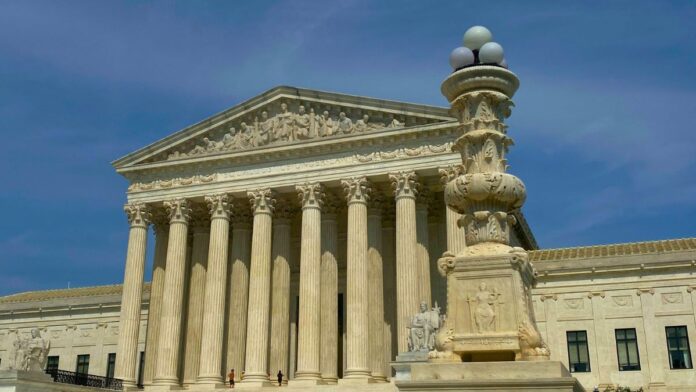

The United States Supreme Court ruled on June 30 that President Donald Trump’s executive order ending birthright citizenship is unconstitutional, delivering one of the most significant defeats of his second term and reaffirming a legal tradition that has defined American identity for more than 150 years. The ruling in Trump v. Barbara was 6-3, with Chief Justice John Roberts writing the majority opinion — joined, notably, by two justices Trump himself appointed.
What the Court Decided
In a sharp rebuke to President Trump, the Supreme Court ruled that the Constitution guarantees automatic birthright citizenship to virtually all children born in the United States. Chief Justice John Roberts wrote the court’s opinion, citing both the colonists’ demands for the “rights of Englishmen” as well as the abolitionists’ lauding of the “ancient and universal” rule of citizenship by birth alone. “Citizenship, then and now, was the right to have rights — to freely participate in our political community.”
The court ruled that the executive order ran foul of the Constitution’s 14th Amendment, which has long been interpreted to bestow birthright citizenship on almost anyone born in the United States. The decision firmly rejected the executive order that Trump issued on the first day of his second term. It sought to bar citizenship for babies born in the US to parents who either entered the country illegally or who are living and working here legally with temporary visas.
The opinion was delivered by Chief Justice Roberts, in which Justices Sotomayor, Kagan, Barrett and Jackson joined. Justice Jackson filed a concurring opinion, joined by Justice Sotomayor as to the introduction and Part I. Justice Kavanaugh filed an opinion concurring in the judgment and dissenting in part. Justices Thomas, Gorsuch and Alito dissented.
What Trump’s Executive Order Claimed
On January 20, 2025, President Trump issued Executive Order No. 14160, titled “Protecting the Meaning and Value of American Citizenship.” The order provided that children born in the United States of parents who are unlawfully or temporarily present are not “subject to the jurisdiction” of the United States — and thus do not qualify for citizenship.
The administration’s legal argument rested on a specific reading of the word “domicile.” The executive branch argued that the Supreme Court’s own landmark 1898 decision in Wong Kim Ark — which established birthright citizenship for children born to Chinese immigrants — relied centrally on the concept of “domicile,” meaning lawful long-term residency. The government argued that people unlawfully or temporarily present in the United States could not be considered domiciled there, and that birthright citizenship therefore should not apply to their children.
Why the Court Rejected That Argument
The executive order never went into effect because every lower court judge who reviewed it concluded, in the words of one, that it was “blatantly unconstitutional.” As Chief Justice Roberts observed, the men who wrote the Fourteenth Amendment to the Constitution after the Civil War defined citizenship in broad terms on purpose, rejecting the views of those who wanted to limit citizenship.
The decision in the Wong Kim Ark case was so widely accepted that even in periods of great hostility to immigrants, the notion of birthright citizenship remained untouchable. So much so that in World War II, when Japanese citizens were held as enemy aliens in detention camps in the United States, their newborn children were automatically granted American citizenship because they were born on US soil.
The ACLU’s Cecillia Wang, herself a birthright citizen born to Chinese parents, argued the birthright case before the Supreme Court. As she put it, the men who wrote the Fourteenth Amendment deliberately chose to confer automatic citizenship on the child, not the parent — the idea being that “in America we do not punish children for the sins of their fathers, but instead we wipe the slate clean.”
The Significance of the Two Trump-Appointed Dissenters Who Joined the Majority
The composition of the majority is as notable as the decision itself. The ACLU Executive Director Anthony D. Romero noted: “It was especially gratifying that the majority opinion was authored by Chief Justice Roberts, and that Trump appointees Brett Kavanaugh and Amy Coney Barrett agreed with the decision to strike down the order.”
The willingness of two justices appointed by Trump to join the majority in striking down one of his signature Day One executive orders signals that even within a predominantly conservative court, the constitutional arguments for birthright citizenship were strong enough to command a broad coalition.
What Trump Says He Will Do Next
Trump posted after the ruling urging Congress to pass a law to end birthright citizenship. Constitutional law experts immediately noted that this misunderstands how the Supreme Court and the Constitution work. “The only way the Constitution can be changed is with a constitutional amendment,” one expert told NBC News. “Trump doesn’t understand how the Supreme Court works.”
Senate Republicans who supported Trump’s executive order now appear to agree that a constitutional amendment would be required. “This decision confirms what I already suspected. If we want real, lasting change, it has to come through the amendment process,” Sen. Rand Paul posted to X. Sen. Eric Schmitt announced he was introducing a constitutional amendment that would change the scope of birthright citizenship to only the children of US citizens and legal permanent residents.
Passing a constitutional amendment requires a two-thirds vote in both chambers of Congress and ratification by three-quarters of state legislatures — a threshold that current political arithmetic makes effectively impossible.
Why This Decision Matters Beyond Politics
Birthright citizenship under the 14th Amendment is not simply a legal technicality. It is the mechanism through which hundreds of thousands of children born annually in the United States to noncitizen parents automatically become American citizens — with all the rights, including the right to vote at 18, that citizenship confers.
Immigrant advocates and civil liberties groups had warned that ending birthright citizenship would harm hundreds of thousands of children born every year to noncitizen parents and create a bureaucratic nightmare for older Americans who would no longer be able to prove citizenship simply with a birth certificate.
The ruling does not end the political debate over birthright citizenship. But it closes, definitively, the executive order route — and places the legal foundation for jus soli citizenship on firmer ground than at any point in recent memory.