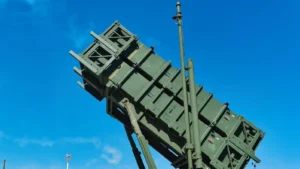
President Donald Trump announced at the NATO summit in Ankara on July 8 that the United States would grant Ukraine a licence to manufacture Patriot interceptor missiles — the most significant US weapons technology transfer since Russia launched its full-scale invasion in February 2022, and a commitment that Ukraine’s President Volodymyr Zelensky had been seeking for years. The announcement was made publicly, in Zelensky’s presence, in one of the summit’s most consequential bilateral moments.
But the gap between the political announcement and the military reality is substantial, and every expert who has examined it reaches the same conclusion: Ukrainian-produced Patriot interceptors will not arrive in meaningful quantities before 2028 at the earliest — and Russia is firing 100 ballistic missiles at Ukraine every month right now.
What Trump Said — and How He Said It
“We’re going to give a licence to you to make Patriots. That’s pretty cool, right?” Trump told Zelensky during their bilateral meeting at the Bestepe Presidential Compound during the NATO summit. “This way, you can’t complain that we’re not giving ’em enough. I said, ‘Make them yourself.'”
Trump said pressure could be applied to Lockheed Martin and Raytheon — the primary Patriot manufacturers — to begin the process. He also acknowledged, apparently without concern, that the companies had not yet been informed of the decision: “We haven’t informed the company of that yet, but that’ll work out all right. I’m sure they will be thrilled,” he said.
Seated next to Trump, Zelensky at times looked like he almost couldn’t believe his luck, CNN noted. The two men share a rocky relationship, and the flareup in the war with Iran appeared to have put Trump into a foul mood just before the meeting. The warmth that emerged represented a meaningful shift from their contentious Oval Office showdown earlier in Trump’s second term. “We’ve actually developed a good relationship, it’s hard to believe,” Trump said. “It’s hard to believe,” he added, appearing amused by his own assessment.
Why the Announcement Is Genuinely Historic
The United States has historically been extremely reluctant to allow foreign production of the Patriot system — a reluctance rooted in the complexity of the missile’s technology, the sensitivity of its guidance and seeker systems, and the risk of intellectual property or capability diffusion to adversaries. No ally has previously been granted a licence to manufacture Patriot interceptors domestically. Trump’s announcement overturns decades of US weapons export policy in a single sentence.
Ukraine has at least seven Patriot systems: three supplied by the US, three from Germany and at least one from a group of European allies. The systems are operational and effective. Analysis of Ukrainian Air Force data shows that Ukraine is regularly shooting down 90% of Russian drones and cruise missiles. But ballistic missiles are a fundamentally different challenge — two-thirds regularly get through. The shortage of Patriot interceptors has created an irreparable gap in Ukraine’s air defence against ballistic threats.
Russia has exploited that gap systematically. Russian attacks killed at least 59 people in the Kyiv area in just the past week — with one massive aerial strike claiming 31 lives on Thursday and another killing 28 on Monday. More than 200 people were injured. Ukraine’s military said on July 7 that it had failed to shoot down any of the Russian ballistic missiles fired overnight because all available interceptors had been exhausted.
The Supply Chain Reality That Makes the Timeline So Long
A PAC-3 interceptor can take up to 24 months to produce, while some key components require about 30 months. The missile itself depends on a supply chain of more than 400 companies covering seekers, solid rocket motors, guidance software, propulsion elements, electronics, control surfaces, thermal batteries, sensors, composite materials, test equipment and final certification.
These bottlenecks cannot be solved by adding money alone because many suppliers require specialised machinery, qualified workers, security approvals and quality-control processes before they can expand output. US annual Patriot interceptor production currently stands at approximately 600 missiles. Ukraine’s potential requirement — if it sought sustained coverage of Kyiv, major cities, energy nodes, military headquarters, air bases, logistics hubs and other high-value targets — could reach roughly 2,000 interceptors per year.
The most realistic early production model is therefore phased: US company supervision, imported components, European industrial participation and gradual Ukrainian involvement in assembly, testing or component manufacturing, rather than immediate full-scale production on Ukrainian territory.
Ukrainian production at any meaningful scale is therefore not a 2026 or 2027 story. It is a 2028 story at the earliest — and that assumes the licence is formalised immediately, Lockheed Martin and RTX engage cooperatively, and the supply chain expansion decisions needed to source 400+ components are made now.
What Ukraine Needs in the Interim
Zelensky was direct about the gap between the licence’s long-term significance and the immediate operational reality. Following the bilateral meeting, Kyiv said it had asked nearly 40 countries to provide Ukraine with missiles from their existing stocks as soon as possible, “in exchange for future deliveries already contracted for Ukraine” — a creative mechanism designed to accelerate the movement of interceptors from allied stockpiles to Ukrainian air defence units without requiring new production decisions.
Russia is currently firing as many as 100 ballistic missiles per month at Ukraine. Ukraine’s existing Patriot batteries can only fire a limited number of interceptors before their magazines are depleted. Without resupply from existing stocks — from the US, from European allies who hold Patriot inventories, or from other Patriot operators in Asia and the Gulf — the gap will persist regardless of the licence announcement.
Trump signalled some awareness of this when he said “some” additional interceptors from existing US stocks could be sent swiftly, but he emphasised: “We have Patriots, but we don’t have that many. We need them for ourselves, too.” The Iran conflict has consumed significant Patriot interceptor stocks from US and Gulf inventories, making the short-term transfer question more complicated.
What Russia Said
Russia’s foreign ministry criticised the announcement, with Foreign Minister Sergei Lavrov saying Washington was giving up its role as an “honest broker” and shifting back toward more decisively supporting Kyiv. Russian state media picked up Trump’s comments quickly — broadcasting them factually and briefly. Kremlin spokesperson Dmitry Peskov, notably, had described the Ukraine conflict as a “real war” for the first time the previous week, dropping Russia’s longstanding euphemism of “special military operation,” in response to what Moscow characterises as Western involvement in the conflict.