
Less than two weeks after the United States and Iran signed a ceasefire memorandum of understanding, Iran’s Revolutionary Guards struck a commercial cargo vessel in the Strait of Hormuz with a drone — the first confirmed attack on shipping since the deal was reached and a significant blow to hopes that the world’s most important oil chokepoint would return to normal operations.
What Happened
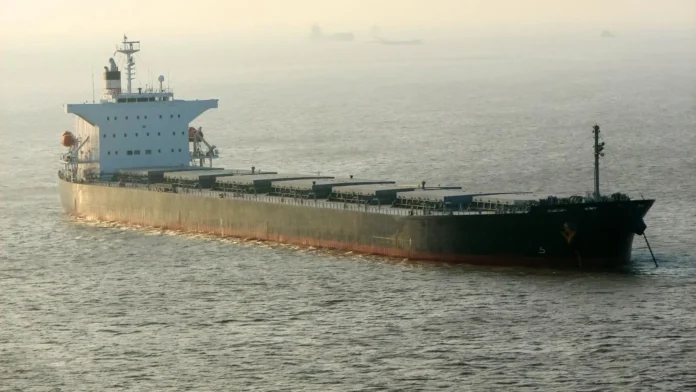
Iran’s Revolutionary Guards attacked a Singapore-flagged commercial vessel in the Strait of Hormuz with a drone on Thursday. A US official confirmed the attack to CBS News. The ship’s bridge was damaged after it was struck on its starboard side off the coast of Dahit, Oman, according to an advisory from the UK Maritime Trade Operations Centre. No casualties or environmental impact were reported.
The attack came hours after Iran’s powerful Revolutionary Guards warned that vessels would only be given safe passage via Iranian routes, challenging the Trump administration’s claim that the strait is free and open once more.
Following the attack, the UN’s International Maritime Organization paused its plan to evacuate hundreds of ships stranded in the Persian Gulf. IMO Secretary-General Arsenio Dominguez said the halt was needed “in order to reconfirm that the necessary safety guarantees continue to be in place for the ships on our evacuation list and all those in the region.”
Why It Matters
The timing of the attack is significant. With shipping picking back up through the strait in the days after the ceasefire deal, global oil prices had plummeted. The IMO had announced a large-scale evacuation effort to help thousands of mariners scattered across hundreds of vessels exit the region.
In the week following the ceasefire, 125 vessels passed through the strait, according to Lloyd’s List Intelligence — the highest level of weekly transits since the war started in late February. On Wednesday alone, 70 vessels crossed the strait, a 105% increase day on day, according to data from analytics firm Kpler.
That momentum has now stalled. Maritime intelligence firm Windward warned that the IRGC’s new stance “marks a reversal in the normalization trajectory building since the MoU signing.” The firm noted that the IRGC published a claim on its official Telegram channel that three tankers transiting the southern corridor had been ordered to turn back, and identified five vessels exhibiting behavior consistent with that claim.
The Route Dispute at the Core of the Crisis
The attack has made visible a fundamental disagreement that had been present in the ceasefire agreement from the moment it was signed. The IMO announced two routes for shipping: one through Iranian waters in the northern portion of the strait, and another through Omani waters in the south. The US-favored route involves sailing close to the Omani coastline, while Iran has insisted that ships seek its permission before transiting the strait and use a route closer to its own coast.
Iran’s newly established Persian Gulf Strait Authority — an agency Tehran set up during the conflict to manage the waterway — said after the attack that “safe transit would not be guaranteed” and that “the consequences of traveling on unauthorized routes will be the responsibility of the owner, operator, and commander of the vessel.”
This directly contradicts the position being pressed by Washington. US Secretary of State Marco Rubio, speaking in Bahrain at the conclusion of a Gulf Cooperation Council meeting, warned that any Iranian tolls or control over ships transiting Hormuz would spread “like a contagion” to other waterways worldwide. “International waterways do not belong to any nation-state,” Rubio said. A joint statement from Gulf foreign ministers later rejected any tolls or fees on Hormuz transit.
The Memorandum’s Unresolved Gaps
The 14-point memorandum of understanding signed on June 17 at the Palace of Versailles — following the G7 summit — was intended to halt fighting, open the strait and offer economic relief to Iran in exchange for a pledge never to develop nuclear weapons. But it left vital details, including the future of Tehran’s nuclear programme and its stocks of enriched uranium, to be resolved over 60 days of negotiations.
Technical talks at expert level, with working groups on subjects including nuclear energy and sanctions, are scheduled to begin on June 30, according to Rubio. But the process has been complicated by persistent fighting between Israel and Hezbollah, which threatened to derail talks last week. Rubio has tried to separate the Israel-Lebanon file from the US-Iran negotiations, even as Iran has repeatedly insisted the issues are linked.
Simmering Internal Tensions Within Iran
Analysts have noted that Thursday’s attack may reflect tensions within Iran itself. Simmering frictions between the IRGC and the Iranian government that have emerged in recent months make it difficult to assess who is in control in Iran and who has the final say in operations on this strategic waterway.
The IRGC’s willingness to strike a commercial vessel days after the government in Tehran signed a ceasefire raises questions about whether the Iranian leadership has full command and control over the guards’ actions in the strait — a factor that significantly complicates any durable resolution.
What Happens Next
Vice President JD Vance is leading negotiations with Iran and is expected to head to Switzerland for further talks. The two sides must resolve details including sanctions relief, Iran’s nuclear enrichment programme, and the long-term administration of the Strait of Hormuz.
The next days will test whether the ceasefire can withstand the IRGC’s challenge. If Iran’s government cannot or will not restrain its own Revolutionary Guards, the 60-day window for reaching a permanent agreement — already narrow — narrows further.
For global shipping companies and insurers, Thursday’s attack has reinforced what maritime intelligence firms have been warning since the deal was signed: the Strait of Hormuz is not yet open in any operationally meaningful sense, and will not be until the route dispute, the mine threat, and the question of who controls the waterway are definitively resolved.