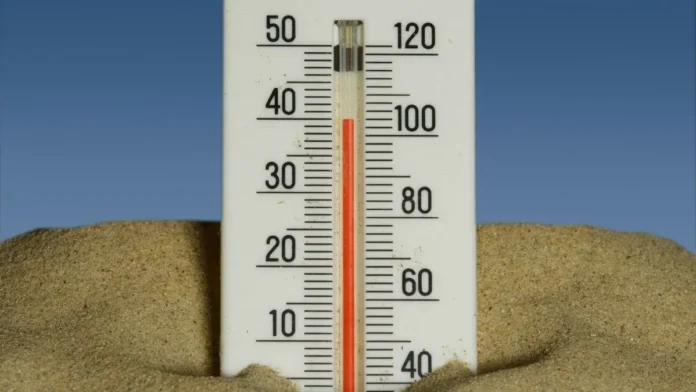

The United Kingdom broke its hottest-ever June temperature record on June 24, recording 35.8°C and shattering a mark that had stood since 1976 — as a historic “heat dome” gripped much of Western Europe, killing at least 18 people in France, prompting red alerts in 16 Italian cities, and straining power grids from Florence to northwestern France.
The UK has broken its record for hottest June temperature with the mercury hitting 96.4 degrees Fahrenheit (35.8 Celsius) in Wiggonholt, in the south of the country, according to provisional figures from the UK Met Office. This broke the previous June record of 96.08 degrees Fahrenheit (35.6 Celsius) last set in 1976.
The country’s previous June record of 96.08 degrees Fahrenheit (35.6 Celsius) was set in 1976 during a historic heatwave that saw harvests fail, food prices rise and hundreds of heat-induced deaths. It remained unbroken for 50 years.
A record that survives half a century is, by definition, a record that has weathered an enormous range of British summer weather — and its fall on Wednesday is precisely the kind of single, easily understood data point that makes an abstract climate trend suddenly concrete.
The UK’s Red Warning
It is now expected that the current UK highest temperature on record for June will very likely be broken, this being 35.6°C recorded in Southampton in June 1976 and Camden Square.
Professor Stephen Belcher CBE, Met Office Chief Scientist, said: “The heatwave this week will be a significant weather event, with a Red Extreme Heat warning issued. Human induced climate change has made events like this more likely and more intense. To see temperatures like this in the UK in June is sobering.”
Met Office Deputy Chief Forecaster Mark Sidaway, said: “Red warnings are reserved for the most severe events and we’re expecting severe and significant impacts from this heatwave, with health impacts likely for many, even beyond those who are normally more vulnerable to the heat.”
Overnight temperatures will also be very high, with widespread Tropical Nights, where the temperature does not drop below 20°C, across parts of England and Wales, especially in urban areas. Humidity is also a factor, making this heatwave even more impactful with heat stress a danger to all.
The combination of daytime extremes and “Tropical Nights” — nights that never cool below 20°C — is medically significant in a way that a single hot afternoon is not. Sustained heat stress without overnight relief is one of the clearest predictors of heat-related mortality, particularly among elderly populations and those with underlying cardiovascular or respiratory conditions, because the body never gets the recovery window it needs between successive hot days.
What’s Happening Across the Rest of Europe
Several countries in Europe have issued red weather alerts as a fresh bout of extreme heat pushes temperatures beyond 40 degrees Celsius (104 degrees Fahrenheit), bringing dangerous conditions across large swaths of the world’s fastest warming continent.
Red heat alerts were also issued in France, Spain and Italy, alongside similar warnings by authorities in Germany, Italy and Switzerland. At least 18 people died in France, Reuters reported on Monday, and hundreds of schools were ordered to close as the country’s weather agency Meteo France warned a “prolonged and intense” heat wave episode was now underway. Temperatures in Bordeaux in southwestern France hit 42 degrees Celsius on Monday.
As of Monday, at least 18 people died in France, including two children and three elderly people, amid the heatwave. A two-year-old and a four-year-old were found unconscious by their mother in the family car in the southeast French town of Carpentras on Monday, according to local prosecutor Hélène Mourges. First responders were unable to resuscitate the children. Temperatures in Carpentras exceeded 102.2°F (39°C) on Monday afternoon.
In the Bordeaux region of France, three elderly people, between the ages of 80 and 95, died over the weekend from health issues related to the heatwave, local government official Sophie Brocas told France TV on Sunday. The temperature in the region rose to 107.4°F (41.9°C) on Saturday. Another 13 people drowned in France over the weekend, according to authorities, as experts warn that heatwaves increase the risk of water safety incidents due to more people seeking relief in open water. Last year, drowning deaths during heatwaves in France rose by 172% from the year before.
The death of two young children in a hot car is among the most heartbreaking and recurring tragedies associated with extreme heat events anywhere in the world — a reminder that the most dangerous heat exposure often happens in confined, enclosed spaces rather than out in the open sun, and that the youngest and most vulnerable bear a disproportionate share of the risk.
Italy’s Cities Under Siege
Italian authorities placed 12 cities under its highest heat alert on Monday, including Rome, Florence, Bologna, Milan, and Verona. The number of red-alert cities would rise to 15 on Tuesday and 16 on Wednesday as the heatwave intensifies, according to the country’s health ministry.
The Italian capital of Rome, which surrounds Vatican City, was among 16 cities placed under Italy’s highest “red” heat alert by the health ministry, alongside Milan, Turin and Verona. Visitors tried to keep cool with handheld fans and by making use of the water fountains scattered across the city.
In parts of Italy, excessive air conditioning use appeared to cause electricity outages; the Uffizi museums in Florence closed because air conditioners caused power issues.
The progressive escalation in Italy — from 12 red-alert cities on Monday to 15 on Tuesday to 16 by Wednesday — illustrates how a heat dome of this scale doesn’t simply arrive and plateau; it expands geographically day by day as the underlying high-pressure system strengthens and persists. The Uffizi closure is a small but telling example of cascading infrastructure failure: a heatwave overwhelms air conditioning demand, that demand strains the power grid, and the resulting outages then force the closure of facilities that depend on climate control to protect both visitors and irreplaceable artworks.
The Meteorological Cause
With sinking air (compression and warming at the surface), surface temperatures have exceeded the 40 °C threshold since Sunday and will continue to rise through the next weekend, affecting Iberia, France, England, parts of Benelux and western Germany, Italy, and, over the weekend, the central Balkan peninsula.
The mechanics of this significant climate anomaly lie in the immovable omega block, acting as a lid that traps a stagnant mass of dry Saharan air and relentlessly compresses it downward. The unprecedented Heat Dome is leading to excessive heat that will be not only intense but also long-lasting, among Europe’s most intense and historic heatwaves on record.
A stagnant heat dome — a sprawling area of high pressure feeding on hot Saharan air — settled over the continent, with the most brutal heat concentrated over the Iberian Peninsula and France between 20 and 23 June.
The “heat dome” mechanism — a stable, high-pressure system that traps air in place and compresses it toward the surface, where compression itself generates additional warming — is precisely the same meteorological pattern responsible for several of the most destructive heatwaves of the past decade, including the events that struck the Pacific Northwest in 2021 and Western Europe repeatedly since.
Why This Keeps Happening — and Happening Earlier
An exceptionally early and intense heatwave swept across Europe in the days around the 2026 summer solstice, sending temperatures 14–18°C above normal for late June and breaking long-standing records.
Europe is the fastest-warming continent, heating at roughly twice the global average. As the baseline climate warms, the same weather patterns that have always brought summer heat now deliver more extreme spikes — and they arrive earlier in the season.
Europe is heading into its second deadly heatwave in two months after several countries experienced a “heat dome” last month with record-breaking temperatures that killed several people across the continent. Forecasters have warned that temperatures could rise further this month, as climate change is making heatwaves more frequent and intense.
The phrase “14-18°C above normal for late June” is the figure that should command the most attention. A heatwave that pushes temperatures a few degrees above seasonal norms is a notable weather event. One that pushes temperatures nearly twenty degrees Celsius above what would ordinarily be expected, this early in the summer, is a different order of phenomenon entirely — and one that climate scientists have explicitly linked to the broader warming trend that LoudFact has tracked throughout this period, including the El Niño formation reported earlier this month, which is layering additional warming on top of an already elevated baseline global temperature.
What Happens Next
Red warnings for heat extend into Thursday as soaring temperatures are expected to persist.
The extreme, prolonged, and excessive heatwave will engulf two-thirds of Europe. Therefore, daily highs will continue to reach the low to mid-40s across France and Iberia, and by the weekend into early next week, also across parts of the Balkans and Italy.
With the heat dome expected to persist and even expand into the Balkans by the weekend, the death toll, school closures, and infrastructure strain documented across France, Italy, and the UK this week are unlikely to be the final tally of this particular event. The longer-term concern articulated by meteorologists — that this represents the second such deadly heat dome in as many months, arriving earlier and more intensely than historical patterns would predict — is the one that should outlast this week’s specific headlines.
LoudFact.com is an independent global news and explainer platform. This report is based on reporting from CNN, CNBC, TIME, the UK Met Office, and Severe-Weather.eu as of June 22-24, 2026.