
The US-Iran war has diverted American air defence stockpiles from Ukraine to the Middle East, creating a growing gap in Ukraine’s ability to intercept Russian ballistic missiles — a vulnerability that Putin has identified and is systematically exploiting with the largest aerial attacks of 2026.
Wars are connected in ways that official statements rarely acknowledge clearly. The Iran war, which began on February 28, 2026, was presented to the public primarily as a conflict with specific Middle Eastern dimensions: Iran’s nuclear programme, the Strait of Hormuz, Israeli security. What was not presented clearly — and what is now becoming visible in the body count from Ukraine’s bombed cities — is the ways in which a war in one theatre creates military and material vulnerabilities in another.
Ukraine’s shortage of air defense systems, in part because of depleted U.S. stocks from the Iran war, has left civilians especially vulnerable to ballistic missiles, even as Kyiv’s defenses stop most of Moscow’s drones.
This sentence, from PBS NewsHour’s reporting on the June 2 Russian attack, contains one of the most significant strategic facts of the current global moment: the Iran war is weakening Ukraine’s ability to defend its cities against Russian missiles. And Russia — which has been watching closely — is capitalising on the gap.
How Air Defence Stockpiles Work — and Why They Run Out
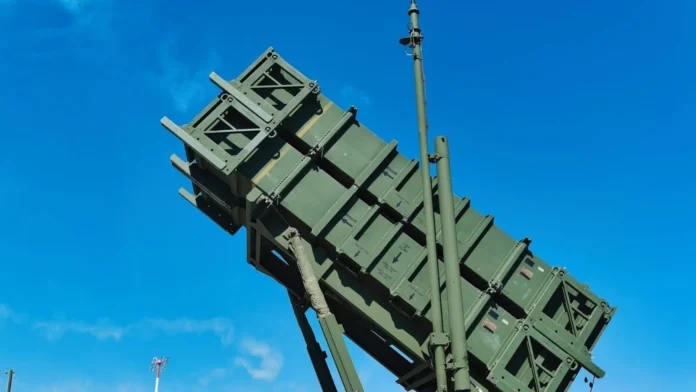
The Patriot missile defence system — the primary US-supplied air defence platform capable of intercepting ballistic missiles in Ukraine’s inventory — operates on interceptor missiles that are individually manufactured, individually expensive (approximately $4 million per interceptor), and individually consumed in each engagement. Every time a Patriot battery fires at an incoming Russian ballistic missile, one interceptor is used. Those interceptors must be replaced from stockpiles, and stockpiles must be replenished through manufacturing.
The United States maintains production lines for Patriot interceptors, but those production lines have capacity constraints. The demand generated by the Ukraine conflict — which has been ongoing for more than four years and has involved high rates of interceptor expenditure — was already straining production and stockpile levels before the Iran war began.
When the Iran war started and US forces began conducting sustained operations in and around the Persian Gulf — maintaining carrier groups, running daily sorties near the Strait of Hormuz, intercepting Iranian drones and ballistic missiles directed at US forces and allies — the demand on US air defence stockpiles increased. US forces in the region needed interceptors. Every interceptor allocated to the Persian Gulf theatre is an interceptor not available for Ukraine.
The Specific Vulnerability: Ballistic Missiles
Ukraine’s air defence network has demonstrated significant capability against Russian cruise missiles and drones. Ukrainian air defenses destroyed or suppressed 40 missiles and 602 drones in the June 2 attack — an interception rate that reflects genuine operational effectiveness.
But ballistic missiles are a different challenge. They travel faster — hypersonic Oreshnik missiles in particular reach speeds that outpace conventional interceptors — and arrive on trajectories that require specific interceptor types. The Patriot PAC-3 is among the systems capable of ballistic missile defence; without sufficient interceptors, even a capable Patriot battery can be overwhelmed or run dry.
Putin has stepped up his aerial campaign against Ukraine, with Russian forces recently launching another of their powerful hypersonic Oreshnik ballistic missiles.
The deployment of Oreshnik-type missiles — against which Ukraine has essentially no current defence — is a deliberate escalation. Russia is not using these missiles because they are its only option; it is using them because it knows Ukraine cannot shoot them down. That knowledge is derived, at least in part, from Russia’s observation of the global air defence supply picture — including the additional demands placed on US stockpiles by the Iran war.
Putin’s Calculation
Understanding Russia’s escalation requires understanding the strategic logic Putin is applying. Four years into the war, Russia has not achieved its initial objectives. Ukrainian territory has not been subdued. Western support, while variable, has sustained Ukrainian resistance. The narrative that Russia would prevail quickly has been definitively disproven.
What Putin has identified is that the window in which Ukraine is most vulnerable — air defence interceptor stockpiles depleted, US attention divided between the Middle East and Europe, European production ramping up but not yet at full capacity — is now. The largest aerial assault of 2026 on June 2 was not random. It was timed.
Russian President Vladimir Putin has escalated Moscow’s aerial campaign in recent weeks in an apparent bid to take advantage of Ukraine’s shortage of U.S.-made air defense systems and persuade an increasingly pessimistic audience at home that Moscow is prevailing in the 4-year-old war.
Two audiences simultaneously: the international audience, which sees Russian firepower overwhelming Ukrainian defences; and the Russian domestic audience, which sees evidence that the war is going in Russia’s favour.
Europe’s Response: Accelerating Production
European NATO members have been increasing their own production of air defence interceptors and additional Patriot batteries. Germany has committed to sending additional Patriot systems. The UK has increased ASRAAM and other air defence component deliveries. Several European countries have pooled resources to accelerate production at Raytheon’s European facilities.
Zelensky appealed for more US and European support, describing the massive overnight attack as “an explicit statement by Russia: If Ukraine is not protected from ballistic missiles and other missile strikes, those strikes will continue.”
Zelensky’s appeal — public, pointed, and explicitly framing Russian attacks as a consequence of inadequate Western support — is designed to create political pressure in European capitals and Washington to prioritise Ukraine’s air defence supply even amid Middle Eastern demands.
The challenge is production capacity and lead time. Patriot interceptors cannot be manufactured overnight. The gap that exists today will take months to close through accelerated production, even if all political decisions to prioritise Ukraine are made immediately.
The Strategic Irony
There is a profound strategic irony in the current situation. The United States went to war with Iran partly to prevent Iran from threatening regional stability and US allies in the Middle East. The consequences of that war — including the diversion of air defence resources that were supporting Ukraine against a nuclear-armed Russia — have created new vulnerabilities for US strategic interests in Europe.
Russia, which has been monitoring the US-Iran war closely since February, has had four months to observe how US resources are being allocated, where gaps are appearing, and how to time its own escalations to take maximum advantage. The June 2 attack is, in this reading, not a coincidence. It is a strategic response to a strategic opportunity — one created, indirectly and unintentionally, by the Iran war itself.
The lesson is one that strategic planners have studied for decades: military commitments in one theatre constrain capacity in others. The US is learning that lesson again in real time, in the rubble of Dnipro’s apartment buildings.
What Happens Next
The immediate priority is closing the air defence gap in Ukraine. That requires a combination of: accelerated European Patriot interceptor production; reallocation of some US stockpile resources from the Persian Gulf (which becomes possible if the Iran ceasefire holds and operations reduce in tempo); and potentially new air defence system types that do not depend on the same supply chain being stressed by both theatres.
The medium-term question is whether the strategic connection between the Iran war and Ukraine’s vulnerability produces a more explicit coordination of US Middle East and European policy — acknowledging that decisions made in one theatre have consequences in the other, and that a coherent global strategy requires managing those interdependencies rather than treating them as separate problems.
For now, the missiles keep coming. And Ukraine, without the interceptors it needs, keeps absorbing the ones it cannot stop.
LoudFact.com is an independent global news and explainer platform. This report draws on reporting from PBS NewsHour, NPR, Kyiv Independent, and Euronews, alongside documented US military stockpile and air defence policy reporting as of June 2-3, 2026.