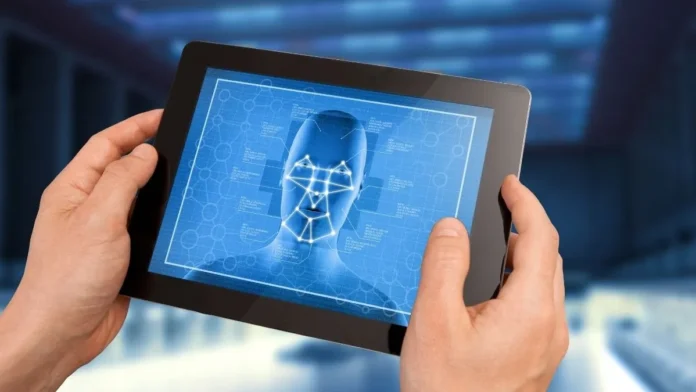

A newly revealed Department of Homeland Security document outlines plans to issue local police departments access to the same facial recognition technology used by federal immigration agents — a move privacy experts and civil liberties advocates warn will sweep US citizens into a surveillance system, with every scanned photo retained by the government for 15 years.
A newly revealed Department of Homeland Security document outlines plans to issue local police facial recognition technology, a move that will expand the scope of ICE surveillance.
Federal immigration officers often use facial recognition technology to identify immigrants in the field. Now, a newly revealed document from the Department of Homeland Security outlines plans to give local police working on its behalf the same type of technology. The document, first reported earlier this month by the tech news outlet 404 media, is a Privacy Threshold Analysis, which is essentially a federal report assessing whether the privacy implications of a tool warrant further government study.
The document does something that federal agencies generally try to avoid doing in their own internal paperwork: it explicitly flags, in writing, that the technology it describes is likely to misidentify and capture US citizens who have nothing to do with immigration enforcement.
What the Document Actually Says
But Eddington says U.S. citizens will get caught up in this surveillance. Officers conducting immigration enforcement, whether they are federal or local, will not know a person’s citizenship status before they conduct a scan. “It is conceivable that a photo taken by an ICE non-federal law enforcement officer using the TFM mobile application could be that of someone other than a removable individual, including U.S. citizens,” the DHS document states.
This is an unusual admission for a government agency to make in its own documentation. The Privacy Threshold Analysis process exists specifically to surface and assess these kinds of risks before a tool is deployed — but the fact that DHS’s own analysis acknowledges the likelihood of citizen misidentification, rather than asserting that the tool will only ever capture non-citizens, is itself informative about how the technology is expected to function in practice. Facial recognition scanning, by its nature, cannot determine a person’s legal status before the scan occurs — it can only attempt to match a face against a database after the fact.
Because every photo taken through the app is kept for 15 years, Eddington says that suggests a long-term government record of citizens and immigrants alike.
A fifteen-year retention period for facial recognition photographs is a substantial commitment to long-term data storage. It means that a person scanned in 2026 — whether or not they were ever found to have any immigration violation — will have their facial biometric data held in a federal database accessible to ICE and its local police partners until 2041.
What “Local Police Partners” Means in Practice
DHS said its law enforcement methods are constitutional. “Like other law enforcement agencies, ICE employs various forms of technology to investigate criminal activity and support law enforcement efforts while respecting civil liberties and privacy interests,” the statement said.
ANDERSON: So I asked DHS how police are using the app. The agency did not provide any more insight to us on that. But in a statement, you know, they said ICE is committed to ensuring that their local police partners have the tools that they need to support ICE’s mass deportation mission.
The phrase “mass deportation mission” is the operational context in which this tool is being deployed. The expansion of facial recognition access to local police departments — agencies whose officers interact with members of the public far more frequently than federal ICE agents do, in routine traffic stops, community policing, and general law enforcement — multiplies the number of touchpoints at which a person’s face could be captured and run against an immigration enforcement database.
That sort of surveillance already appears to be happening at the federal level: In places like Minnesota and Maine, community members observing ICE activity reported that federal immigration officers would take photos of their faces and license plates. They said the officers would often know personal information about them, including their names and where they live.
These accounts — of ICE officers appearing to already know names and addresses of people simply observing enforcement activity from a public space — suggest that the underlying data infrastructure connecting facial recognition to personal identifying information is already operational at the federal level. Extending that same capability to local police departments represents a significant scaling up of who can access it and under what circumstances.
The Civil Liberties Concern
Privacy experts told NPR that allowing local police to conduct similar surveillance could create a chilling effect on freedom of speech, if people begin to worry they’ll face repercussions for attending protests, for instance, or for legally observing ICE activity in their communities.
The DHS analysis “raises more questions than I think it answers,” says Clare Garvie, deputy director of the Technology Law and Policy Program at New York University School of Law’s Policing Project.
Garvie’s framing — that the document raises more questions than it answers — points to the central problem with how this expansion is being disclosed and assessed. A Privacy Threshold Analysis is meant to be a preliminary screening document, not a comprehensive privacy impact assessment. Its existence in public view, via a leak to 404 Media rather than through proactive government disclosure, suggests the rollout was not initially intended to be transparent.
The chilling effect concern is specific and well-grounded in prior research on surveillance and political participation: when people believe their attendance at a protest, a vigil, or even a public observation of government activity could result in their face being captured and stored in a federal database for fifteen years, documented behavioural research shows that participation in those activities declines — regardless of whether the person has any immigration-related vulnerability at all.
What Happens Next
The document’s existence is now public. Whether it produces legislative oversight, litigation from civil liberties organisations, or simply proceeds toward deployment without further public input depends on the political response over the coming weeks.
DHS’s framing — that the tool supports ICE’s stated mass deportation mission and that its methods are constitutional — signals the administration’s intent to proceed regardless of the privacy concerns the document itself surfaces. For the millions of US citizens who attend protests, observe government activity in public spaces, or simply live in communities where local police now carry this technology, the practical reality is that a tool designed to identify “removable individuals” will, by DHS’s own admission, also be capturing them.
LoudFact.com is an independent global news and explainer platform. This report is based on reporting from NPR, WVXU, WBGO, KGOU, WGCU, STLPR, and 404 Media as of June 18-19, 2026.