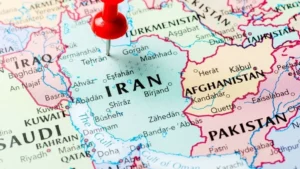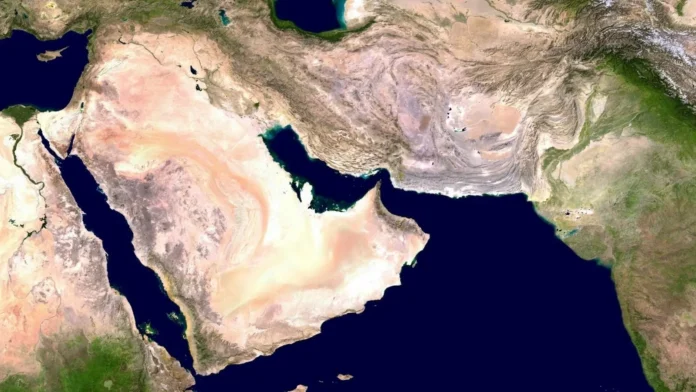

Iran’s military declared on June 20 that the Strait of Hormuz is closed, citing continued Israeli strikes in southern Lebanon as a violation of the peace deal signed five days earlier — but US Central Command immediately and directly contradicted the claim, stating that commercial ship traffic through the strait had actually increased that day and that Iran does not control the waterway.
Iran’s military declared Saturday that the Strait of Hormuz is closed due to Israeli attacks on Hezbollah in Lebanon, The Associated Press reported citing Iranian state media, on the eve of detailed talks about a long-term peace deal.
U.S. Central Command countered shortly afterward that commercial ship traffic in the strait actually increased Saturday. “Iran does not control the Strait of Hormuz. Traffic continues to flow, and U.S. forces are monitoring the situation to ensure this remains the case,” CENTCOM spokesperson Capt. Tim Hawkins said later, adding that the U.S. military has not tracked any movement from Iran to close the strait so far.
This is a genuinely unusual moment in the history of the conflict’s coverage: two governments issuing direct, irreconcilable, factual claims about the same physical reality on the same day. One says the strait is closed. The other says traffic through it actually rose. Both cannot be true. Understanding which is closer to reality — and why each side has an incentive to say what it is saying — is the key to understanding where the peace deal genuinely stands, five days after its signing.
What Iran Actually Said
“In view of the flagrant bad faith and breach of covenant by America regarding the failure to implement the first clause of the end-of-war agreement, and in reaction to the relentless and continuous violation of the ceasefire by the Zionist regime in southern Lebanon and the brutal massacre and displacement of hundreds of thousands of the oppressed people of this land, and also in light of the occupying Zionist forces’ refusal to withdraw from the lands of southern Lebanon, it declares that the Strait of Hormuz will be closed to the passage of vessels,” the agency wrote in a post on X.
Calling this the first response, Iran said it will take “subsequent steps” if the MoU’s terms are breached further. “It is recalled that this step is the first response to the enemy’s breach of promise, and if the aggression continues, subsequent steps will be planned and taken to compel the enemy to fulfill its commitments,” the post read.
The Islamic Revolutionary Guard Corps Navy warned ships not to approach the waterway, which Iran had committed to reopening under the interim peace deal signed this week. It said in a statement that vessels’ safety would be at risk if they did so.
The IRGC Navy’s specific language — warning that “vessels’ safety would be at risk” if they approached — is a threat of potential action rather than a confirmed account of a physical blockade already in place. This distinction matters enormously for assessing whether Iran’s declaration represents an actual operational closure or a political and rhetorical signal designed to pressure the US and Israel without yet escalating to direct interference with shipping.
What CENTCOM Said — and Why the Contradiction Matters
Iran’s military declared Saturday that the Strait of Hormuz is closed due to Israeli attacks on Hezbollah in Lebanon… U.S. Central Command countered shortly afterward that commercial ship traffic in the strait actually increased Saturday.
CENTCOM’s counter-claim is significant because it is empirically verifiable in a way that few wartime claims are. Commercial shipping traffic through a major strait is tracked continuously by multiple independent systems — AIS (Automatic Identification System) transponders that virtually all large commercial vessels are required to broadcast, satellite tracking services used by shipping insurers and analysts, and naval monitoring by multiple countries’ militaries. If CENTCOM’s claim that traffic increased on Saturday is accurate, it should be independently verifiable by maritime tracking firms within days — and if it is later shown to be false, that would represent a significant credibility cost for the US military’s public statements.
Despite the rising tensions over Lebanon, there had been hope that ships trapped in the Persian Gulf will be able to transit through the Strait of Hormuz since the deal was signed. Industry experts have warned, however, that it could take weeks for the shipping traffic to fully normalize, given that the threat of mines still needs to be cleared.
This is the crucial context that helps reconcile, partially, the two contradictory claims. The mine-clearing process LoudFact described in detail when the deal was first announced — a 30-day technical process — was always going to mean that “the strait is open” and “the strait is fully normalized” are two different statements. It is entirely possible that ships were transiting in greater numbers on Saturday than they had been the previous week (supporting CENTCOM’s claim), while Iran simultaneously issued a political declaration of closure that has not yet translated into an actual physical blockade (meaning Iran’s declaration is, for now, more rhetorical than operational).
The Trigger: Israeli Strikes in Lebanon
This comes after the Israeli Defence Forces on Saturday… Israeli strikes on southern Lebanon on Saturday killed at least 16 people, including two children, hours after reports emerged of a ceasefire agreement.
Lebanon’s civil defense agency said Saturday that Israeli strikes killed at least 16 people in the south overnight. The Israeli Defense Forces accused Hezbollah of firing dozens of projectiles toward soldiers in southern Lebanon.
In a post on X, the Israeli Air Force claimed that Hezbollah launched over 50 strikes on Israeli forces, adding that the forces retaliated by striking dozens of “terrorist infrastructures” and terrorists in overnight strikes.
The sequence — a reported ceasefire agreement, followed within hours by Israeli strikes that killed 16 people including two children, followed by Hezbollah’s claim that it had “adhered to the ceasefire” while accusing Israeli forces of attempting to advance — is precisely the pattern of mutual violation claims that has characterised every previous Lebanon ceasefire attempt throughout this conflict. A U.S. official told MS NOW on Friday that Israel and Hezbollah had agreed to a ceasefire. Israeli Ambassador to the U.S. Yichael Leiter said on X that the country halted offensive operations Friday morning local time, but Israeli forces remain in southern Lebanon to fight Hezbollah.
The distinction Leiter draws — halting “offensive operations” while remaining present “to fight Hezbollah” — is exactly the kind of formulation that allows both sides to claim compliance with a ceasefire while continuing military activity that the other side experiences as ongoing war.
Trump’s Own Frustration With Israel
“You don’t have to knock down an apartment house every time you’re looking for somebody,” Trump said Tuesday, chastising Israel. “Because there are a lot of people in those houses, and they’re not all Hezbollah.”
Iran and the U.S. have both shown frustration with Israel for continuing to strike Lebanon despite the deal signed this week, which committed to end fighting on all fronts.
The fact that Trump himself — the president whose administration negotiated and announced the deal — has publicly criticised Israel’s conduct in Lebanon this same week underscores that the Lebanon problem is not simply an Iranian negotiating tactic. It is a genuine gap between what the US believed it had secured in the deal and what Israel has actually done on the ground.
What Happens Next
Trump’s special envoy Steve Witkoff and son-in-law Jared Kushner were in Switzerland on Saturday “dealing with some of the technical elements of this negotiation,” Vice President JD Vance told Fox News. Hours after he spoke to Fox, the vice president also departed for Bürgenstock, Switzerland, to join the ongoing negotiations.
Speaking to reporters before he boarded the plane, Vance said that the situation in Lebanon had, “calmed down,” despite news reports and added, “I think we’re going to hopefully make progress on the nuclear issue, hopefully make progress on the Lebanon ceasefire issue.”
The deployment of both Witkoff and Vance to Switzerland in person, on a Saturday, signals that the administration is treating the situation with real urgency rather than dismissing it as routine friction. Vance’s characterisation that Lebanon had “calmed down” — made even as Lebanese officials were reporting 16 dead from overnight strikes — illustrates the gap between the administration’s public framing and the reporting on the ground.
Whether Iran’s Hormuz declaration escalates into an actual physical disruption of shipping, or remains a political statement designed to pressure Israel and the US without derailing the broader deal, will likely become clear within days, as independent maritime tracking data either confirms or contradicts CENTCOM’s claim of increased traffic.
LoudFact.com is an independent global news and explainer platform. This report is based on reporting from NBC News, MS NOW, India TV News, and Lokmat Times as of June 20, 2026.