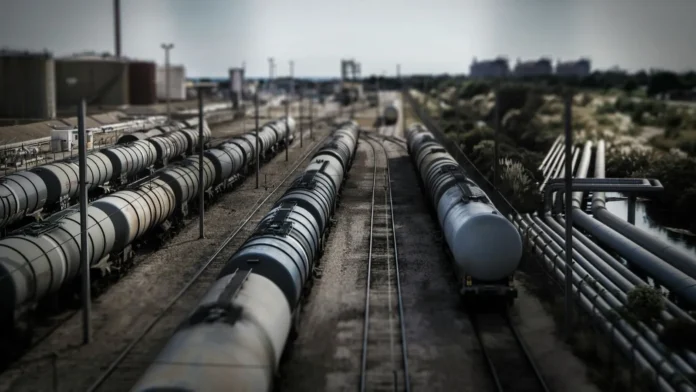

The Iran war’s naval blockade has now forced the world’s fourth-largest oil producer to resort to one of the most logistically impractical oil export methods available: shipping crude oil by rail, in improvised containers, to its most important buyer.
What Was Confirmed
The regime is attempting to ship crude oil to China by rail, with the containers used in these shipments improvised as well. This situation stems from the fact that the Iranian extraction and refining systems can’t be shut down, with Kharg Island’s infrastructure at risk of failure if the oil flow is cut.
A Washington Post report revealed that Iran has been using unorthodox means to store its excess oil for several weeks now. Satellite images showed empty tankers loading oil at Kharg Island. Three tankers were spotted at Kharg Island, while another two were seen at Bandar Mahshahr, Iran’s northernmost port in the Persian Gulf.
The rail shipments are not a viable long-term solution to the blockade. A standard oil tanker carries approximately 2 million barrels. A rail container carries, at most, 1,800 barrels.
Getting the equivalent of one supertanker cargo to China by rail would require approximately 1,111 individual container cars. The logistics cost is extraordinary, the volume is marginal, and the infrastructure between Iran and China via the overland rail route is not designed for bulk crude oil transport.
Why Iran Has No Choice
The situation stems from the fact that the Iranian extraction and refining systems can’t be shut down, with Kharg Island’s infrastructure at risk of failure if the oil flow is cut.
This is the physical reality behind every diplomatic deadline: Iran’s oil infrastructure is not like a tap that can be turned off cleanly. The wells are under pressure. The pipelines need continuous flow. The refineries need feedstock. Stopping production entirely causes permanent geological damage to reservoirs — damage that costs billions to repair and takes years to reverse.
Iran is therefore trapped in a situation where it must keep pumping even when it has nowhere to send the oil, because the alternative — shutting down the system — is more economically catastrophic than improvised rail shipments.
The Storage Countdown
Bloomberg reported analysis from data and analytics company Kpler suggesting Iran could run out of crude storage in 12 to 22 days if the blockade persists. Muyu Xu, a senior crude oil analyst at Kpler, told Al Jazeera that the blockade could eventually force Iran to cut production.
“However, given there is still available storage capacity onshore, we expect any production reduction to be gradual over the coming week, with a higher likelihood of acceleration into May,” she said.
From April 13 to April 21, data showed that stocks rose by more than 6 million barrels, according to the Columbia Center on Global Energy Policy. Iran also has some crude oil storage capacity in the form of “floating tanks”, or parked ships. About 127 million barrels can be stored in this way.
The 12-to-22-day estimate from Kpler was published approximately 8 days ago — meaning the lower end of that range is either already here or within days. The improvised rail shipments and the floating storage tankers are the physical evidence that Iran has crossed from “approaching capacity” to “at capacity workaround mode.”