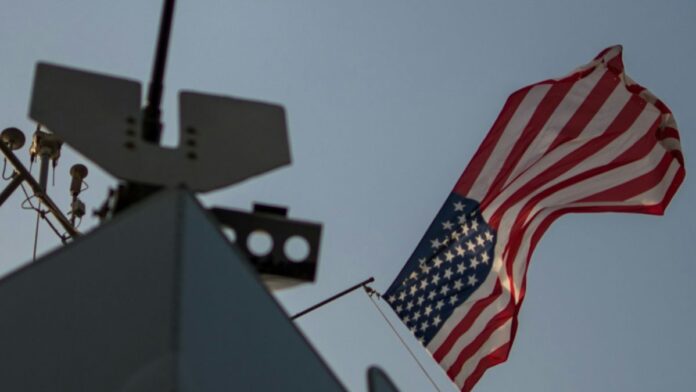

The aircraft carrier USS George H.W. Bush completed one of the longest carrier deployments in recent US Navy history on Thursday, arriving in the US Central Command area of responsibility after a 24-day transit that took it around the southern tip of Africa rather than through the Suez Canal and Red Sea.
Its arrival completes an unprecedented concentration of US naval power in the Middle East: three aircraft carrier strike groups operating simultaneously in the same theatre.
The Arrival
The aircraft carrier USS George H.W. Bush and its strike group arrived Thursday in the US Central Command area of responsibility. It will be the third US aircraft carrier in the region — tightening the naval blockade on Iran and giving Trump more military options if he decides to resume the war, sources said.
The carrier departed Naval Station Norfolk on March 31, 2026, and has been transiting via the Cape of Good Hope, a route assessed by US officials as reducing exposure to potential threats in the Red Sea and the Bab el-Mandeb Strait. Upon arrival, it will reinforce US operations in the Arabian Sea and Persian Gulf.
The George H.W. Bush carrier strike group includes the guided-missile destroyers USS Ross, USS Donald Cook, and USS Mason, along with the fast combat support ship USNS Arctic.
Why It Sailed Around Africa
The routing decision reveals the seriousness with which US military planners assess the Houthi threat in the Bab al-Mandab Strait. The Bab al-Mandab — the narrow passage between Yemen and Djibouti connecting the Red Sea to the Gulf of Aden — has been the target of sustained Houthi anti-ship missile and drone attacks since 2024.
Rather than transit a nuclear-powered aircraft carrier through that threat environment, CENTCOM sent the Bush on a 12,000-mile detour around the entire African continent.
That decision adds weeks to the transit time and significant operational cost, but it also demonstrates that US military planners considered the Houthi anti-ship threat in the Bab al-Mandab to be sufficiently serious to justify the diversion of a carrier battle group.
What Three Carriers Mean
Each carrier strike group is a self-contained combat force. A carrier and its escorts carry approximately 70-90 aircraft, can strike targets anywhere within a 500-mile radius, and project air superiority over a large section of ocean. Three such groups in the same theatre represent:
Approximately 210-270 combat aircraft available for operations against Iran. Multiple layers of missile defence protecting the fleet. Submarine assets capable of tracking and neutralising Iranian naval forces. The capacity to sustain high-tempo air operations against Iran for weeks without resupply.
CENTCOM said Thursday it has redirected 33 vessels since the blockade began.
The blockade is the primary current mission — turning back ships approaching Iranian ports. Three carriers make that blockade significantly more difficult for Iran to break by force.
Iran’s surface navy, which Trump claimed has 159 vessels “at the bottom of the sea,” cannot confront a three-carrier battle group. Its asymmetric capabilities — mines, small boats, drones, anti-ship missiles — remain dangerous but are now facing a substantially reinforced adversary.
The Diplomatic Signal
Three carriers in the Middle East is also the most visible possible signal to Iran’s civilian leadership: the window for a negotiated solution is narrowing, and the military alternative is being assembled in real time.
Pakistan’s mediators understand that signal. Iran’s civilian diplomatic team understands it too. Whether it accelerates their effort to bring the IRGC hardliners to the table, or whether it hardens Iranian resolve, will be determined by events in Tehran over the next 72 hours.