
For decades, Western alliances have relied on a simple principle: unity in times of crisis. Even when disagreements existed behind closed doors, public messaging remained coordinated, carefully managed and strategically aligned.
That principle is now under visible strain.
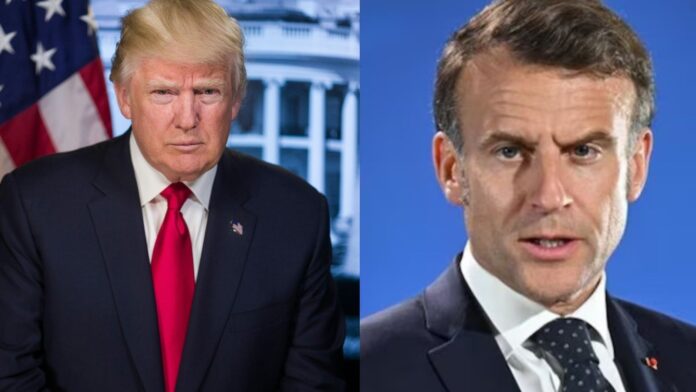
French President Emmanuel Macron has openly criticized aspects of the United States’ approach to the ongoing conflict, warning that certain military strategies could be unrealistic and potentially dangerous. The remarks mark one of the clearest public divergences between major Western allies in recent years.
This is not routine diplomacy.
It is a signal that something deeper is shifting.
Why This Moment Matters More Than It Appears
At first glance, disagreements between allies are not unusual. Different nations often have different strategic priorities, shaped by geography, economic interests and domestic politics.
But the context here is critical.
The disagreement is happening:
- during an active geopolitical crisis
- in full public view
- with implications for global security
That combination makes it significant.
When allies diverge publicly, it introduces uncertainty not just within the alliance, but across the entire international system.
The Strategic Divide Beneath the Surface
The core of the disagreement lies in how to manage escalation.
On one side, there is a belief that strong military action can stabilize the situation by deterring further aggression. On the other, there is concern that such actions may trigger unintended consequences, expanding the conflict rather than containing it.
This is a classic strategic dilemma.
History shows that escalation can sometimes restore balance. It also shows that escalation can spiral beyond control.
The challenge is knowing which path the current situation will follow.
NATO and the Question of Unity
Although NATO has not formally fractured, moments like this raise questions about cohesion.
NATO’s strength lies in collective action. When member states act in coordination, they amplify their influence. When they diverge, that influence weakens.
Macron’s remarks do not signal a breakdown of NATO, but they do highlight a potential fault line.
And in geopolitics, fault lines matter.
Europe’s Position: Caution Over Escalation
European nations often take a more cautious approach to military escalation, particularly when conflicts occur near critical economic or energy routes.
The reasons are practical.
Europe is heavily dependent on stable trade flows, energy imports and regional security. Any disruption has immediate consequences for its economy and political stability.
This creates an incentive to prioritize de-escalation.
The United States Perspective
The United States, by contrast, operates from a position of global reach. Its strategic considerations include not only regional stability but also long-term deterrence and global influence.
This can lead to a more assertive posture.
The divergence between these perspectives is not new, but it is becoming more visible.
Global Implications of Alliance Tension
When major powers disagree, the effects extend beyond their immediate relationships.
Other countries begin to adjust their strategies.
Some may align more closely with one side. Others may seek to exploit the division. Still others may adopt a more independent stance.
This creates a more complex and less predictable international environment.
Markets and Diplomacy: An Interconnected Response
Financial markets are highly sensitive to geopolitical signals.
A unified response tends to stabilize expectations. A divided response introduces uncertainty.
That uncertainty can affect:
- investment decisions
- currency stability
- trade flows
In this way, diplomatic disagreements translate into economic consequences.
Historical Context: When Alliances Diverge
History offers several examples of alliances facing internal disagreement during times of crisis.
In some cases, these disagreements led to stronger coordination after initial tension. In others, they contributed to long-term shifts in global power structures.
The outcome depends on how the disagreement is managed.
What Happens Next
Several paths are possible.
The disagreement may be resolved through diplomatic engagement, leading to a more unified strategy. Alternatively, it may persist, creating ongoing tension within the alliance.
In a more complex scenario, the divergence could lead to parallel strategies, with different countries pursuing different approaches.
Conclusion
The current moment represents more than a policy disagreement. It is a reflection of evolving global dynamics.
As power becomes more distributed and interests more complex, alignment becomes harder to maintain.
The question is not whether disagreements will occur. It is how they will shape the future of global cooperation.