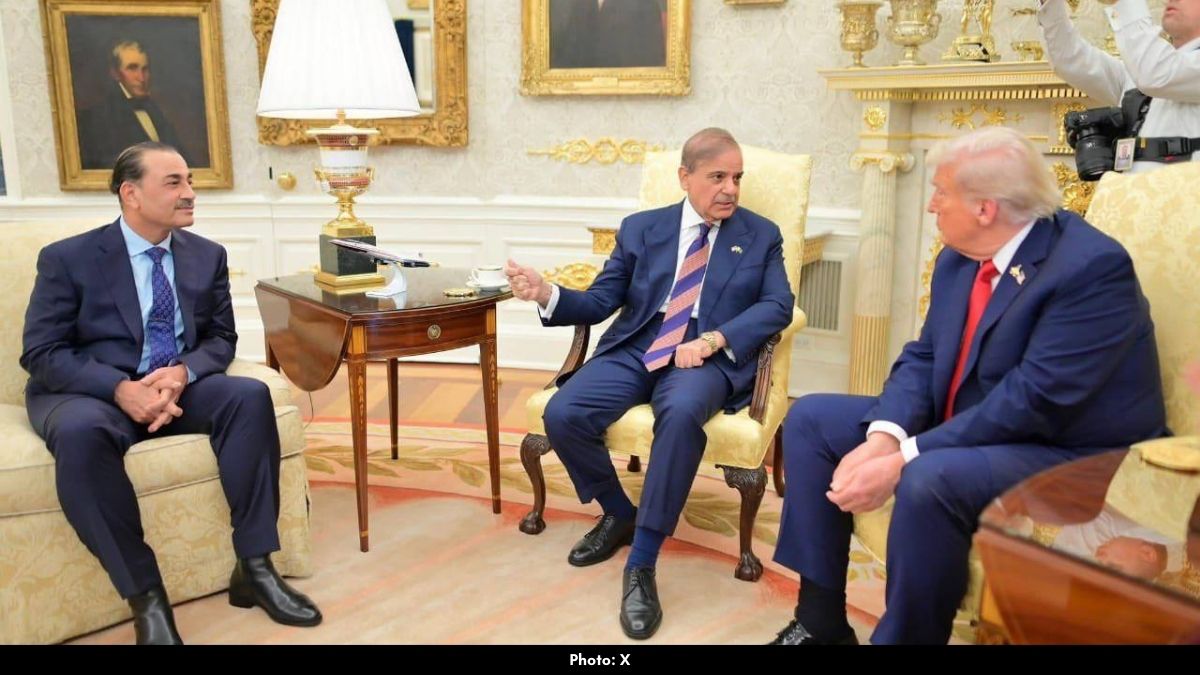
Six weeks ago, Islamabad’s role in global diplomacy was an afterthought. Pakistan was managing a struggling economy, an open conflict with the Afghan Taliban on its western border, and a volatile relationship with India to the east. It had no US ambassador. It was not a member of the UN Security Council. It was not part of the G7.
Today, Islamabad is the host of the most significant diplomatic talks in the world. The ceasefire that pulled the US-Iran war back from catastrophic escalation was brokered by Pakistan’s prime minister and its army chief. And the peace talks that will determine the future of the Middle East are happening in a hotel in Pakistan’s Red Zone, not in Geneva or New York or Vienna.
This is worth understanding.
The Structural Position
A country bordering Iran along nearly 900 kilometres of frontier, maintaining longstanding security ties with Washington, coordinating economic policy with Riyadh, and holding enough credibility in Beijing to serve as a quiet channel, occupies a position the great powers cannot fill. They are too implicated. Pakistan is merely indispensable.
Pakistan has strong relations with Iran, with which it shares a very long land border. It recently signed a defence pact with Saudi Arabia — which is obviously part of this crisis — and it has strong connections with China, which is affected by the energy crisis.
Pakistan is trying to use these different connections to place itself in a mediator role in ways that signal a greater level of geopolitical clout than might have been expected.
The intra-Gulf Cooperation Council disagreements over a ceasefire and a diplomatic dialogue with Iran created the need for exactly that kind of actor — one with ties to both sides but not too directly implicated in either camp’s strategic interests. Pakistan’s ties with both sides made it a natural choice for a mediator.
How It Happened
The process began in early March. By March 3, Pakistan’s Deputy Prime Minister and Foreign Minister Ishaq Dar was addressing the Senate, outlining Pakistan’s position. “Pakistan is ready to facilitate dialogue between Washington and Tehran in Islamabad,” he told lawmakers.
At home, protests erupted in Karachi when demonstrators tried to storm the US consulate, leaving at least 10 people dead. Pakistan’s Shia Muslim population, estimated at 15 to 20 percent of the country’s roughly 250 million people, was watching closely. As sectarian tensions rose, army chief Munir summoned Shia clerics to Rawalpindi and warned that violence inside Pakistan would not be tolerated.
On March 12, Prime Minister Sharif travelled to Jeddah with Munir to meet Saudi Crown Prince Mohammed bin Salman, expressing “full solidarity” while urging restraint against mounting Iranian attacks against Gulf countries. It was a delicate balancing act. Pakistan had to maintain its mutual defence pact with Riyadh without being drawn into direct confrontation with Iran, its southwesterly neighbour.
From March 22 to 23, officials confirmed that army chief Munir spoke directly to Trump. The US president had already announced a five-day pause on strikes targeting Iranian energy infrastructure by then, signalling he was open to a diplomatic exit. On March 23, Pakistan formally offered to host talks. Sharif echoed the offer publicly hours later on X, tagging Trump, Araghchi, and Witkoff.
On March 26, Dar confirmed that the US had shared a 15-point proposal with Iran via Pakistan. Pakistan then delivered that proposal to Tehran — becoming the formal carrier of the most sensitive diplomatic document of the war.
The Key Relationship: Munir and Trump
Central to Pakistan’s role was army chief Munir. His relationship with Trump dates back to early last year when Pakistan arrested the alleged perpetrator of the Abbey Gate bombing in Kabul in 2021, which killed 13 American service members.
Their relationship truly took root after the brief conflict between Pakistan and India in May 2025, when Trump publicly claimed credit for brokering a ceasefire — a claim acknowledged by Pakistan but rejected by India. Munir became Pakistan’s army chief in November 2022. After the four-day India-Pakistan conflict in May 2025, he was promoted to field marshal.
When the ceasefire was announced, Trump said he had agreed to it “based on conversations with Prime Minister Shehbaz Sharif and Field Marshal Asim Munir, of Pakistan,” adding that they had “requested that I hold off the destructive force being sent tonight to Iran.” Iran’s Foreign Minister Araghchi was even more explicit in his praise, saying Iran had accepted the ceasefire “in response to the brotherly request of PM Sharif.”
The 1971 Parallel
Pakistan has played this role before. In 1971, Pakistan’s then-president Yahya Khan helped facilitate US National Security Advisor Henry Kissinger’s secret visit to China — a backchannel operation that reshaped Cold War geopolitics. Pakistan leveraged its geography, military channels, and status as an intermediary between two sides with no contact with one another toward a larger diplomatic purpose.
The destination today is not China but a US-Iran rapprochement — and the Pakistani military establishment is once again at the forefront. The bold move in 1971 altered the course of Cold War geopolitics. Whether the current effort can match that outcome depends on whether the Islamabad talks produce something durable.
The Risks for Pakistan
Pakistan’s mediation is built on a brittle foundation. Its diplomatic rise is tied disproportionately to one man, Munir, as well as to a White House that rewards theatre, access, and tactical usefulness. Pakistan is not being embraced because its institutions are strong or its economy is resilient; it is simply available.
The danger is that in the court of a transactional leader like Trump, the distance between a favoured intermediary and a discarded asset is remarkably short. If this mediation fails, Munir and Sharif might find themselves recast as the villains.
Pakistan defied expectations by brokering a two-week ceasefire, averting a looming Strait of Hormuz conflict. Yet the deal is fragile and key nuclear and sanctions issues remain unresolved. What Pakistan has managed is the prior step: creating the space in which conditioning between both parties might become possible.
What It Means for the World
Pakistan’s emergence as the central mediator in the most consequential conflict of the current era signals something larger about the structure of global diplomacy.
Pakistan and others are filling gaps left by mediators of the past, particularly those from NATO countries that have distanced themselves from Trump’s war. The incentives for Pakistan to get involved are clear. It has a mutual defence pact with Saudi Arabia that could pull it into the war, and it relies on the tightly restricted Strait of Hormuz for most of its oil imports.
A country that was not at the table for talks that resulted in the 2015 Iran nuclear deal or the Abraham Accords has now positioned itself at the centre of a major diplomatic effort. Whether the temporary ceasefire leads to lasting peace, Pakistan’s role marks a significant shift — not just in its own foreign policy trajectory, but in which countries matter in global diplomacy today.