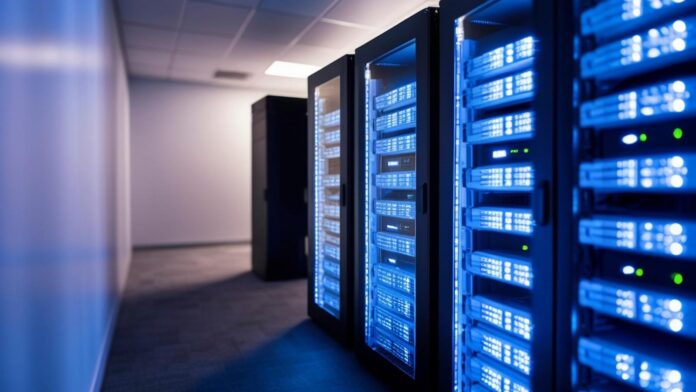

The artificial intelligence boom is running into a hard physical limit: electricity.
For much of the past two years, the global AI race has been framed as a battle over chips, models, cloud platforms and talent. But as companies expand data centers to train and run increasingly power-hungry AI systems, the next bottleneck is becoming harder to ignore. The question is no longer only who has the best technology. It is who can secure enough power to keep that technology running.
That challenge has moved from boardroom forecasting to real-world grid management. Google said this week it had expanded agreements with five U.S. utilities to cut electricity usage at data centers during periods of peak demand, a sign that the technology industry is beginning to adapt to tighter power conditions rather than assuming unlimited access to cheap energy. In total, those contracts allow Google to curtail up to 1 gigawatt of demand, roughly enough to power 750,000 homes.
The development matters far beyond one company. It signals that AI infrastructure, which has been treated as a pure growth story, is now becoming an energy security issue, a utility planning issue and a political issue. The expansion of data centers is no longer just reshaping the technology sector. It is beginning to reshape the electricity system itself.
Why the power question is suddenly central
Large AI systems require vast computational workloads. Training frontier models involves running thousands, and sometimes tens of thousands, of advanced processors for extended periods. Even after training is complete, deploying those systems at scale for inference — the stage when users actually query AI systems — also consumes large amounts of electricity.
That creates a structural problem for grids that were not designed around hyperscale, always-on data demand. Utilities are now being asked to connect new facilities that can consume as much electricity as a medium-sized city. In regions where transmission upgrades, new generation and permitting timelines move slowly, the mismatch becomes obvious.
The growth in AI has therefore exposed a tension between digital ambition and physical infrastructure. Tech companies want to expand quickly. Power systems expand slowly.
Google’s new demand-response agreements illustrate how utilities are trying to bridge that gap. Instead of simply supplying more power on demand, utilities are asking data center operators to reduce usage when the grid is under strain, especially during extreme weather and peak consumption periods. That is a notable shift. It suggests data centers are being treated less like passive industrial loads and more like participants in balancing the grid.
What The Google Deals Tell Us
The agreements announced by Google are significant because of both their scale and timing. They come at a moment when U.S. power demand is rising after years of relatively modest growth, driven by the expansion of data centers, electrification and industrial reshoring. Reuters reported that Google’s new deals cover five utilities, including Entergy Arkansas, Minnesota Power and DTE Energy, and expand on earlier arrangements with Indiana Michigan Power and the Tennessee Valley Authority.
The practical logic is straightforward. When peak demand threatens to overload the grid, Google can temporarily reduce consumption at certain data centers. That helps utilities lower blackout risk and manage system stress without relying entirely on expensive emergency generation.
But the broader meaning is more strategic. Tech companies are effectively acknowledging that power availability cannot be taken for granted. The old model — build a data center, request interconnection and assume supply will follow — is giving way to a more negotiated model in which energy access depends on flexibility, long-term contracting and in some cases direct involvement in generation.
AI’s Growth Story Now Depends On Energy Economics
This is where the issue becomes more than an engineering story. It becomes a macroeconomic one.
Reuters Breakingviews noted that the wider energy shock tied to Middle East tensions could derail parts of the AI boom by increasing operating costs and making huge infrastructure bets harder to justify. The article argued that high oil and gas prices could weaken revenue growth across the wider economy while making energy-intensive AI projects more expensive to run.
That interaction matters because the AI buildout is being funded at extraordinary scale. Reuters separately reported that analysts have raised their forecasts for 2026 debt issuance by major hyperscalers — Amazon, Alphabet, Meta, Microsoft and Oracle — after Amazon’s huge bond sale, reflecting the vast capital requirements of AI infrastructure.
In other words, this is not a niche constraint. The AI industry is betting hundreds of billions of dollars on data centers, chips and cloud capacity. If power costs rise sharply, if grid access becomes uncertain, or if projects face delays because transmission or generation is not ready, the economics of that bet can change.
The Grid As A Competitive Advantage
This is also becoming a geopolitical and regional competition issue.
Germany said this week it wants to double domestic data center capacity by 2030 and quadruple AI data processing, explicitly linking digital competitiveness to physical infrastructure planning. Reuters reported that the country is proposing land allocation and other policies to accelerate data center development as it tries to catch up with the United States and China.
The message is clear: countries increasingly see data centers as strategic assets. But the ability to attract them depends not just on tax incentives or regulatory support. It depends on whether there is enough land, enough power and enough grid capacity.
That is why access to electricity is becoming a form of competitive advantage. Regions that can deliver reliable, affordable and scalable energy will be better positioned to capture AI investment. Regions that cannot may watch projects go elsewhere.
Friction Is Growing At The Local Level
The AI buildout is also creating political resistance.
Reuters reported last week that opposition to data centers is spilling into municipal election campaigns in France, where residents and local candidates are criticizing projects over energy consumption, pollution and limited local job creation.
That backlash matters because it highlights a growing disconnect between national industrial strategy and local acceptance. Governments may want more AI infrastructure, but communities often see only the trade-offs: higher power demand, land use conflicts, water concerns and limited visible public benefit.
As the sector grows, these tensions are likely to increase. The more AI infrastructure becomes tied to everyday systems such as grid stability and local energy pricing, the less invisible it becomes politically.
Why This Is Discover-Worthy Now
This story sits at the intersection of several themes that are all globally important right now: AI, power security, industrial policy, climate and infrastructure. It also has a strong explanatory angle. Readers who have followed the AI boom mainly through product launches and valuations are now seeing the deeper systems question beneath it: can the physical world support the digital expansion?
That question is becoming more urgent because the answer affects more than tech stocks. It affects electricity markets, utility planning, clean energy investment and the pace of economic transformation.
Reuters also reported this week that AI-driven demand is transforming the clean energy offtake market, pushing long-term corporate power purchase prices higher as hyperscalers compete for supply. That reinforces the point that AI is no longer just a software story. It is a power market story too.
What Happens Next
The next phase of the AI race will likely be shaped by three factors.
The first is grid flexibility. More utilities will try to sign demand-response deals or similar arrangements that allow them to manage big data center loads during stress periods.
The second is direct energy procurement. Tech companies are likely to deepen investments in renewable power, storage and potentially firm generation sources to secure long-term electricity access. Reuters has already reported that hyperscaler demand is reshaping corporate clean-energy contracting.
The third is political scrutiny. As communities, regulators and governments realize how much power AI infrastructure requires, permitting and public debate around data centers are likely to intensify.
The big picture is now hard to miss. The AI boom has entered a new phase in which success depends not only on model capability and capital expenditure, but on the ability to solve a far less glamorous question: where the electricity will come from, and who gets priority when the grid is under stress.