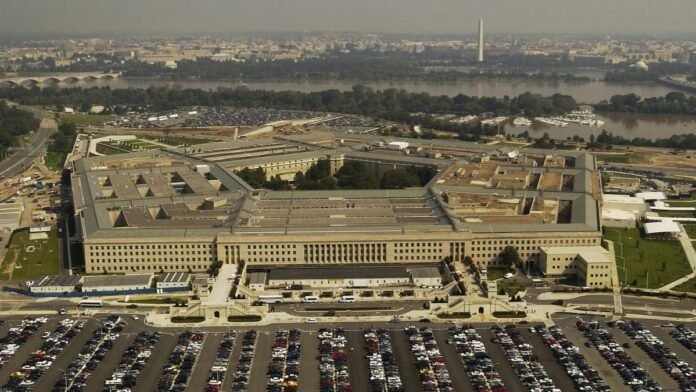

The Pentagon has warned that China’s accelerating military expansion is narrowing America’s long-standing advantages, according to its newly released China Military Power Report 2025 delivered to Congress on December 23.
The assessment describes Beijing’s buildup as “historic,” citing rapid advances across nuclear forces, naval power, missiles, space systems, and cyber capabilities that could directly challenge US forces—particularly in the Western Pacific.
Pentagon Calls PLA the Top “Pacing Challenge”
Defense officials say the People’s Liberation Army is now the US military’s primary “pacing challenge.” The report notes China fields the world’s largest navy by ship count and is on track to expand its aircraft carrier fleet to nine by 2035, narrowing the gap with the US Navy.
In a potential Taiwan conflict, the Pentagon assesses that PLA rocket forces could launch massed strikes early, overwhelming defenses and threatening US bases in Japan and Guam. The report urges tougher defenses, more dispersed basing, and stronger alliances to preserve deterrence.
Nuclear Expansion Raises Global Alarm
China’s nuclear growth is highlighted as a major concern. The report estimates China possessed warheads in the low 600s by late 2024 and could exceed 1,000 by 2030, with a potential rise to 1,500 by 2035.
New radar systems and counterstrike capabilities, the Pentagon says, could allow Beijing to respond rapidly in a nuclear exchange—complicating traditional deterrence models and raising risks of escalation.
Naval Reach, Missiles Pressure US Allies
The PLA Navy’s expanding footprint enables longer-range operations across the Pacific, including sustained pressure around Taiwan and against US allies. Missile forces are assessed to blanket the first and second island chains, placing ships, aircraft, and forward bases at risk.
The report also points to China’s expanding network of dual-use ports across the Indian Ocean, Middle East, and Africa, which could support intelligence collection and military access—though still short of the US global posture.
Space and Cyber Threats Intensify
China is assessed as the world’s second-strongest space power, with anti-satellite weapons capable of targeting US GPS, communications, and early-warning systems. Cyber operations are described as persistent and preparatory, designed to exploit civilian infrastructure and disrupt US networks in a crisis.
The Pentagon adds that Beijing’s ties with Russia are “almost certainly” intended to counter US influence, even as mutual distrust remains.
Taiwan Timeline and Strategic Urgency
The report reiterates that Chinese leader Xi Jinping has directed the PLA to be ready to seize Taiwan by 2027, drawing lessons from the war in Ukraine on tactics and technology.
The assessment comes amid tentative diplomatic signals; Donald Trump recently acknowledged an invitation from Xi and spoke publicly about the strength of US-China relations. Still, the Pentagon warns that while US forces retain overall superiority, the margin is shrinking fastest near China’s borders—making timely action critical to sustain deterrence.