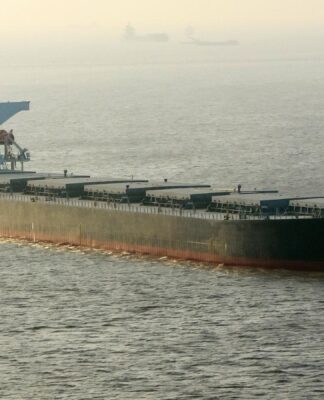

“US Central Command forces will begin implementing a blockade of all maritime traffic entering and exiting Iranian ports on April 13 at 10 AM ET, in accordance with the President’s proclamation,” CENTCOM confirmed Sunday. “The blockade will be enforced impartially against vessels of all nations entering or departing Iranian ports and coastal areas, including all Iranian ports on the Arabian Gulf and Gulf of Oman.” CENTCOM also confirmed that vessels transiting the Strait of Hormuz to and from non-Iranian ports will not be impeded.
The blockade is now active. This is no longer a threat. It is an operation.
The Oil Market’s Immediate Reaction
Markets did not wait for 10 AM. Brent crude rose more than 8 percent on Sunday to top $103 a barrel — the first time the benchmark rose above $100 since Tuesday, when prices surpassed $111 a barrel.
US crude oil futures for May delivery jumped nearly 8 percent to $104.04 per barrel by early Monday morning. International benchmark Brent for June delivery advanced more than 7 percent to $102.25.
The oil market’s violent rally began in early Asian trading hours. WTI front-month futures jumped $8.24, or 8.53 percent, to $104.80 per barrel. The ceasefire optimism that had briefly pushed Brent below $92 a barrel last week has been entirely reversed. Goldman Sachs warned Brent could average over $100 through year-end if restrictions persist, versus a drop to $70-75 on resolution.
What Iran Said This Morning
Iran’s response came quickly and was notably direct. Iran’s unified armed forces command said the ports in the Arabian Gulf and the Sea of Oman are “either for everyone or for no one.” The IRGC posted a video showing vessels in crosshairs alongside a warning that “the enemy will become trapped in a deadly vortex in the strait if it makes the wrong move.”
Iran’s forces stated that “enemy-affiliated vessels” would face restrictions while other vessels would be allowed passage subject to Iranian regulations — a framing that directly contradicts CENTCOM’s position that only Iranian-port vessels will be blocked.
What Trump Said — And the Strikes Under Consideration
Trump and his advisers are looking at resuming limited military strikes in Iran in addition to the blockade of the Strait of Hormuz as a way to break the stalemate in peace talks, the Wall Street Journal reported, citing officials and people familiar with the situation.
Officials have considered an operation centred on specific targets to gain additional leverage against the regime in an eventual new round of talks. The officials also said that, even if the option is unlikely in the short term, Trump is also considering the full resumption of the bombing campaign against the Iranian regime. The main factor against this is the risk of further destabilisation in the region and Trump’s aversion to prolonged operations.
Iran’s Foreign Minister Abbas Araghchi posted on X: “In intensive talks at highest level in 47 years, Iran engaged with US in good faith to end war. But when just inches away from ‘Islamabad MoU’, we encountered maximalism, shifting goalposts, and blockade. Zero lessons earned.”
Asian Markets Open Lower
Asia-Pacific markets opened lower Monday as investors weighed the US blockade announcement after talks between Washington and Tehran fell apart. Japan’s Nikkei 225 fell 0.72 percent. South Korea’s Kospi was 0.73 percent lower. Hong Kong’s Hang Seng index declined 0.71 percent. Australia’s S&P/ASX 200 was 0.38 percent lower.
The blockade is live. The oil market has repriced. The ceasefire clock is ticking. This is where the Iran war stands at the start of Monday, April 13.